
When the transition from an unknown figure to a household name occurs, the transformation can be a fabulous moment.
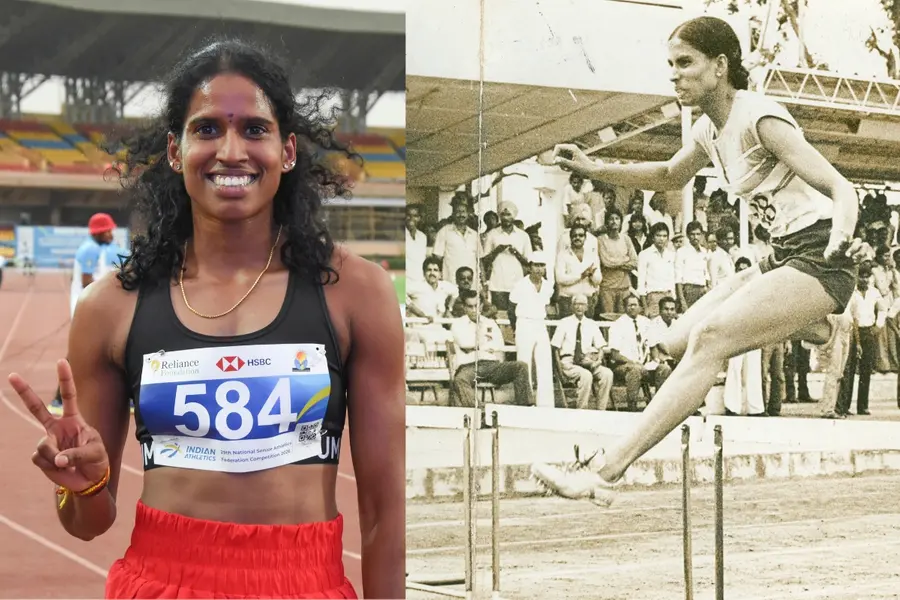
Sporting endeavours can make a fascinating study of a sportsperson's journey. Struggle, hard work, pain, and sacrifice—not to mention ambition and desire—all combine to yield the final results. When the transition from an unknown figure to a household name occurs, the transformation can be a fabulous moment. We already have, for instance, the story of P.T. Usha, the one-time queen of Indian athletics, who evolved from a hugely talented athlete into an internationally well-known name thanks to all that she achieved on the track. True, an Olympic medal eluded her by a whisker, but her 400 m hurdles run in the 1984 Los Angeles Olympics established a national record that stood intact until 2023, when another Indian super-talent went ahead and erased it. Overnight, Vithya Ramraj from Coimbatore hit the headlines thanks to her feat at the Asian Games.
History is repeating itself, but in Vithya's case, the impact was overwhelming. Usha, currently the IOA President, was present to witness Vithya's feat and lauded her with encouraging and inspiring words. Rising from humble surroundings to national fame seemed just a step away, but it did not come overnight; it was achieved through determined effort under the tutelage of Coach Nepal Singh Rathore. Born into a family where her father is a truck driver, pursuing a sporting career was not easy because funding was a major issue. Working overtime to ensure that his daughters—Vithya and her twin sister Nithya, herself a hurdler—received full support, their father kept his struggles to himself, and the results are there for all to see. Dedication and hard work were key, and as Rathore noted, her potential, character, and mental toughness deserve to be underlined. While enjoying the adulation—something she was never used to—Vithya's goal remains focused, for she still has miles to go and more rewards to reap.
Equally touching and fantastic has been the journey of archer Kumkum Mohod, the 17-year-old from Amravati, Maharashtra. The Asian Games saw her emerge as a breakout star after creating sporting history for India by becoming the first woman ever to win an individual recurve gold at this continental event. In fact, she returned from Japan with three medals: aside from the individual recurve gold, she won a gold in the recurve team event and a silver in the mixed recurve team event. Still, it was her path to individual gold that showcased her special talent. First, she defeated the world and Olympic champion Kang Chae-young of South Korea in the quarterfinal, followed by China's Zhu Jingyi, a world championship silver medallist, in the semifinal. She then downed another South Korean, Oh Ye-jin, in a dramatic final that went to a shoot-off. In that shoot-off, where her opponent scored an 8, Kumkum's arrow responded with a perfect 10—showing no nerves, just the feeling of doing something routine! That effort earned India a direct quota place for the Los Angeles 2028 Olympics. What a gigantic effort it proved to be!
Like Vithya, Kumkum is another performer from a humble background—someone who transitioned from an unknown athlete to a widely celebrated archer, earning recognition overall, including the inaugural IOA-instituted Jaspal Rana Award. It was in 2018 that she took up the sport after her grandmother provided ₹3,000 to buy her first wooden bow. Her father used his savings to fund her training and drove her to practice sessions on his motorcycle to save money. She no longer needs to burden her father or grandmother, as widespread support ensures her talent will continue to flourish as great exploits await this young girl, who is an avid reader and avoids social media. Her coach, Prafull Dange, highlighted her mental toughness and composure at major competitions, traits that have served her well.
Vithya, Kumkum, and many others like them—such as middle-distance runner Gulveer Singh (a multiple medal winner) and long jumper Ancy Sojan—have similar stories of earning stardom after overcoming early hardship. Gulveer was a late starter who turned his passion into reality; running in torn shorts as a youth, he harboured big dreams and realised them spectacularly. Ancy, the daughter of an auto-rickshaw driver, understood struggle and progressed in athletics along similar lines. Her first breakthrough moment came when she broke Anju Bobby George's 22-year-old national record in the long jump. At the Asian Games, she returned with a silver medal in the long jump.
Such narratives could go on, but what they ultimately bring to light is the deep reservoir of talent in this land of billions. Indian sports are looking up, largely due to these bright young men and women who show immense promise, though much work remains. With the Union Government fully backing the development of sportspersons through generous funding, the onus is on the federations to spot, nurture, and elevate exciting talent across the country. While the Games in Japan brought exciting success stories, overall—as the government itself feels—Indians could have performed even better. With the 2036 Olympics in sight, which India is keen to host, the ground reality must become far more dynamic. In that sense, the Games were an overall eye-opener.
Published: 20 Oct 2026, 07:00 am IST
ABOUT THE AUTHOR

Related Topics
Disclaimer: Kindly avoid objectionable, derogatory, unlawful and lewd comments, while responding to reports. Such comments are punishable under cyber laws. Please keep away from personal attacks. The opinions expressed here are the personal opinions of readers and not that of Mathrubhumi.