
The most outstanding feature of the film lies in its actors mainly Vasudeva Rao as Venkayya
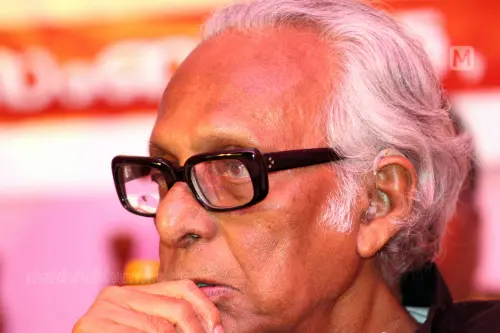
The world premiere of the 4K restored version of acclaimed filmmaker Mrinal Sen’s Telugu classic Oka Oorie Katha (1977) is currently underway at Karlovy Vary, Czech Republic, in the Karlovy Vary International Film Festival, which is being held from July 3 to 11, 2026. A meticulously restored 4K version of the movie recently had its world premiere at this festival. The restoration was spearheaded by the National Film Development Corporation – National Film Archive of India (NFDC-NFAI) under the National Film Heritage Mission.
His son Kunal Sen said, “It was challenging for him to make a film in a language he did not know, and being a regional language film, it wasn’t widely screened in India. My father would have been very happy to see it being restored by the National Film Archive of India, and being screened in a Film Festival he loved.”
Also Read

The spoken language of a film is used majorly by a filmmaker who is familiar with the language he is making the film in. But trust Mrinal Sen to make a complete feature film based on the Hindi litterateur Munshi Premchand’s famous story Kafan (Shroud) not in Hindi, which he knew a bit of, not in Bengali, his mother tongue he was the most comfortable in, but in Telugu of which he did not speak, know or understand a word of.
Looking back, Sen probably shifted the base of the original story of Premchand from a North Indian village to a deeply feudal Telangana landscape. This radically alters the linguistic and cultural nuances of the characters. This also widens the geographical implications of power across India where never mind the time, the space or the language, the basic exploitation of the poor by the thieving rich, of women by the thieving and exploitative poor is timeless and universal. Sen’s choice to make it in Telugu is a pointer to his desire to spread this message right through the map of India – from the Hindi belt through the Bengal belt right upto the Telugu belt where languages, customs and lifestyles differ but the practice of human exploitation by other humans remains the same.
The film focusses on the intertwined lives of four characters – the exploitative capitalist who gets the very poor work for him on the very land he has cunningly snatched from them from under their nose; Venkayya (the father), Kistayya (the son) and Nilamma (the son's wife) who the son married. Venkayya does not believe in working for a living just to satiate hunger because he believes that it is useless and futile. He pushes his son to do the same though we never see the son arguing with him about needing to go to work for a living. This is perhaps the only film in Indian cinema to demonstrate such a nihilistic relationship between father and son. These two men across two generations have convinced themselves that working will not lift them from their severely impoverished lives.
The film revolves around Venkayya (Vasudeva Rao) and his son Kishtaiah (Narayana Rao), members of the lowest subaltern class. Recognizing that the ruling class exploits the labor of the poor, they choose to drop out of the system entirely. But do they really stay away from work because it will not really relieve them of poverty? If yes, then why do they resort to the most undignified work such as stealing, begging, or doing minimal work to afford their daily liquor? This writer’s interpretation is that avoiding work because they are being exploited is a flimsy excuse to either remain idle or resort to small crimes. Are they truly interested in getting some relief for the kind of beggarly life they are leading?Perhaps, Sen wished to point out the sociological truth of what low depths extreme poverty can push a person down to.
The film sharply points out how extreme poverty can dehumanize a person completely. The father-son duo have no hesitation is allowing the heavily pregnant Nilamma to die in childbirth, completely immune that it is their criminal negligence of her minimum needs that has pushed her to her death. We find flies resting on the corpse as it lies prostate on the ground, beyond pain. The father-son duo set out on a journey to beg for some money to buy cloth for the shroud (kafan) when Nilamma dies. They show no sign of remorse or pain or grief. The camera pans to show the father and the son actually waiting for the young woman to die. After they realise that she is dead, they set out to drink themselves crazy at the local tavern with the money they have collected from the community for the kafan or shroud. Nilamma lies neglected, ignored, forgotten and insulted in death as she was in life.
Oka Uri Katha is a stark representation of life at its lowest, inhuman strata where some groups of people have lost every possible purpose in life. While the capitalist does not bat an eyelid to cut from the measly wages of his poor workers or snatch from them the very grounds they once owned and are now working on, the father-son duo have no compunction to steal from other poor of the village or beg for money for a shroud which they actually spend in getting drunk. The father has a strange logic – “it is no use working for a capitalist who exploits us by making us work and paying us nothing to lighten the burden of our poverty.” He convinces his son of this belief bringing out the strangest of father-son bonding in the history of Indian cinema.
“The manner in which Sen drifts from the conservative notion of work as an essential concomitant to life. Rather, through his lead protagonist, Sen mocks the notion of work and its necessity,” writes artist Shiladitya Sarkar in his incisive piece on the film in The Politics of Choice, the Politics of Representation: Mrinal Sen’s ‘Oka Oorie Katha’ published in the Silhouette on May 23, 2023. He goes on to add, “Second, is the manner in which Sen drifts from the conservative notion of work as an essential concomitant to life. Rather, through his lead protagonist, Sen mocks the notion of work and its necessity.”
The sound design and the background score invest the film with a strange strength though the film is by no means entertaining. It begins with the sound of drums as the camera pans across an arid plot of land where men and women are busy digging out mud, filling it on an empty basket and passing it on to the next waiting man or woman. Kistaiyya, the son, comes a bit late as he had gone for a smoke and the capitalist immediately cuts his daily wages by half. Endless pleading fails to work and his father, Venkaiyya (Vasudeva Rao) says that it is better to choose hunger in place of exploitative work.
The father-son duo is ruled by a strange philosophical question their answer to which neither solves their unending hunger nor their poverty, nor their attempts to find solutions in petty criminal acts which they also botch. Venkayya is shown to be an anti-establishment rebel who either roams about aimlessly, or gets drunk the minute he has some small coins or sleeping away in the courtyard outside the apology of their living quarters comprised of a hut with a thatched roof which can collapse any minute.
As if that is not enough, Venkayya and his son begin to live off the meager earnings of Kistaiyya’s wife Nilamma (Mamata Shankar) who works as a daily labour under the same exploitative contractor Venkayya rebelled against and feeds the father-son duo even when she becomes heavily pregnant and is unable to do heavy work. The father-son duo continue to exploit Nilamma and Venkayya keeps abusing her for keeping the food for herself which is not true.
Sen’s choice of the location – an arid, dry landscape which might not have witnessed a healthy monsoon for months, his choice of the actors to portray the three major roles, completely stripped of even a hint of glamour, and the lifestyle we watch them in, somehow invests the film with a rawness not easily witnessed in Indian cinema except in Satyajit Ray’s Sadgati also adapted from a Munshi Premchand story years after Sen’s incisive film.
The most outstanding feature of the film lies in its actors mainly Vasudeva Rao as Venkayya. His face is like an irrigated profile with eyes glaring with anger all the time, nearly naked and not bothered about how his tiny dhoti covers or uncovers him, angry at himself, at his ‘destiny’, at the contractor and at life in general. The only person in the world he is attached to is his son who has never learnt to question his father simply because he has never learnt to think. But Venkayya’s eyes brighten when he clasps the coins he has gathered as alms for the dead Nilamma’s “kafan” and off he goes with his son in tow to the nearest wine shop.
The cinematography by Sen’s favourite cameraman K.K. Mahajan almost carries a three-dimensional impact as it captures the arid landscape of a Telengana wasteland, or, the manner in which the father-son duo try desperately to save the roof of their thatched hut from collapsing but fail, and last, but never the least, the anguished and painful cries of Nilamma in her labour, the camera coming back again and again to focus on her pained face and her swollen stomach. She dies without giving birth while her husband and his father wait simply for the woman to die.
Published: 07 Jul 2026, 11:38 am IST
Related Topics
Disclaimer: Kindly avoid objectionable, derogatory, unlawful and lewd comments, while responding to reports. Such comments are punishable under cyber laws. Please keep away from personal attacks. The opinions expressed here are the personal opinions of readers and not that of Mathrubhumi.