
For me, John was never merely an individual filmmaker. He represented a restless cinematic energy that could not be contained within institutions, conventions or even time itself
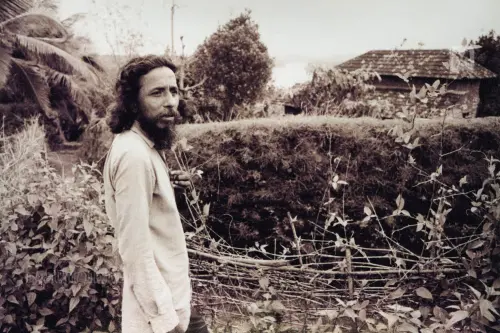
The restored 4K version of the Malayalam feature, the late John Abraham’s Amma Ariyan (Report to Mother, 1986) was screened at the Cannes Film Festival as part of the Cannes Classics section. In connection with this, this critic decided to interview Abraham’s friend and associate Prem Chand, also a noted film critic of Kerala who has written not less than five books on cinema. Prem Chand’s daughter produced a feature film called John while his wife Deedi is a very distinct persona in Malayalam cinema, a woman script writer and Women in Cinema collective activist. Both Prem Chand and Deedi have contributed to this interview.
What was the inspiration to make such a difficult film like John so many years after his tragic and untimely demise?
John is a feature film structured through memory, absence and return. In the film, John Abraham revisits the people from his life years after his death and finally returns to the grave. The people he meets are now older, carrying the passage of time, memory and loss within them. Many of those appearing in the film were actually John’s friends, collaborators and family members, which gives the film its emotional authenticity. My connection with John goes back to many years. At the time of his death, I was working as a reporter and I was the journalist who reported his death. In many ways, making this film felt like destiny completing a circle that had remained open for decades.
Also Read

One incident stayed with me. On the day John died, his close friend Hari Narayanan, who was also the hero of Amma Ariyan, came to meet me in a state of anguish. He handed over a set of incomplete screenplays and story ideas that John had made him write down just a few nights earlier. Hari remembered John arriving in the middle of the night, knocking on his door, waking him up and dictating fragments of stories with tremendous urgency, almost as if he was racing against time. Those unfinished writings haunted me for years. That episode is also recreated in John.
But yours is not exactly a bio-pic. Right?
I did not want to make a conventional biographical film. I wanted to capture the spirit of a man who continues to live in the memories, contradictions and emotional histories of those who knew him. For me, John was never merely an individual filmmaker. He represented a restless cinematic energy that could not be contained within institutions, conventions or even time itself.
What is the team’s response to John Abraham’s film chosen to be screened at Cannes this year?
We feel happy and emotional, but also reflective, because over the years John Abraham has slowly become more of a myth than a filmmaker in public memory. Many people celebrate John as a 'maverick genius', quote stories about his unconventional life, but comparatively fewer people have actually watched and engaged seriously with his films. This is perhaps the first posthumous tribute paid to John decades after his demise. There is no monument or memorial built in his honour. I often felt that we owe him this. We romanticise such immortal personalities, but we do not preserve their work or their legacy in a meaningful way.
John had punctured the control of capital on cinema and this deserves a much heightened platform. He believed that cinema belonged to the masses. At a time when crowd-funding was almost unknown. He mobilised ordinary people to make Amma Ariyan. That was not merely a production method; it was a political and cultural statement against the dominance of capital in filmmaking.
For me, the restoration and international recognition of his work is important because it finally brings attention back to the films themselves, not merely to the mythology surrounding him. Even if John does not have a monument in his name, the fact that his cinema is being restored, revisited and screened for newer generations gives me a sense of content. In many ways, preserving his films is a far more meaningful memorial to John than any physical monument.
Since you set out to make the film so many years after his demise, how did you manage to land significant documents as part of the research on the film?
For me, the research did not happen through archives alone. It came through people who had actually lived with John Abraham, travelled with him, struggled with him and carried fragments of his memory for decades. That is why John became possible even after so many years. Many of those who appeared in the film were themselves part of John’s life and his cinema journey. Hari Narayanan, Shobheendran Master and Ramachandran Mokeri, who acted in my film, were all friends who had acted in Amma Ariyan. Their memories were not academic recollections; they were lived experiences.
Madhu Master was another very important presence. He was a revolutionary thinker, mentor and companion who stood with John throughout the unrealised Kayyur project from beginning to end. Nandakumar represented John’s Kozhikode anarchist friendships and cultural circles. Chelavoor Venu first brought John to Kozhikode and remained close to him. Each shooting schedule became an act of remembering. Cinematographer Ramachandra Babu, who participated in the film, had been John’s classmate at the Pune Film Institute. Another person in the film was related to John’s family through his sister Shantha’s son. John’s own sister Shantha appeared in the film as herself.
So the film grew out of conversations, memories, unfinished stories, personal documents and emotional histories preserved by people rather than institutions. In many ways, these individuals themselves became living archives of John.
Why JOHN and not any other filmmaker, past or present? What is so special about him, his filmmaking and his films?
What fascinated me the most about John Abraham was the fundamental conflict that defined both his life and his cinema — the constant contradiction between capital and creativity. John’s biggest struggle was against the idea that cinema could exist only through money, control and industrial structures. He believed cinema belonged to people and to artistic freedom, not merely to producers or markets. That is why his filmmaking practice itself became political. He questioned not only cinematic language, but also the systems through which films were produced and circulated. Amma Ariyan remains one of the strongest examples of this. At a time when crowd-funding was almost unheard of, John travelled among ordinary people, collecting small contributions to make the film. For him, the process of making cinema was as important as the final film itself. At the same time, John was deeply contradictory, vulnerable and self-destructive. That complexity also enters his films. His cinema was never polished or comfortable; it carried rawness, urgency and emotional unrest. Even today, his films feel alive because they resist easy consumption.
Another reason is because I feel society has not truly honoured him. People continue to celebrate the myth of John — the anarchist, the rebel, the unconventional artist — but proper tribute has rarely been given to the filmmaker and his work. Even after all these years, there is no significant memorial in his name. In many ways, John remains culturally celebrated but institutionally neglected. So for me, making John was not simply about remembering a filmmaker. It was about revisiting an unresolved cultural history — a man who challenged cinema itself and who still remains difficult to contain within conventional narratives of success or failure.
Prem worked actively with John as I learn. What are his summations of John Abraham (a) as a man, (b) a filmmaker and (c) both?
I haven't worked actively with his films. As a man, John Abraham was deeply affectionate, unpredictable, restless and emotionally intense. He could walk into the lives of people without barriers of class, status or formality. John had an extraordinary ability to create friendships and communities wherever he went. At the same time, he carried loneliness, anger and self-destructive impulses within him. There was always a tension between tenderness and chaos in his personality.
As a filmmaker, John was radically uncompromising. He was not interested in cinema as a commercial product alone. He constantly questioned cinematic form, production systems and the relationship between cinema and society. His films were politically alive, emotionally raw and formally unconventional. Even their imperfections carried energy and honesty. He believed cinema should disturb, provoke and connect with ordinary people rather than merely entertain audiences.
For those of us who knew him, John was never a “settled” person. He remained in constant search — artistically, politically and personally. Perhaps that is why he continues to haunt Malayalam cinema even decades after his death.
How long did it take to make the film from concept to the censor certificate?
In one sense, the journey began 36 years ago, when I first thought about making a film on John Abraham after his death. But even then, it was almost impossible to find support for such a project within the conventional capital structure of Malayalam cinema. John himself had struggled against that very system throughout his life. By then, the old activist cultural circles and collective networks that once surrounded John had also disappeared. People had scattered into isolated islands of their own lives. So the idea remained with me for many years. The project took concrete shape in 2013. Instead of a conventional industry structure, people associated with the film contributed their labour, creativity and time as part of the project itself. The basic production expenses were borne largely by my own family. We also sought subsidy from the Kerala government through KSFDC. The journey was extremely difficult. We went through two major floods in Kerala and then the Covid pandemic. Post-production alone took nearly 5 years to complete.
My daughter Muktha handled both production and creative coordination for the film. My life partner Deedi, apart from co-writing the screenplay, also managed major production responsibilities. So this was never merely a film project for us. When John finally reached theatres in 2023, it represented a ten-year journey lived collectively by our family.
What do you think led John to alcoholism?
I do not think it is possible or fair to reduce John Abraham’s alcoholism to a single reason. Human beings are always more complex than one explanation. But I do believe that John carried deep internal conflicts — personal, artistic and social — which he could never fully reconcile. One important aspect was his continuous struggle with the systems surrounding cinema itself. John wanted to make films outside the logic of capital, hierarchy and commercial compromise. But surviving within the industry without surrendering to those structures was extremely difficult. There was a constant tension between his creative vision and the realities of production, money and distribution. That struggle exhausted him emotionally and materially. At the same time, John was someone who lived intensely. He absorbed people’s pain, political anxieties, friendships and failures very deeply. He was affectionate and full of life, but also lonely in many ways. There was always an element of self-destruction within him. What remains tragic is that society often celebrates the myth of the self-destructive artist after death, while failing to support the artist meaningfully during life. John’s life carried that contradiction very strongly. I would also hesitate to romanticise alcoholism as part of artistic genius. That is a dangerous tendency. Alcoholism damaged John physically, emotionally and professionally. The people close to him also suffered because of it. But instead of moral judgement, I think one must look at the loneliness, instability and unresolved conflicts that often exist behind such addictions.
Do you find any similarities between Ritwik Ghatak and John Abraham (a) as filmmakers whose films were not popular, (b) as men who led very unconventional lives and (c) as incurable alcoholics?
Yes, I do see similarities between Ritwik Ghatak and John Abraham, especially in the way both existed outside the comfort and acceptance of mainstream cinema culture. Neither of them was fully embraced by the dominant film industry during their lifetimes. Their films demanded emotional, political and intellectual engagement from audiences rather than easy consumption, and therefore they often remained outside commercial popularity. Both also lived highly unconventional lives. They were not interested in respectability or social conformity in the usual sense. Cinema for them was not merely a profession but a way of living, thinking and resisting. That intensity made their lives artistically rich, but also unstable and difficult. There are also parallels in their alcoholism, but I would be careful not to romanticise that aspect. In Indian film culture, there is sometimes a tendency to turn self-destruction into part of an artist’s legend. I do not think alcoholism should be viewed that way. In both Ghatak and John, one can perhaps see deep emotional conflicts, disappointments and loneliness interacting with extraordinary creative energy. But alcoholism also caused suffering — to themselves and to the people around them.
Would you term Ghatak and John as failures in life and work, or as extraordinary ‘others’ in the world of films? Give reasons for your response.
I would never describe Ritwik Ghatak or John Abraham as failures. If we judge cinema only through box office success, institutional acceptance or material stability, then many important artists in history would appear as failures. But cinema history itself has repeatedly corrected such judgments over time. Both Ghatak and John existed as extraordinary “others” within Indian cinema because they refused to comfortably fit into dominant systems. Their films challenged cinematic form, politics, narrative structure and even the economics of filmmaking itself. They were not trying to become successful within the existing order; in many ways, they were questioning that order altogether.
John, especially challenged the belief that cinema must depend entirely on capital and industrial power. His attempt to create people-funded cinema through Amma Ariyan was not merely a production experiment but a philosophical and political intervention. Such people are rarely rewarded by mainstream systems during their lifetime. Both men also carried personal contradictions, instability and self-destructive tendencies. Their lives were difficult, and sometimes painful. But suffering alone cannot define their legacy. What survives is the artistic and intellectual force of their work. The fact that people continue to revisit, restore and discuss their films decades later itself proves that they were not failures. In many ways, they were ahead of their time. Society often takes much longer to understand artists who disturb accepted ways of thinking.
Published: 01 Jun 2026, 11:43 am IST
Disclaimer: Kindly avoid objectionable, derogatory, unlawful and lewd comments, while responding to reports. Such comments are punishable under cyber laws. Please keep away from personal attacks. The opinions expressed here are the personal opinions of readers and not that of Mathrubhumi.