
Technically, The Middleman is a brilliant film. Pradip Mukherjee, who makes his debut in the Ray film, was 24-25, the exact age of Somnath in the film sparkles as a slightly diffident, a little introvert, shy, simple young man who cannot understand why he cannot get a proper job
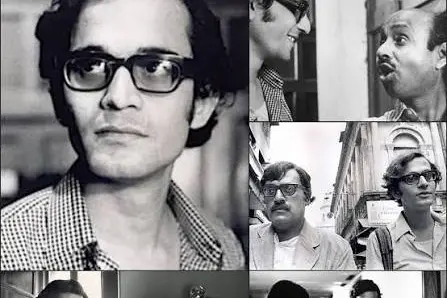
Jana Aranya (The Middleman) is the final film in Satyajit Ray’s Calcutta trilogy Pratidwandi (The Rival) and Simabaddha (Company Limited). Though its theatrical release dates back by fifty years, the film is timeless in every way in terms of the issues raised within the film through the struggles of the protagonist Somnath (Pradip Mukherjee) and more importantly, through the rapidly changing ideology of the city of Calcutta seen through the eyes of Somnath and through his search for a respectable job following his graduation.
The timelessness reveals itself through the bitter truth of unemployment in urban metros like Calcutta. The film opens in an examination hall where young students are taking the university’s final graduation examination. Somnath is a bright student so his widowed father is convinced that he will bring home a solidly good result. He does not. This happens not because Somnath did not write his answers well but because the examiner could not read his very tiny writing which he could not read with his weak glasses. This points out clearly that it is not necessary that a brilliant student will necessarily bring home a brilliant result. This presses the “start” button of Somnath’s struggle and the “close” button on his affair with his girlfriend (Aparna Sen) who, fed up of waiting without any hope in sight, meets to tell him that she has agreed to an arranged marriage to a doctor organized by her parents.
Also Read

His hunt for a job takes quite some footage in the film through a collage of continuous shots – Somnath trying to type out a job application on an ancient typewriter and failing, getting it done by a professional typist for a fee; Somnath joining the mammoth crowds of youngsters to file in applications in a dozen different agencies all in vain, Somnath coming home to open the letterbox eager to find a response without result and so on. Then one fine day, he chances upon an old acquaintance (Utpal Dutt) who takes him to his “office” on an antique elevator to the first floor which has a common peon and several tables each allotted to a separate business of “Order Supply” known more commonly as “dalaal” (broker) or, to use a more sophisticated English term, “Middleman.” This middle-aged gentleman offers Somnath a table for an “office”, the use of the peon who is forever chewing on something and introduces him to possible clients and a hail-fellow-well-met and jovial p.r.o. of everything under the sun who turns up when Somnath meets an unforeseen ‘emergency’ before getting a handsome “order.”
Somnath’s affectionate sister-in-law (Lily Chakraborty), his father and elder brother all believe Somnath is into business which he is not. Basically, Somnath, a simple, well-meaning and honest young man, feels guilty about hiding his real profession of a “middleman” but he lets Life go on as it does.
He lands what promises to be a big contract from one Mr.Agarwal. But there is a catch. Mr. Goenka, a successful and young businessman, is married to the only polio-stricken heir of a rich businessman. Goenka is off drinks and other vices as he is a severe diabetic. The catch is – in order clinch the order, Somnath needs to procure a ‘woman’ for him. The deadline is the same evening. Somnath is completely ignorant about this side of society, he calls up his p.r.o. contact (pro being an acronym for “middleman”) portrayed brilliantly by Robi Ghosh who promises to help him get the woman and the contract.
Satyajit Ray set against a definite, socio-historical backdrop, has shown that the sex worker or prostitute no longer exclusively belongs to an ear-marked ghetto called a “red light area.” The political turbulence in Kolkata and the rest of the state resulting in severe unemployment, pushing the urban middle class lower down the socio-economic ladder, created a situation where prostitution became a clandestine form of employment within mainstream, “normal” families and sometimes, for a given family, its single source of livelihood.
Ray has taken the sex worker out of her traditional ghettoes like Sonagachhi and Harkata Goli to place her within mainstream society where her vocation is rendered ‘invisible’ and therefore, becomes mainstream. In India, approximately 10 million women are sex workers and live off their earnings from prostitution which is not only ill-paid but also has an entire chain of “agents” or middlemen who cut into the earnings of each sex worker. This is not a legalised profession and trafficking in women and girls continues to flourish across the crevices and dark alleys of every Indian city, small town and village. Says social activist Jasodhara Mukherjee, “Sonagachi, which once witnessed at least 15,000 to 20,000 clients every day, though it had come down very much during the pandemic.”
As the hero Somnath, along with his pr friend, goes from door to door in search of a woman for the ‘reward’ of a prized contract, Ray, with his subtle sense of sharp-edged black humour, cracks the facade of the bhadralok Bengali society in Calcutta to expose the incredibly dirty goings-on in girl-running.
The first home they visit introduces us to a very sexy young woman (Arati Bhattacharya) who accepts the offer and goes to get dressed, But before she can wrap the sari, her husband, totally drunk, puts his foot down and says that since she has been out for three days at a stretch, she cannot go out tonight.
They next visit another home, more lavishly decorated, in apparently a better locality than the former one. The lady has an Alsatian which was a status symbol during the time of the film. She has two daughters she has pushed into prostitution. She has redecorated the well-appointed apartment with “two rooms, each, with an attached bath” for visiting clients. However, when the pro informs her that the other daughter who is busy servicing a client in her room needs to go with them to a posh hotel, she vehemently refuses to let the girl step out to visit a client. “No outdoor visits” she says, putting her foot down and the two men make a run for it. Time is running out.
The third place is a seedy looking coaching class where the watchman is reading out from the Ramayana. Kawna, now named Juthika, is the sister of Somnath’s friend Sukumar, a graduate who now runs a taxi, a sharp comment on the educated unemployed in Calcutta.
Kawna/ Juthika symbolises a world of crumbling morals among the lower middle class on the one hand and the upper class on the other in different ways. She operates as a “call girl” through telephonic appointments by the watchman of the coaching class who gets a meagre tip of Rs.10 for each girl he supplies. She is a freelancer and visits her clients instead of it being the other way round. The classrooms of the coaching class are used as waiting rooms for girls waiting for a call after the classes are over. The watchman tells Sukumar that Juthika, the girl he has fixed for them, is only three months into the business but her rates have jumped from Rs.50 to Rs.250 within that short time. But she is “invisible” and belongs clearly to the mainstream, albeit of lower middle class Bengali stock.
Kawna accepts her vocation in a no-nonsense, matter-of-fact way, refusing to recognise the hero in the changed circumstances of their encounter as a friend of her brother Sukumar. She denies that she is Kawna, Somnath’s friend’s sister and tells him that she is Juthika, not Kawna. She does not narrate a sob story to evoke his sympathy. She insists that he should not turn the taxi back to where they came from because it will be a waste of time and money for both of them.
Kawna’s prostitution in this film, is a bribe in human form for a big contract to be gained by Somnath, the hero while the ‘taker’ of the bribe is personified in the diabetic Mr. Goenka who married the polio-afflicted daughter of a rich businessman, shows the other side of the ugly face of corruption.The film denotes a masquerading social and moral universe. When Somnath hands her the payment, she points out that he is overpaying her but he insists so she pockets it quietly. Somnath gets the handsome contract.
Jana Aranya spells out that over time, the sex worker works as much in the mainstream as she does in her ghetto of Sonarpur and Harkata Goli. So, for people living within the mainstream, it is difficult to identify a sex worker simply on the basis of where she lives. The whole city, in other words, is a “red light area” and is no longer constrained within the limits of a marked ghetto.
All three films denote different periods in the social history of West Bengal in general and Calcutta in particular, the mainstreaming of prostitution indicating that sex work is almost as normal as being a nurse, or the wife of a pimping alcoholic or the daughters of an exploitative mother. The sex worker is neither portrayed as a victim of circumstance, or an agency between two or more cogs in the wheel of Life or even a worker belonging to an illegal, anti-social trade but as an inevitable and integral part of the ever-changing mainstream.
Technically, The Middleman is a brilliant film. Pradip Mukherjee, who makes his debut in the Ray film, was 24-25, the exact age of Somnath in the film sparkles as a slightly diffident, a little introvert, shy, simple young man who cannot understand why he cannot get a proper job. Lily Chakraborty as his silent but supportive sister-in-law is very good too. But the award-worthy performances come from Utpal Dutt and Robi Ghosh.
The camera-work, specially the lighting is outstanding. Add to this the sound design what with the sights and sounds of the busy Boro Bazaar in Calcutta, the loud sound of the ancient elevator, the irritating ring of the telephone in the office and so on. Somnath’s brief meeting with his departing girlfriend is captured in a most unromantic place on an old bench inside a forgotten park with brambles and bushes, peeking into a face of Calcutta we generally ignore. The same goes for Somnath’s meeting with his friend Sukumar near a ground where a very decisive football match is being played between Mohan Bagan and East Bengal with the former running away with the trophy.
The climax of Jana Aranya suggests that the hero has reduced himself to prostituting his conscience to eke out a livelihood through meagre contracts gained at the cost of procuring a woman for the contractor. He therefore, is as much, if not more, a prostitute than the prostitute he procures for his prospective clients.
If Kawna had not been Somnath’s friend’s sister, would he have suggested reversing the taxi and going back? Is he sorry for the girl? Or, is he sorry for himself? The deal is done and Somnath bags the contract. But when he returns home, his body language, caught in semi-shadow as he leans against the wall near the entrance, spells out that he is not only a man defeated in the game called Life but is also now, really a Middleman. In fact, the English title of the film by Ray himself, is more fitting for the subject than the original Bengali title. The film is timeless and universal because the situation in large metros of the globe, is the same as in the 1970s is the same or perhaps, worse.
Published: 02 Jul 2026, 01:25 pm IST
Related Topics
Disclaimer: Kindly avoid objectionable, derogatory, unlawful and lewd comments, while responding to reports. Such comments are punishable under cyber laws. Please keep away from personal attacks. The opinions expressed here are the personal opinions of readers and not that of Mathrubhumi.