Did comets really bring life to Earth? New study says unlikely
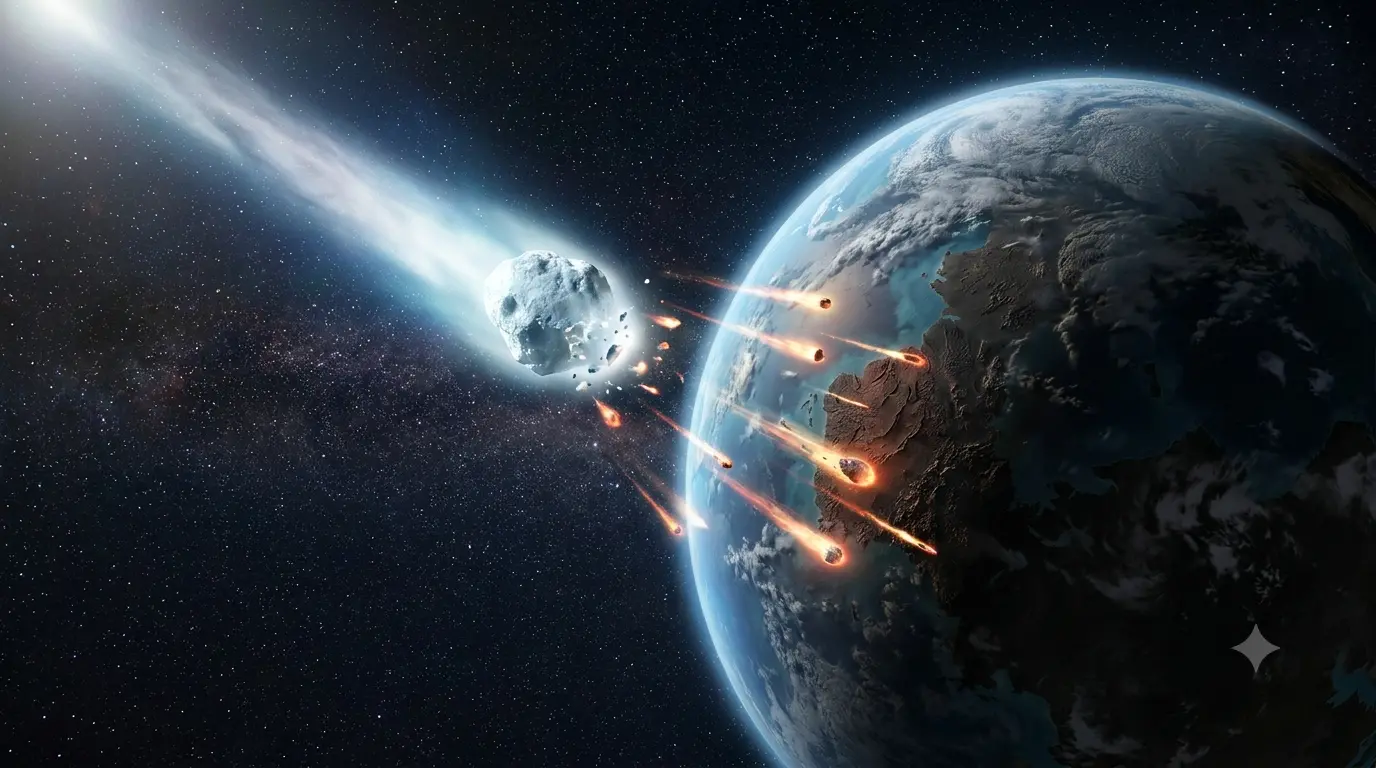
Comets may not have played the significant role in the origin of life on Earth that scientists once thought, according to a new study led by researchers at the University of Cambridge. The research suggests that delivering essential organic molecules through comet impacts would have been extremely rare, potentially making the process a one-off occurrence rather than a regular source of life's chemical ingredients.
The findings, published in the peer-reviewed journal Scientific Reports on October 28, 2026, challenge a theory that has been discussed for nearly a century. Comets are known to contain several molecules associated with the chemistry of life, leading scientists to consider whether these icy bodies transported essential chemical ingredients to early Earth.
However, the researchers used computer modelling to examine how comets interacted with Earth's atmosphere and surface. Their simulations indicated that comets generally travel too fast and approach at unsuitable angles for fragile organic molecules to survive an impact. Most of these molecules would likely be destroyed by the extreme conditions generated during impact.
Why scientists focused on hydrogen cyanide
The research specifically examined hydrogen cyanide (HCN), a molecule regularly detected in comets and considered important in prebiotic chemistry, the chemical processes that may have preceded life.
The simulations found that even if some HCN survived a comet impact, delivering it in a concentration useful for prebiotic chemistry would have been extremely unlikely.
The researchers also considered the timing of comet impacts. The number of comets striking Earth declined rapidly during the planet's first 500 million years. This meant there were, at most, only a handful of opportunities for comets to deliver HCN during Earth's early history.
Even if the molecule reached the surface, it would not have remained concentrated for long. Any chemical reactions leading towards the emergence of life would therefore have needed to progress quickly after the impact.
Lead author Dr Richard Anslow of Cambridge's Institute of Astronomy said the findings made the possibility of cometary delivery highly unlikely. He described it as potentially a 'one-in-a-million occurrence', requiring the right impact speed, angle and subsequent chemical conditions.
Could Mars have received life's building blocks from comets?
The researchers also examined whether Mars could have been a more suitable destination for comet-delivered organic molecules.
Their modelling suggests that cometary material may have had a better chance of reaching the Martian surface. Mars is smaller than Earth and has a much thinner atmosphere, making it less likely that incoming cometary material would be destroyed before reaching the ground.
However, the researchers stressed that this does not establish that comets delivered the building blocks of life to Mars. They suggested that if such a process occurred on Earth, it would be reasonable to investigate whether it also happened on Mars. It is also possible that neither planet received these molecules through comet impacts.
Where did the building blocks of life come from?
If comets were not a significant source of life's chemical ingredients on early Earth, researchers have other possible explanations.
One possibility is that asteroid impacts helped produce the chemical precursors needed for life. Asteroids struck Earth more frequently than comets, potentially providing more opportunities for relevant chemical reactions.
Another possibility is that the essential molecules formed through chemical processes on Earth itself, without requiring material from space.
The new study does not establish which explanation is correct. Instead, it places limits on how likely cometary delivery was as a route for supplying prebiotic molecules to early Earth.
What the findings mean for the search for life beyond Earth
The research could also help scientists identify planetary systems that may have conditions suitable for the delivery of organic molecules.
The team suggested that future observations, including those made possible by proposed successors to the James Webb Space Telescope, could help astronomers investigate planetary systems where comets might move between planets.
Understanding how frequently comets can deliver organic material could provide another way to assess the chemical conditions that may support life elsewhere in the universe.
The research received support from the Royal Society, the Leverhulme Centre for Life in the Universe and the Science and Technology Facilities Council (STFC), part of UK Research and Innovation (UKRI).
Does this rule out comets as a source of life on Earth?
No. The study does not prove that comets played no role in the origin of life. It suggests that the delivery of useful quantities of prebiotic molecules through comet impacts was extremely unlikely under the conditions examined.
The distinction is important because the presence of organic molecules in comets does not automatically mean they could survive an impact and remain available for chemical reactions on a planet's surface.
The research also does not identify the actual origin of life's chemical building blocks. Asteroid impacts and chemical processes on early Earth remain possible explanations, but further research is needed to understand how these ingredients formed and how they eventually contributed to the emergence of life.