
The comet was first spotted on July 1, 2023, by the Asteroid Terrestrial-impact Last Alert System (ATLAS) located in Chile.
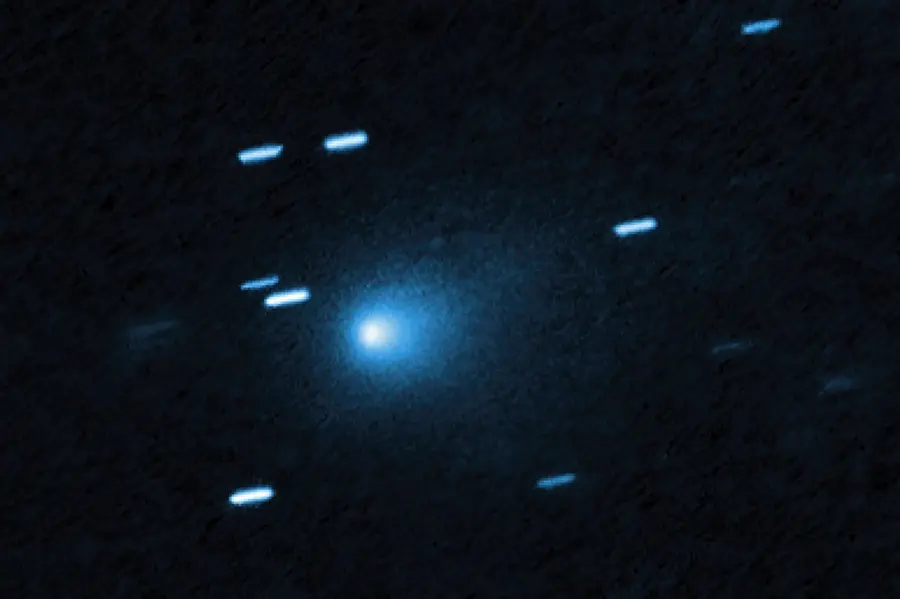
NASA and the European Space Agency recently shared remarkable new images of the interstellar comet 3I/ATLAS, which was discovered last month. This comet is only the third known interstellar object to pass through our solar system, offering an extraordinary glimpse into a visitor from beyond our star system. The latest images, captured by the Hubble Space Telescope, provide the sharpest view of the comet yet.
First spotted in July; no danger to Earth despite high speed

3I/ATLAS was first spotted on July 1, 2023, by the Asteroid Terrestrial-impact Last Alert System (ATLAS) located in Chile. At the time of its discovery, the comet was approximately 675 million kilometres away from the Sun. Since then, astronomers have closely monitored its journey through the solar system.
The comet is currently speeding through space at a staggering velocity of 130,000 miles per hour (209,000 kilometres per hour). Despite its high speed, 3I/ATLAS will not pass dangerously close to Earth. Instead, it will come nearer to Mars, which remains well out of reach. When the comet was photographed by Hubble a couple of weeks ago, it was about 277 million miles (446 million kilometres) from Earth.
Hubble estimate size of the ‘teardrop-shaped plume of dust’
Initially, scientists estimated the size of the comet's icy nucleus to be several miles across. However, Hubble's sharp observations have refined this estimate, suggesting the nucleus could be between 320 metres and 5.6 kilometres in diameter. Some experts believe it could even be as small as 1,000 feet (320 metres). Although the heart of the comet remains hidden, the images from Hubble clearly show a teardrop-shaped plume of dust and a faint trail of debris streaming from the nucleus, likely caused by the Sun’s heat.
While 3I/ATLAS's exact origin remains a mystery, scientists are intrigued by its origin. "No one knows where the comet came from. It's like glimpsing a rifle bullet for a thousandth of a second. You can't project that back with any accuracy to figure out where it started on its path," said David Jewitt, a scientist from the University of California, Los Angeles, who leads the Hubble observations team.
A significant moment in sky survey
The comet’s high speed and distant origin make it an exciting object of study for astronomers. “This latest interstellar tourist is one of a previously undetected population of objects bursting onto the scene that will gradually emerge,” Jewitt added. "This is now possible because we have powerful sky survey capabilities that we didn’t have before. We've crossed a threshold."
This comet, which is hurtling through the solar system at an unparalleled velocity, is part of a growing trend of interstellar objects that are beginning to be detected more frequently, thanks to improved observational tools.
The space agencies continue to monitor 3I/ATLAS as it speeds past the inner planets, adding to the increasing body of knowledge about these rare visitors from other star systems.
Published: 10 Aug 2025, 02:57 pm IST
Related Topics
Disclaimer: Kindly avoid objectionable, derogatory, unlawful and lewd comments, while responding to reports. Such comments are punishable under cyber laws. Please keep away from personal attacks. The opinions expressed here are the personal opinions of readers and not that of Mathrubhumi.