After 35 years, Bangladesh gets a male PM as Tarique Rahman assumes office
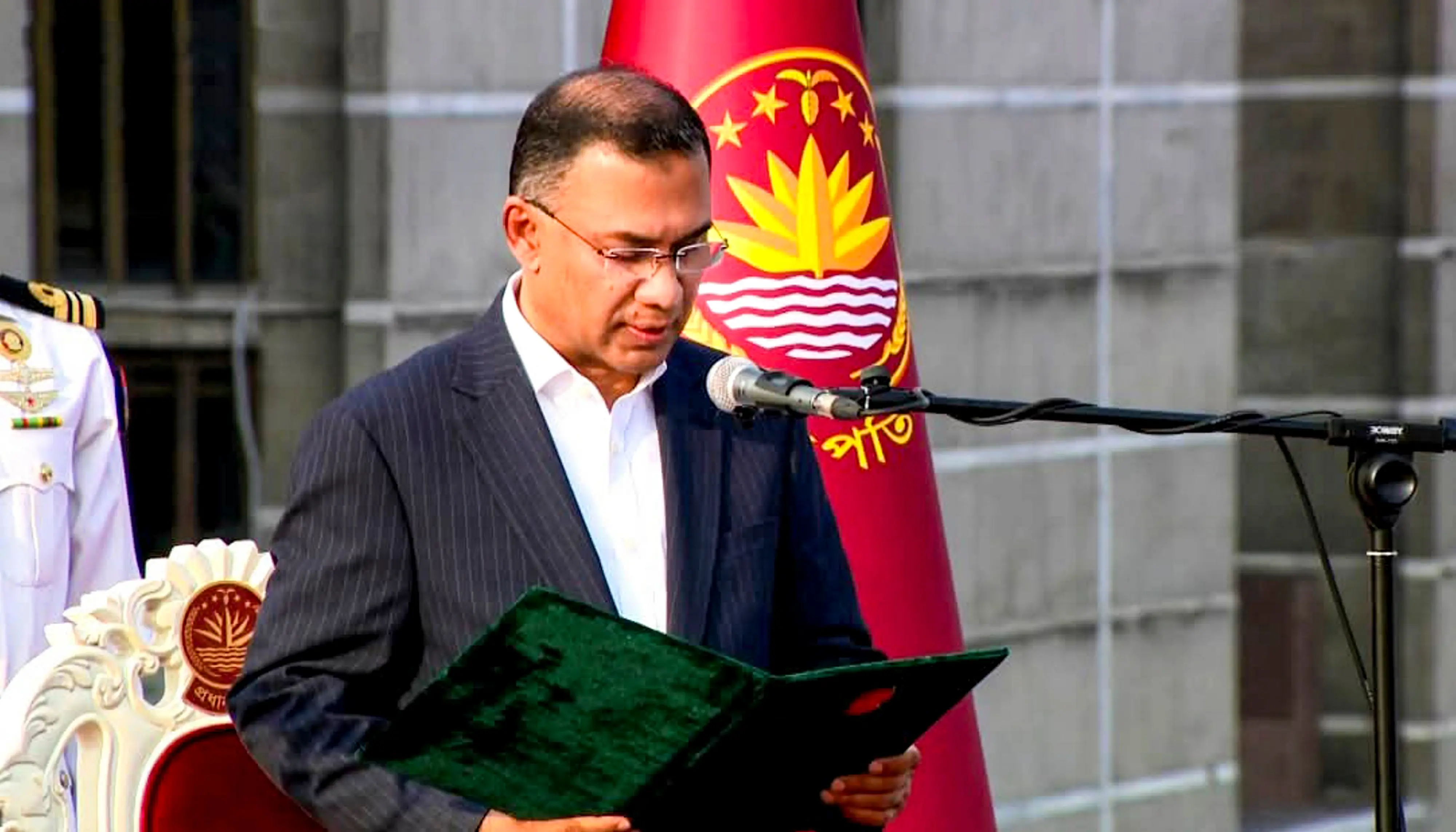
Bangladesh ushered in a new political chapter on Tuesday as Tarique Rahman, chief of the Bangladesh Nationalist Party (BNP), was sworn in as the country’s next prime minister – becoming the first man to hold the office since 1989. His elevation follows the BNP’s sweeping victory in the 12 February general election, which saw the party secure a commanding lead in the 300-member parliament.
Rahman, 60, formally assumed office after being elected leader of the BNP’s parliamentary party earlier in the day. Bangladesh President Mohammed Shahabuddin administered the oath at the South Plaza of the Jatiya Sangsad Bhaban in Dhaka, with India represented by Lok Sabha Speaker Om Birla, signalling New Delhi’s intent to reset ties after a turbulent period.
The BNP’s triumph marks a dramatic reversal for a party sidelined during the more than 15-year rule of ousted premier Sheikh Hasina, whose government collapsed amid a student-led uprising in August 2024.
A new political era
Rahman’s rise brings to a close an era dominated by two women – Khaleda Zia, his mother, and Sheikh Hasina, his long-time rival – who shaped Bangladesh’s political landscape for more than three decades.
With his appointment, the country now sees a male head of government for the first time since 1989.
The BNP and its allies clinched 212 seats, including 209 for the party alone, while Jamaat-e-Islami, the main challenger, secured 68 seats. The Awami League was barred from contesting the polls.
Return from exile and a swift ascent
Rahman’s comeback is one of the most extraordinary in Bangladesh’s political history. He returned to Dhaka in December after spending 17 years in self-imposed exile in London, having left in 2008 citing medical reasons.
Five days after his arrival, he suffered a personal blow when former prime minister Khaleda Zia died following prolonged illness.
Despite the bereavement, Rahman rapidly consolidated his position at the helm of a party long pushed to the margins. As BNP chairman, he reorganised the party, projected a conciliatory tone, and drew massive crowds during the election campaign.
From dynastic scion to elected PM
Born on 20 November 1965 in Dhaka, Rahman lived through the turbulence of Bangladesh’s 1971 Liberation War, during which he and his family were detained briefly. He later studied international relations at the University of Dhaka before turning to business.
Under the Awami League government, Rahman faced multiple corruption and criminal cases, including a life sentence for the 2004 grenade attack on Sheikh Hasina. He denied all allegations, calling them politically motivated.
During the interim administration led by Nobel laureate Muhammad Yunus, he was acquitted of all charges.
During his emotional return to Dhaka last December, Rahman declared,
"I have a plan for the people of my country and for my country," invoking the words of US civil rights icon Martin Luther King Jr.
He has since outlined parts of that plan:
- recalibrating foreign partnerships to attract investment without overdependence on any single global power,
- introducing “family cards” to expand financial support for low-income households,
- diversifying the economy beyond garment exports into sectors such as toys and leather goods,
- and proposing a two-term or 10-year limit for future prime ministers to prevent authoritarian drift.
Challenges ahead
Rahman faces the formidable task of restoring political stability in a nation of 170 million people. Analysts say his government must urgently address a fragile economy, weak institutions and concerns over violence, particularly attacks targeting minority Hindu communities since Hasina’s fall.
Observers also point to internal friction within the BNP. Over the past 18 months, the party expelled around 10,000 activists following allegations of extortion, business takeovers, and filing fabricated cases against rivals.
At a post-election press conference, Rahman urged the nation to reject hostility, calling for ‘national unity’ and ‘peace’ and warning that further polarisation would only weaken democracy. Asked how he planned to win the trust of millions of Awami League supporters, he replied simply: “By ensuring the rule of law”.
Rahman, once dismissed by critics as a power broker during his mother’s 2001–2006 term despite holding no official role, is now widely viewed as a more measured figure after years abroad.
A leader from the minority Hindu community who recently met him described “a different Tarique”, noting his calm demeanour, humour, and detailed vision for the country.
Rahman is married to Dr Zubaida Rahman, a cardiologist and daughter of a former navy chief. The couple have a daughter, Zaima Zarnaz Rahman.
(With inputs from PTI)