
Zomato CEO Deepinder Goyal has once again sparked curiosity online after appearing on a podcast wearing a tiny metallic gadget on his temple.
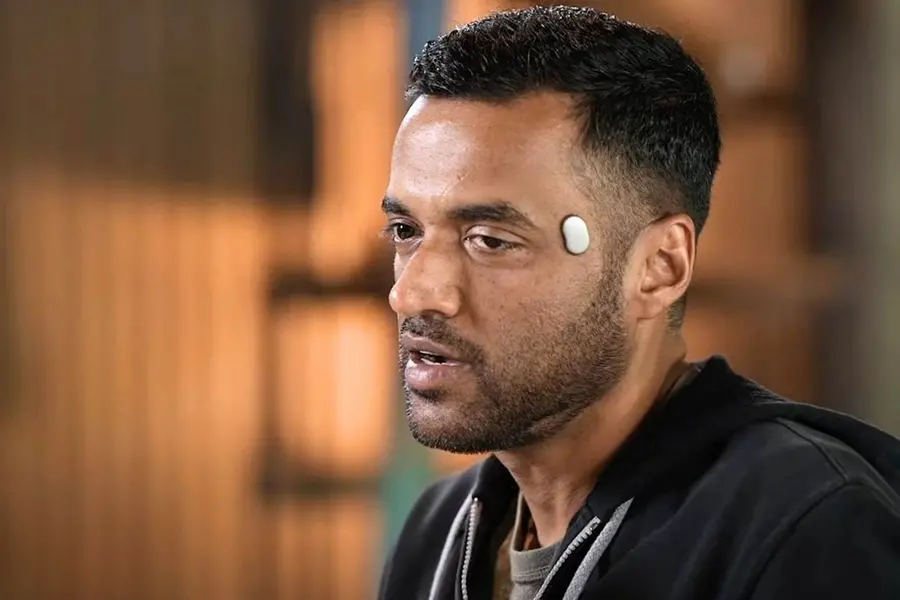
A tiny, metallic device on Eternal CEO (parent company of Zomato and Blinkit) Deepinder Goyal’s temple stole the spotlight during his appearance on Raj Shamani’s Figuring Out podcast, leaving viewers guessing and social media buzzing. Seconds into the episode, eagle-eyed fans noticed the small gadget, sparking jokes, memes and a wave of speculation. Some wondered if it was chewing gum, a patch, an “external SSD” or a futuristic implant.
But as it turns out, the gadget is far more than a quirky accessory – it is called Temple, an experimental wearable designed to monitor blood flow to the brain in real time. Goyal has been personally testing the device for almost a year as part of research into brain health and ageing.
What is Temple?
Temple is not a fashion statement or marketing stunt. Goyal explained that the device is intended to track cerebral blood flow continuously, which scientists consider a key marker of cognition, neurological health and the ageing process. “It’s like a fitness tracker, but for your brain,” he said, emphasising the experimental and research-driven purpose of the tool.
The device is linked to a theory Goyal calls the Gravity Ageing Hypothesis, which suggests that over decades, gravity may slow blood circulation to the brain, potentially affecting how humans age. To study this, Goyal and his team needed a wearable capable of measuring brain blood flow accurately and continuously – a capability that most existing consumer devices lack.
Temple is currently a research project and not a consumer product. Goyal has stressed that the device is not intended to be the next large-scale Zomato-style venture. It is neither a publicity stunt nor a marketing effort to promote the Gravity Ageing Hypothesis. “He wouldn’t risk customer trust or credibility for something like that,” industry observers noted.
So far, there is no public preorder, consumer launch or promise that Temple will ever reach mainstream markets. Its purpose remains squarely experimental, aimed at advancing scientific understanding rather than commercial gain.
Internet reaction
The unusual sight of a tech founder casually wearing a brain-monitoring device on a popular podcast made the moment go viral. From jokes comparing it to chewing gum to references to sci-fi implants, social media had a field day. Yet beneath the humour lies serious curiosity about the future of wearable health technology, longevity research, and brain monitoring.
Swapnil Srivastav, founder of Kidbea, described Goyal’s experiment as “wild and fascinating” on X, noting the Zomato CEO’s belief: “People don’t die because of disease. They die because of gravity.” Srivastav added that Goyal is “working on something to never let that blood flow stop” and suggested it could potentially impact longevity.
AIIMS doctor takes a dig
Despite the buzz, not all reactions have been positive. Dr Suvrankar Datta, an AI researcher and radiologist at AIIMS Delhi, dismissed Temple as a “fancy toy for billionaires” lacking clinical validation. He warned: “As a physician-scientist and one of the earliest researchers in India in Arterial Stiffness and Pulse Wave Velocity (2017) which predicts cardiovascular mortality, I can assure you that this device currently has 0 scientific standing as a useful device and do not waste your hard earned money to buy fancy toys billionaires can afford to waste money on. If you are one, then go ahead.”
Temple’s development and background
The device was developed under Goyal’s venture, Continue Research, part of Zomato’s parent company, Eternal. He has invested roughly $25 million of his personal wealth into the project. Temple has appeared in multiple public instances: a silver version during the January 3 podcast and a golden version near his right temple at a Children’s Day event in November.
Goyal has described the project as an open-source research effort, writing on social media: “I’m not sharing this as the CEO of Eternal, but as a fellow human, curious enough to follow a strange thread. A thread I can’t keep with myself any longer. It’s open-source, backed by science, and shared with you as part of our common quest for scientific progress on human longevity. Newton gave us a word for it. Einstein said it bends spacetime. I am saying gravity shortens lifespan.”
Published: 06 Jan 2026, 11:59 am IST
Related Topics
Disclaimer: Kindly avoid objectionable, derogatory, unlawful and lewd comments, while responding to reports. Such comments are punishable under cyber laws. Please keep away from personal attacks. The opinions expressed here are the personal opinions of readers and not that of Mathrubhumi.
