
This milestone advances Joby's FAA certification efforts and showcases the potential of eVTOL technology for commercial use, particularly in congested urban environments.
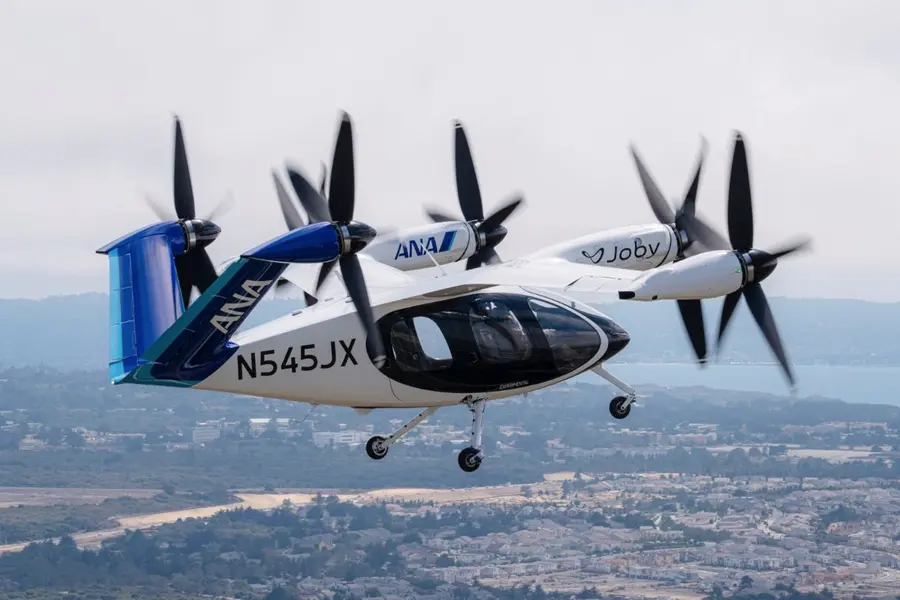
New Delhi: Joby Aviation has taken a major step towards commercial operations with its first-ever flight between two public airports in the United States, operating entirely within controlled airspace managed by the Federal Aviation Administration (FAA).
The piloted aircraft took off from Marina Municipal Airport (OAR) in California and landed at Monterey Regional Airport (MRY), covering a distance of around 10 nautical miles in just 12 minutes. The journey included a vertical take-off, smooth transition into forward flight, and a vertical landing at the destination. To accommodate other arriving aircraft, Joby’s pilot also entered a five-minute holding pattern at Monterey, demonstrating the ability to safely integrate into busy airspace.
This marks the first time in the US that a piloted electric vertical takeoff and landing (eVTOL) aircraft has flown from one public airport to another. The flight showcased several key capabilities, including the aircraft’s performance, Joby’s ability to run mobile operations away from its main base, and its readiness to work within existing air traffic control systems alongside commercial airlines.
“Successfully flying from Marina to Monterey showcased our aircraft integrated into the broader transportation network and further proved its readiness for commercial service,” said Didier Papadopoulos, President of Aircraft OEM at Joby Aviation. “For years, our testing has validated the aircraft’s capabilities, and it was time to take the next step.”
The achievement is a significant milestone in Joby’s journey to FAA certification, which requires aircraft to demonstrate they can operate safely in shared airspace. Joby’s flight test program has already logged more than 40,000 miles. The company recently began final assembly of its first aircraft intended for Type Inspection Authorisation testing, one of the last stages before certification. Test flights with FAA pilots are expected to begin early next year, with commercial services planned first in Los Angeles and New York City.
While this achievement happened in the US, the technology has strong potential in India. With rapid urban growth and worsening road congestion in major cities like Mumbai, Bengaluru, and Delhi, short-distance aerial transport could offer a much faster, cleaner alternative to road travel. An eVTOL can take passengers across the city in minutes instead of hours, bypassing traffic jams entirely.
India’s large population, expanding middle class, and rising demand for premium, time-saving transport options make it a promising market for air taxis. If the right policies, regulations, and infrastructure are put in place, such as dedicated vertiports, airspace management systems, and battery charging facilities, eVTOL operations could become a reality within the next decade. Industry experts say that with public-private partnerships and government support, India could leapfrog into a new era of urban mobility, reducing travel times and emissions in the process.
Published: 16 Aug 2025, 04:51 pm IST
Related Topics
Disclaimer: Kindly avoid objectionable, derogatory, unlawful and lewd comments, while responding to reports. Such comments are punishable under cyber laws. Please keep away from personal attacks. The opinions expressed here are the personal opinions of readers and not that of Mathrubhumi.
