
The walkout follows a series of pro-Palestinian demonstrations at Stanford commencement ceremonies in recent years, reflecting wider tensions on US university campuses over the conflict in Gaza and institutional responses to student activism
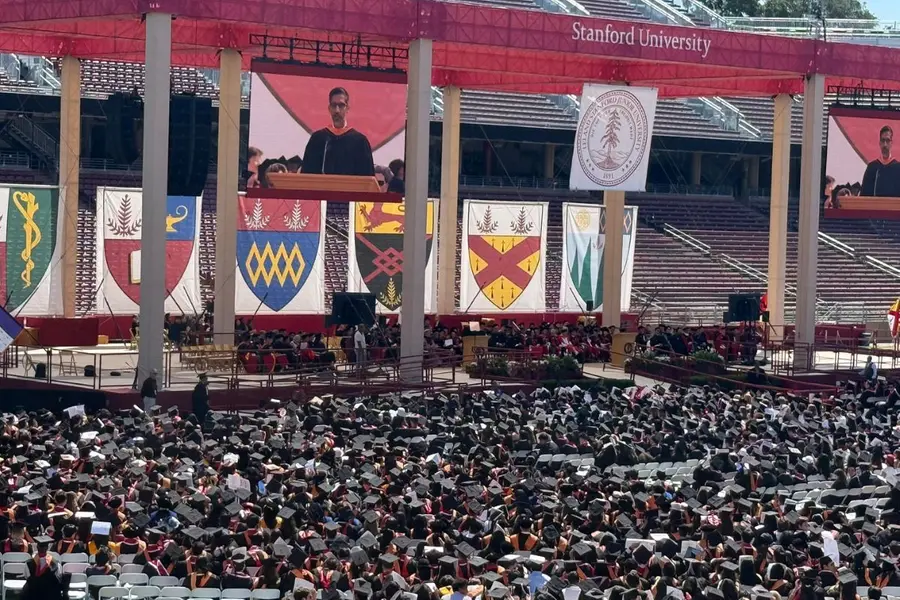
New York: Hundreds of students at Stanford University staged a walkout during a commencement address by Google Chief Executive Sundar Pichai on Sunday, protesting the technology giant's business links with the Israeli government amid the ongoing war in Gaza.
Pichai, who earned a Master of Science in Materials Science and Engineering from Stanford, returned to his alma mater to deliver the keynote speech at the university's 135th commencement ceremony.
According to the Stanford Report, more than 20,000 people, including around 3,600 graduating students, attended the event. However, local media outlet SFGate reported that approximately 200 students left the ceremony while Pichai was speaking.
Videos shared on social media showed students carrying Palestinian flags and banners as they walked out, chanting slogans including “Free Palestine”. Several smaller groups were also seen waving banners, blowing whistles and displaying Palestinian flags before leaving the venue.
The protest was reportedly organised by student groups including Students for Justice in Palestine and No Tech for Apartheid. Demonstrators criticised Google's involvement in Project Nimbus, a US$1.2 billion cloud computing contract awarded jointly to Google and Amazon by the Israeli government in 2021.
The walkout follows a series of pro-Palestinian demonstrations at Stanford commencement ceremonies in recent years, reflecting wider tensions on US university campuses over the conflict in Gaza and institutional responses to student activism.
Despite the disruption, Pichai continued his address, reflecting on his upbringing in Chennai and his journey from India to Silicon Valley.
“It’s easy to look at the news of the day and think that we’re living in uniquely challenging times,” he told graduates. “We don’t get to choose the world we graduate into, but we do get to choose how we frame our circumstances.”
Recalling his childhood in Chennai, Pichai spoke about growing up during periods of drought and waiting years for access to technologies such as a telephone, television and refrigerator.
“My parents never let the constraints limit my imagination of what was possible,” he said. “It’s the reason I even let myself dream I could one day work in a far-away place called Silicon Valley.”
Pichai also recounted his arrival in the United States to study at Stanford, noting that his father spent the equivalent of a year’s salary to purchase his plane ticket.
The Google chief reflected on changing career paths during his time at the university, explaining that he initially intended to pursue a doctorate and a career in academia before leaving his PhD programme and completing a master’s degree instead.
“I’d love to tell you I was an immediate success after leaving Stanford,” he said. “I wasn’t. Even a decade later, I felt like I wasn’t on the right path, and it took me a while to find my footing.”
The protest drew criticism from Indian-American venture capitalist Vinod Khosla, who described the students' actions as “biased, idiotic, short-sighted and very selfish” in a post on social media platform X.
Responding to Khosla, Democratic Congressman Ro Khanna defended the students’ actions, arguing that the demonstration was directed at Google’s contracts with the Israeli military and constituted an exercise of free expression.
“Wherever one stands on those contracts, I believe you would support their right of free expression and challenging authority,” Khanna wrote.
Published: 15 Jun 2026, 09:39 am IST
Related Topics
Disclaimer: Kindly avoid objectionable, derogatory, unlawful and lewd comments, while responding to reports. Such comments are punishable under cyber laws. Please keep away from personal attacks. The opinions expressed here are the personal opinions of readers and not that of Mathrubhumi.
