
Four International Space Station astronauts returned to Earth earlier than planned after a medical concern prompted the first-ever health-related evacuation in the station’s history, according to NASA
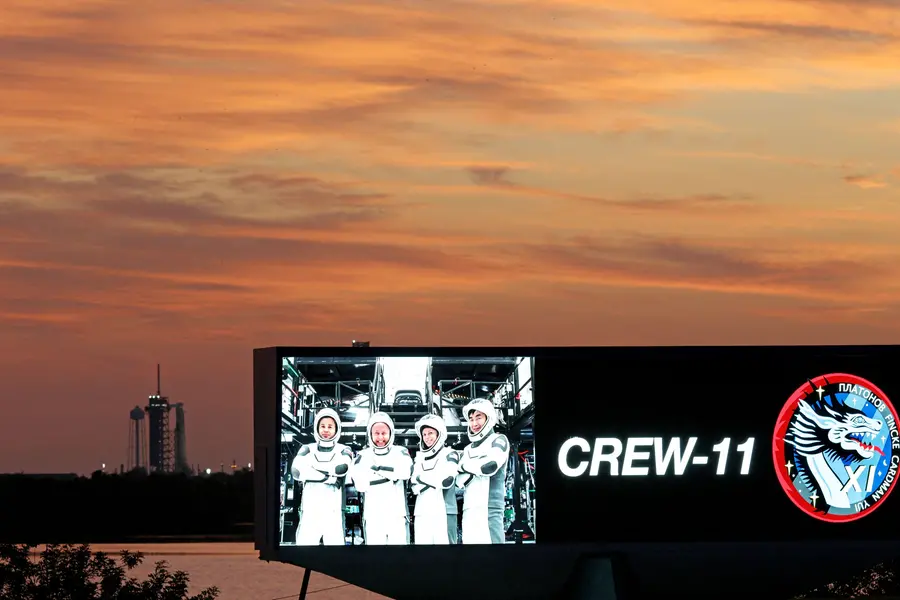
NASA confirmed that a medical issue affecting one crewmember led to the early return of four astronauts from the International Space Station. While the space agency has not disclosed the nature of the health concern, officials said there was a “lingering risk” and uncertainty around diagnosis that made further evaluation on Earth necessary.
NASA stressed that the situation was not an emergency. The affected astronaut was described as stable throughout the decision-making process and during the return to Earth.
Also Read

Who were the astronauts involved?
The crew comprised American astronauts Mike Fincke and Zena Cardman, Russian cosmonaut Oleg Platonov and Japanese astronaut Kimiya Yui. They were part of SpaceX’s Crew-11 mission and had spent about five months aboard the orbiting laboratory.
NASA video footage showed the crew capsule splashing down in the Pacific Ocean off the coast of San Diego at around 12:41 am local time on Thursday (0841 GMT). Recovery teams were deployed following the landing.
NASA officials said the decision was precautionary rather than reactive. The agency explained that the full range of diagnostic tools needed to evaluate the health issue was only available on the ground. According to NASA’s chief health and medical officer, lingering uncertainty around the diagnosis made continued stay in orbit a risk that could be avoided through an early return.
What was the original mission plan?
The Crew-11 astronauts arrived at the ISS in early August and were scheduled to remain there until mid-February, when they were due to be replaced by the next rotation crew. The early splashdown shortened their mission by several weeks.
Following the Crew-11 return, American astronaut Chris Williams and Russian cosmonauts Sergey Kud-Sverchkov and Sergei Mikaev remain on the ISS. They arrived at the station in November aboard a Russian Soyuz spacecraft and will continue station operations.
Why is this event significant for the ISS?
This marked the first medical evacuation in the ISS’s more than 25 years of continuous human occupation. While astronauts are trained to manage medical issues in orbit, this is the first time a health concern has led to a mission being cut short for medical evaluation on Earth.
NASA officials praised the crew’s handling of the situation, noting they were trained for unexpected medical scenarios.
The incident highlights the challenges of managing health risks during long-duration spaceflight. NASA has repeatedly said the ISS serves as a testing ground for future missions to the Moon and Mars, where rapid medical evacuation would not be possible.
The International Space Station is expected to operate beyond 2030. After that, it will be gradually deorbited and guided to break up over a remote area of the Pacific Ocean known as Point Nemo, bringing an end to one of the longest-running multinational space projects.
(With AFP inputs)
Published: 15 Jan 2026, 03:38 pm IST
Related Topics
Disclaimer: Kindly avoid objectionable, derogatory, unlawful and lewd comments, while responding to reports. Such comments are punishable under cyber laws. Please keep away from personal attacks. The opinions expressed here are the personal opinions of readers and not that of Mathrubhumi.