
In a discovery that could rewrite chemistry textbooks, scientists have found that Saturn’s largest moon Titan allows molecules that usually repel each other to combine
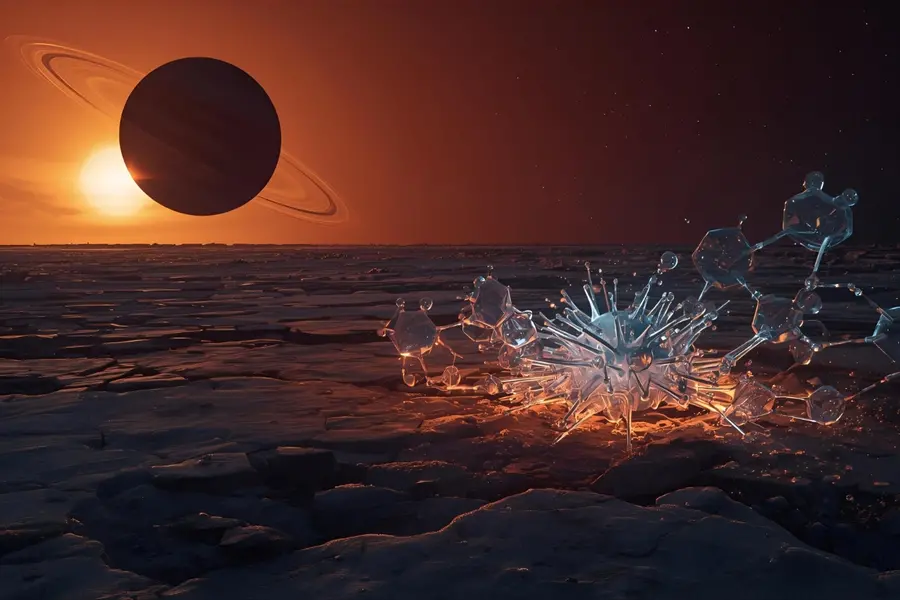
Saturn’s largest moon, Titan, has surprised scientists by defying one of chemistry’s most established rules: “like dissolves like”. A joint study by researchers from Chalmers University of Technology in Sweden and NASA has shown that on Titan’s icy surface, molecules that should never mix can actually combine to form new, stable crystalline compounds.
Published in the journal Proceedings of the National Academy of Sciences (PNAS), the study reveals that methane, ethane, and hydrogen cyanide—substances common on Titan—can interact in ways previously thought impossible. Using low-temperature spectroscopy experiments at NASA’s Jet Propulsion Laboratory, the researchers simulated Titan’s frigid environment, where surface temperatures hover around -180°C.
They found that hydrocarbons such as methane and ethane could integrate into the crystalline structure of hydrogen cyanide, forming new solid compounds. This phenomenon challenges the traditional understanding of molecular interactions between polar and non-polar substances, which typically remain separate, like oil and water on Earth.
Chemist Martin Rahm from Chalmers University explained that the findings could provide vital clues about the chemical pathways that existed before life began on Earth. “These are very exciting findings that can help us understand something on a very large scale, a moon as big as Mercury,” Rahm said.
The results also carry implications for astrobiology. Hydrogen cyanide is a key ingredient in prebiotic chemistry—the set of reactions that can lead to the formation of life’s building blocks, including amino acids and nucleobases. Titan, with its thick nitrogen-rich atmosphere and methane lakes, offers a natural laboratory for studying these early-life processes.
NASA’s upcoming Dragonfly mission, scheduled to land on Titan in 2034, aims to further investigate the moon’s chemical landscape and test whether such reactions could support life under the coldest known conditions in the solar system.
Titan, the largest of Saturn’s 145 moons, is known for its dense atmosphere and lakes of liquid methane and ethane. Scientists have long considered it one of the most Earth-like bodies in the solar system, despite its extreme cold.
In their experiments, researchers combined hydrogen cyanide (HCN) with methane (CH₄) and ethane (C₂H₆) under Titan-like conditions. To their surprise, they discovered that the hydrocarbons penetrated the crystal lattice of hydrogen cyanide, resulting in entirely new solid materials. These compounds appear to be chemically stable under Titan’s low temperatures, indicating that molecular behaviour in such environments is more complex than previously believed.
The research opens a new chapter in astrochemistry, hinting that icy worlds such as Titan could host chemical processes capable of forming complex organic molecules—the precursors to life. Scientists believe that understanding this chemistry could not only reshape our perception of Titan but also shed light on how life’s ingredients first assembled in the early solar system.
Published: 24 Oct 2025, 08:17 pm IST
Related Topics
Disclaimer: Kindly avoid objectionable, derogatory, unlawful and lewd comments, while responding to reports. Such comments are punishable under cyber laws. Please keep away from personal attacks. The opinions expressed here are the personal opinions of readers and not that of Mathrubhumi.
