
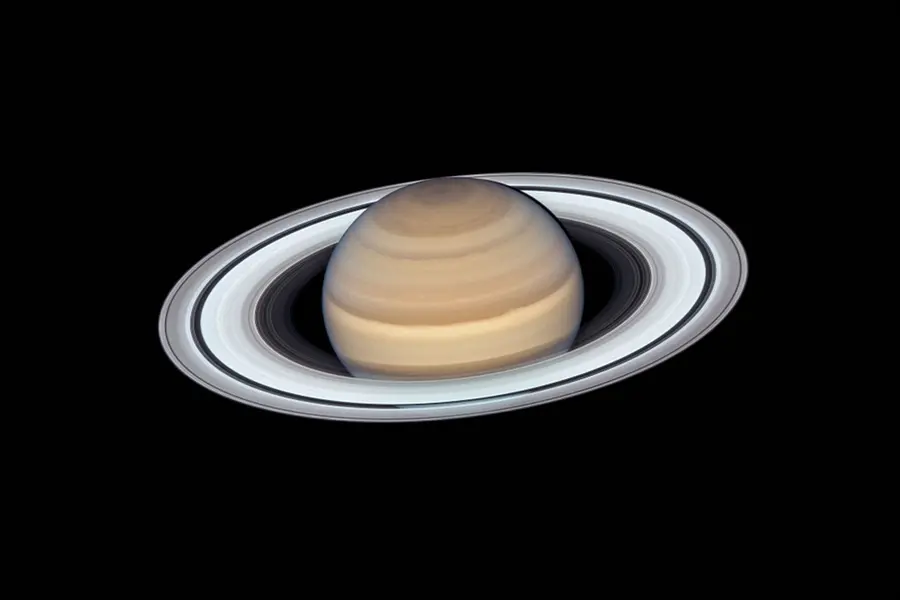
Earlier this week, Saturn made headlines after astronomers officially added a massive 128 new moons to its count. The International Astronomical Union (IAU) confirmed the discovery, which was led by Edward Ashton at the Academia Sinica in Taiwan. With this, Saturn now boasts a total of 274 moons—the most of any planet in the Solar System.
This discovery has sparked curiosity. How do astronomers find new moons? Why hadn’t they been spotted before? And with so many moons, how do they even decide what qualifies as one? Let’s break it down.
Counting moons
Saturn is now the undisputed champion of the Solar System’s moon race, surpassing all other planets combined. But that hasn’t always been the case.
Jupiter’s four largest moons—Io, Europa, Ganymede, and Callisto—were the first to be discovered orbiting another planet. Galileo Galilei spotted them back in 1610. Saturn’s first known moon, Titan, was found 45 years later by Dutch astronomer Christiaan Huygens.
The latest batch of 128 moons was found using the Canada-France-Hawaii Telescope. Astronomers used a technique called “stacking,” where multiple images are layered to track faint moving objects. Other moons were discovered thanks to space missions like Voyager 1 and Cassini or during events called “ring-plane crossings.”
A ring-plane crossing happens when Saturn’s rings appear edge-on from Earth’s perspective, making moons easier to spot. Titan and 12 other moons were found this way. The next ring-plane crossings will happen in March and November 2025.
The moon race
From 2019 to 2023, Jupiter and Saturn went back and forth in a race to have the most moons.
In 2019, Saturn took the lead with 20 new moons, reaching a total of 82, surpassing Jupiter’s 79.
In February 2023, Jupiter bounced back with 12 more moons, taking the lead with 95.
Later that same year, the same team that found the 128 moons also discovered 62 others, bringing Saturn back to the top.
Elsewhere in the Solar System, Earth has just one moon, Mars has two, Uranus has 28, and Neptune has 16. Altogether, they have 142 moons—Saturn is just 10 moons short of having twice that number.
What counts as a Moon?
All 128 of Saturn’s new moons are tiny—just a few kilometres across. But if something that small counts as a moon, where do we draw the line?
NASA says, “Naturally formed bodies that orbit planets are called moons.” However, even asteroids can have moons, and Earth has had temporary “mini-moons” only a few metres wide. There’s no strict definition, making it a bit tricky.
Moons in our Solar System can be either “regular” or “irregular.” The new moons are all irregular.
Regular moons form around a planet at the same time the planet forms. They tend to have circular orbits close to the planet’s equator.
Irregular moons are thought to be small planetary objects captured by a planet’s gravity. They usually have more oval-shaped orbits, are further away, and often get broken up by collisions.
Saturn now has 24 regular moons and 250 irregular ones. Studying them helps scientists understand how moons form and how the Solar System evolved. Since Saturn’s rings are made of broken-up ice, rock, and possibly shattered moons, irregular moons might also give insight into how these rings formed.
What’s in a name?
Naming moons isn’t as simple as picking a random name. The IAU oversees the process, and historically, moons were named after figures from Greco-Roman mythology.
But with planets like Saturn and Jupiter having so many moons, the IAU had to expand the naming system. Saturn’s first seven moons were numbered instead of named. Later, they were given names from Greek Titans. When that wasn’t enough, astronomers started using names from Inuit, Gallic, and Norse mythology.
Discoverers get to suggest names, and the IAU prioritises those choices. In the past, there have even been public competitions to name Jupiter and Saturn’s moons. With 128 new moons to name, it could take a while. Until then, each moon has a placeholder name like “S/2020 S 27.” Maybe new mythologies will be added—only time will tell.
Will we find more moons?
Since there’s no strict definition of what a moon is, it’s hard to say when astronomers will stop looking for them. While nobody is suggesting every tiny rock in Saturn’s rings should count, deciding exactly where to draw the line isn’t straightforward.
Edward Ashton, who led the new discovery, believes we might not find many more moons anytime soon—at least, not until telescope technology improves. But given how often Saturn has reclaimed the title of “most moons,” it wouldn’t be surprising if another big discovery happens in the future.
Published: 16 Mar 2025, 03:13 pm IST
Disclaimer: Kindly avoid objectionable, derogatory, unlawful and lewd comments, while responding to reports. Such comments are punishable under cyber laws. Please keep away from personal attacks. The opinions expressed here are the personal opinions of readers and not that of Mathrubhumi.
