
A new proposal for up to one million satellites in low Earth orbit has reignited global debate over space congestion, environmental risks and the future of the night sky
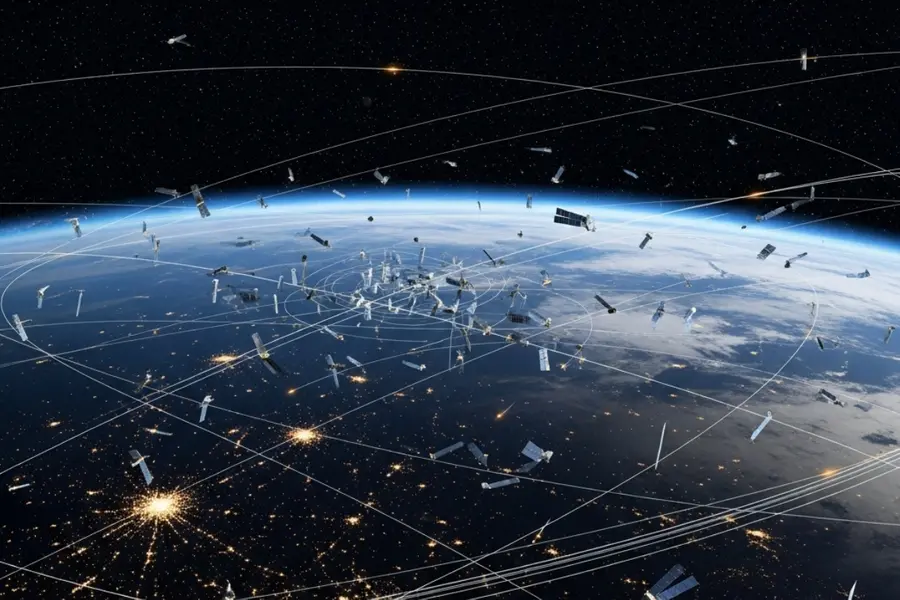
On January 30, 2026, SpaceX filed an application with the Federal Communications Commission for a megaconstellation of up to one million satellites designed to power space-based data centres.
The satellites would operate between 500 and 2,000 kilometres above Earth in low Earth orbit, with some positioned for near-constant sunlight exposure. Public comments on the proposal are currently being accepted.
As of February 2026, around 14,000 active satellites are already in orbit. In addition, approximately 1.23 million proposed satellite projects are in various stages of development.
Permanent changes to the night sky
Experts warn that large-scale deployment of megaconstellations could permanently alter the global night sky.
Satellites in low Earth orbit reflect sunlight for up to two hours after sunset and before sunrise. Even with brightness-reduction measures, large satellites appear as moving points of light. Earlier projections suggested that with 65,000 satellites, one in every 15 visible lights in the night sky could be a moving satellite within a decade.
With proposals now reaching into the millions, light pollution and skyglow may significantly increase. This phenomenon contributes to what researchers call a “shifting baseline syndrome”, where each generation accepts a progressively altered sky as normal.
Scientific and safety risks
Concerns extend beyond visual disruption. Bright reflections and radio emissions from satellites interfere with astronomical research.
Industry experts also highlight the lack of a unified global space traffic management system comparable to aviation control.
Megaconstellations increase the likelihood of collisions and debris accumulation, raising fears of Kessler syndrome, a runaway cascade of collisions in orbit. There are already about 50,000 pieces of debris larger than 10 centimetres in orbit. If collision-avoidance systems failed, modelling suggests a major collision could occur within days.
Environmental and cultural impact
Large-scale satellite launches rely heavily on fossil fuels, contributing to atmospheric damage and ozone depletion. At the end of their five-year lifespan, most satellites are designed to burn up in the atmosphere, depositing metals into the stratosphere.
Cultural impacts are also significant. Satellite light pollution may disrupt Indigenous navigation systems, oral traditions, hunting practices and spiritual ceremonies tied to the night sky.
Under international space law, national governments remain liable for damage caused by private space objects, raising complex legal questions about accountability.
Call for a Dark Skies Impact Assessment
Experts are proposing a Dark Skies Impact Assessment to address regulatory blind spots. This framework would systematically evaluate:
- Effects on astronomy and scientific research
- Cumulative orbital congestion risks
- Environmental consequences
- Cultural and community impacts
Mitigation strategies, including reducing satellite brightness and limiting numbers
The proposal is not intended to halt space development but to improve transparency and ensure balanced decision-making before approvals are granted.
A critical moment for regulation
Current satellite regulations focus largely on technical frequency allocation, launch safety and liability. Broader cultural and environmental consequences are not fully integrated into approval processes.
Researchers argue that without updated regulatory frameworks, long-term changes to the night sky and orbital environment may become irreversible.
The rapid expansion of satellite megaconstellations signals a turning point in space governance, with governments and international institutions under pressure to establish clearer, more comprehensive oversight before orbital congestion reaches critical levels.
Published: 18 Feb 2026, 10:35 am IST
Disclaimer: Kindly avoid objectionable, derogatory, unlawful and lewd comments, while responding to reports. Such comments are punishable under cyber laws. Please keep away from personal attacks. The opinions expressed here are the personal opinions of readers and not that of Mathrubhumi.
