
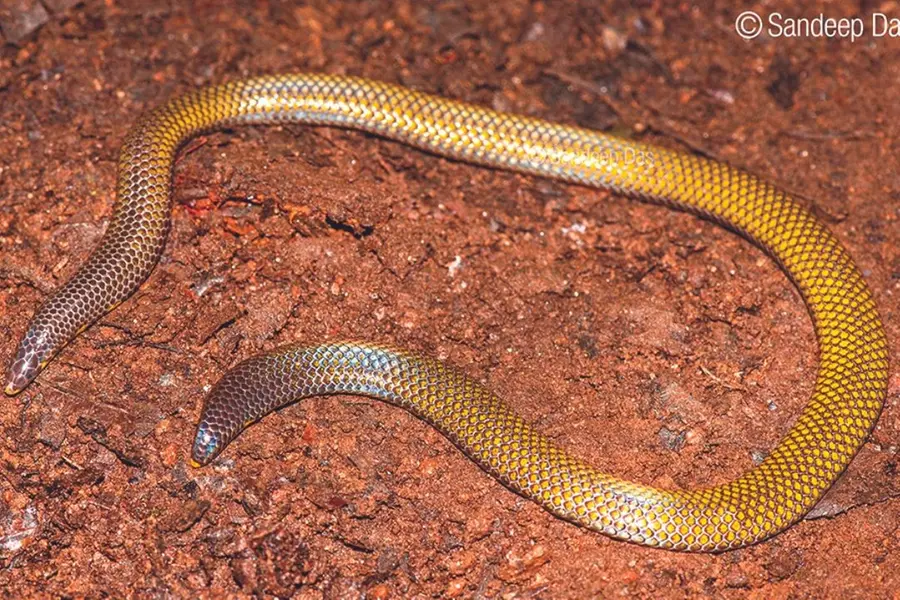
Kozhikode: A new species of snake, distinguished by its yellow-spotted tail, has been discovered in the Western Ghats. Named Uropeltis caudomaculata or shield-tail snake, these non-venomous serpents are notable for their distinct tail markings.
Shield-tail snakes are small, subterranean creatures, typically about the thickness of a finger and growing up to 37 cm in length. Due to their underground habitat, they are rarely seen, emerging only during the rainy season in search of prey. Their favourite food includes earthworms and other small snakes.
The discovery was made by a team of scientists comprising Dr David Gore, a British researcher, Dr Sandeep Das, a Post-Doctoral Fellow in the Department of Zoology at the University of Calicut, Dr V Deepak, Jason Gerrard from the University of Newcastle, and Suryanarayanan from the Ashoka Trust for Research in Ecology and the Environment in Bengaluru.
Their findings were published in the New Zealand-based Magnolia Press, Zootaxa Journal.
The snake was first found and photographed in 2017 during an amphibian survey led by Dr Sandeep Das.
A total of 27 snakes of the species have been found so far, all from the Western Ghats, which is a storehouse of biodiversity.
The research team identified the new species through morphological and genetic studies. This brings the total number of identified snake species in the world to 410, with 349 species in India and 128 species in Kerala.

In 1955, British scientist Angus F. Hutton collected specimens from Meghamalai in Tamil Nadu and brought them to the Natural History Museum in London. Recognising this as a new species, David began studying it.
During a study with National Geographic in Meghamalai, Dr. Deepak discovered this species for the first time after a vehicle had run over it. In 2017, during an amphibian survey under the supervision of the Forest Department at Periyar Tiger Reserve, Dr. Sandeep and his team spotted and photographed snakes in Kerala.
However, the team had to wait until July 2022 for the necessary permissions to conduct a detailed study. Additional information required for the study was obtained from the Yellapetty Munnar region during the rainy seasons of 2022 and 2023.
Dr. Sandeep said that while studies regarding large animals and birds are frequently released, there is a growing need for more research on smaller animals to understand their biodiversity better. He emphasized that such studies could help to uncover new species of living organisms that have not yet been noticed.
Published: 10 Jul 2024, 11:45 am IST
Related Topics
Disclaimer: Kindly avoid objectionable, derogatory, unlawful and lewd comments, while responding to reports. Such comments are punishable under cyber laws. Please keep away from personal attacks. The opinions expressed here are the personal opinions of readers and not that of Mathrubhumi.