
A fascinating new damselfly species in Kerala changes colour with the seasons, appearing brown in summer and blue during the monsoon.
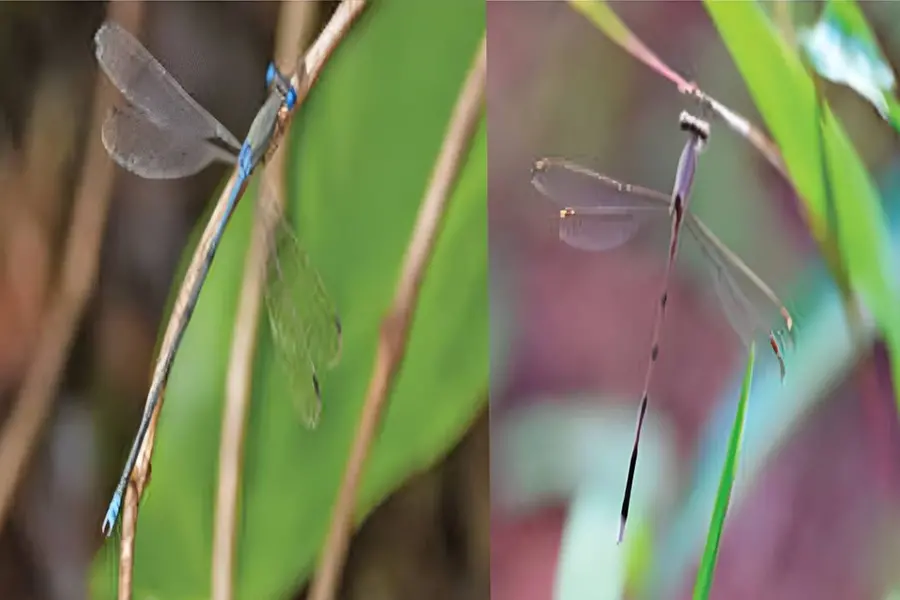
Kochi: A new species of damselfly that changes colour with the seasons has been discovered in Kerala, correcting a nearly century-old misunderstanding in the scientific study of the insect group.
The discovery follows research into a species of spreadwing damselfly belonging to the Lestes genus. The newly identified species appears brown during summer and turns blue during the monsoon, earning it the Malayalam name Neelathavidan.
Also Read

The story goes back nearly a century to 1930, when British Indian scientist F.C. Fraser identified a spreadwing damselfly from northeastern India as Lestes nodalis. Unlike most damselflies, which usually rest with their wings folded, spreadwings typically hold their wings open while perched.
Fraser's findings were published in The Fauna of British India and the journal of the Bombay Natural History Society. However, in 2019, Russian scientist Oleg Kosterin established in the international journal Zootaxa that Fraser's identification was incorrect.
Kosterin found that the damselflies Fraser had identified as Lestes nodalis were actually Lestes garoensis, a species discovered by scientist Lahiri in Meghalaya and Manipur in 1987. The correction brought an unusual 89-year-old error in damselfly taxonomy to light.
Inspired by Kosterin's research, Vinayan P. Nair, a biology teacher at Nadakkavu Government Vocational Higher Secondary School in Kozhikode, began investigating whether similar spreadwing damselflies could be found in Kerala.
Nair later joined hands with Dr Kalesh Sadasivan of the Travancore Natural History Society, Dr Maya George of Alphonsa College, Pala, and Dr Abraham Samuel of the Tropical Institute of Ecological Sciences in Kottayam to conduct further research.
The team discovered the unusual damselflies among the laterite rocks of the Varadoor-Panakkad area behind Sir Syed College in Taliparamba, Kannur. Although the insects resembled Lestes nodalis and Lestes garoensis found in northeastern India, researchers identified significant differences, particularly in the shape of the male appendages and secondary genitalia.
The researchers concluded that the insects represented a previously unknown species. Their findings were published in the International Journal of Odonatology.
The discovery marks the first identification of a new Lestes species from the Western Ghats since Lestes malabarica was recorded from Kochi and Malabar in 1923.
The newly identified species has been named Lestes paloti in English. The English name honours Dr Mohammed Jaffer Palot, a scientist with the Zoological Survey of India in Kozhikode. It recognises his contributions to Indian odonatology, the scientific study of dragonflies and damselflies.
Published: 21 Jul 2026, 12:42 pm IST
Related Topics
Disclaimer: Kindly avoid objectionable, derogatory, unlawful and lewd comments, while responding to reports. Such comments are punishable under cyber laws. Please keep away from personal attacks. The opinions expressed here are the personal opinions of readers and not that of Mathrubhumi.