
NASA`s James Webb Telescope discovered a new, small moon around Uranus, adding to its 28 known moons.
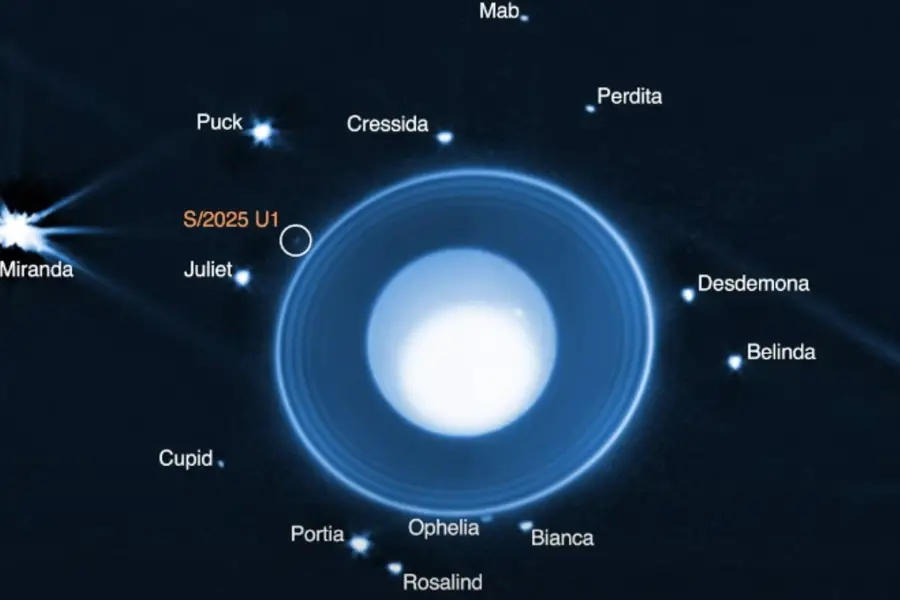
NASA’s James Webb Space Telescope has detected a previously unknown moon orbiting Uranus, the agency confirmed Tuesday.
The object, first spotted on February 2, measures about six miles (10 kilometres) across—making it far smaller and fainter than the planet’s previously known inner moons. Its tiny size likely explains why neither earlier telescopes nor NASA’s Voyager 2 spacecraft, which flew past Uranus nearly four decades ago, managed to detect it. By comparison, Uranus’ largest moon, Titania, is roughly 1,000 miles in diameter, while Earth’s Moon measures more than 2,000 miles across.
“It’s a small moon but a significant discovery,” said Maryame El Moutamid, a lead scientist in the Southwest Research Institute’s Solar System Science and Exploration Division.
Uranus’ expanding family of Moons
Before this find, Uranus was known to host 28 moons, often dubbed the “literary moons” because they are named after characters from works by William Shakespeare and Alexander Pope. The newly discovered body—designated S/2025 U1—raises the total count to 29. It currently lacks an official name, which must be approved by the International Astronomical Union.
The new moon is located about 56,000 kilometres from Uranus’ centre, orbiting between Ophelia, just outside the planet’s main ring system, and Bianca. “Its nearly circular orbit suggests it may have formed near its current location,” El Moutamid said.
It is also the 14th moon identified inside the orbits of Uranus’ five major satellites: Miranda, Ariel, Umbriel, Titania and Oberon.
Scientists expect more to come
The Webb discovery follows the detection of another moon, designated S/2023 U1, in November 2023. Researchers say the latest find hints at an even richer and more complex lunar system around Uranus than previously understood.
“No other planet has as many small inner moons as Uranus, and their complex inter-relationships with the rings hint at a chaotic history that blurs the boundary between a ring system and a system of moons,” said Matthew Tiscareno of the SETI Institute, a member of the research team.
He added: “There’s probably a lot more of them and we just need to keep looking.”
Webb’s role in the discovery
The moon was spotted as part of the Webb telescope’s General Observer programme, which allows scientists worldwide to submit research proposals. The telescope’s NIRCam instrument, with its high resolution and infrared sensitivity, enabled scientists to detect faint, distant objects previously beyond the reach of other observatories.
Published: 20 Aug 2025, 01:13 pm IST
Related Topics
Disclaimer: Kindly avoid objectionable, derogatory, unlawful and lewd comments, while responding to reports. Such comments are punishable under cyber laws. Please keep away from personal attacks. The opinions expressed here are the personal opinions of readers and not that of Mathrubhumi.
