
Scientists say extraterrestrial life may exist elsewhere in the universe, but vast distances, enormous energy requirements and Earth's unique environment make alien visits to Earth highly unlikely.
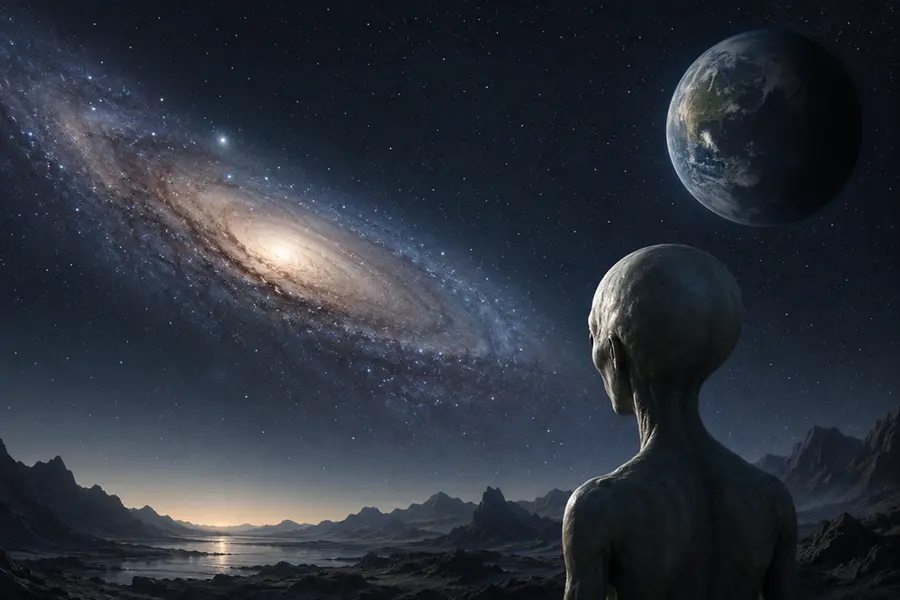
Renewed public fascination with extraterrestrial life has been fuelled by the recent release of hundreds of previously classified Unidentified Anomalous Phenomena (UAP) reports by the United States government and the debut of a new Steven Spielberg film, ‘Disclosure Day’, centred on alien contact.
Public opinion surveys in countries including Australia and the United States suggest that roughly one in three people believes extraterrestrials have already visited Earth. Yet many scientists argue that while intelligent life may exist elsewhere in the universe, there is little evidence to suggest alien civilisations are making trips to our planet.
Researchers point to three major obstacles that make such visits highly unlikely: the immense distances involved, the extraordinary energy needed for interstellar travel and the unique conditions of Earth's environment.
The universe is simply too vast
The nearest star system to Earth, Proxima Centauri, lies about 4.3 light-years away, equivalent to roughly 40 trillion kilometres. Even with humanity's most advanced spacecraft, reaching such a destination would take thousands of years.
NASA's Parker Solar Probe, currently the fastest human-made object, travels at about 191 kilometres per second. At that speed, a journey to Proxima Centauri would require more than six millennia.
Scientists note that any civilisation capable of reaching Earth would likely need to travel at speeds approaching that of light. However, such travel introduces another challenge: time dilation.
According to Albert Einstein's theory of relativity, time passes more slowly for objects moving at extremely high speeds. This effect has already been observed on a small scale. NASA astronaut Scott Kelly, for example, returned from a year aboard the International Space Station slightly younger than his identical twin on Earth because the station was travelling at high velocity.
For hypothetical alien visitors undertaking journeys across interstellar distances, the effect would be far more dramatic. They could return home to find decades or even centuries had passed on their planet, making long-distance travel a costly sacrifice.
The energy barrier remains enormous
Scientists also point to the staggering amount of energy required to accelerate a spacecraft to near-light speeds.
As an object moves faster, its mass effectively increases, demanding ever-greater amounts of energy for further acceleration. Reaching the speed of light itself would require infinite energy, something modern physics considers impossible.
Even if advanced propulsion systems were developed, another danger remains. Space is not entirely empty. Tiny particles scattered throughout the cosmos could become highly destructive when struck at extreme speeds.
Hydrogen atoms, for example, could generate intense radiation capable of harming passengers, damaging onboard systems or even eroding a spacecraft's outer structure. The heat produced by such collisions could eventually destroy a vessel travelling close to light speed.
Theoretical concepts for faster-than-light travel have been proposed, including ideas based on the work of physicist Miguel Alcubierre. However, such concepts remain purely theoretical and would require energy levels far beyond current technological capabilities.
Scientists also question the motivation for such a journey. Any civilisation advanced enough to overcome these challenges would likely possess the resources and technologies needed to obtain materials without travelling across the galaxy.
Earth's environment may not suit alien life
Another argument centres on Earth's unique biosphere.
Life on Earth evolved alongside the planet itself over billions of years. One of the most significant developments occurred around 2.4 billion years ago when cyanobacteria began releasing oxygen into the atmosphere, transforming conditions and paving the way for complex life.
While oxygen is essential for humans and many other Earth organisms, scientists note that it is also highly reactive. For life forms that evolved under completely different conditions, Earth's atmosphere could potentially be harmful or even toxic.
Researchers suggest that alien visitors would likely require protective equipment to survive in such an environment, much as humans need specialised gear when exploring hostile locations. Yet reports of alleged extraterrestrial encounters rarely describe visitors wearing protective suits or equipment.
The search for life continues
Despite doubts about alien visitation, scientists say the possibility of life elsewhere remains an open question.
Astronomers have identified roughly 6,200 planets beyond our Solar System across more than 4,700 planetary systems. While none perfectly mirrors Earth, the sheer number of stars in the Milky Way, estimated at more than 100 billion, suggests countless planets may exist.
Closer to home, several worlds continue to intrigue researchers. Mars, Jupiter's moon Europa, and Saturn's moons Enceladus and Titan are all considered potential candidates for microbial life, either in the past or present.
Scientists say that discovering even simple life elsewhere in our Solar System would significantly increase the likelihood that life exists throughout the universe.
Listening for signals from beyond Earth
Efforts to detect intelligent life have been underway for decades. Since 1960, astronomers have used radio telescopes to search for signs of technological civilisations.
Major projects, including those conducted by the SETI Institute in California and the Breakthrough Listen initiative based at Oxford University, continue to scan the skies for potential signals.
So far, those searches have yielded no confirmed evidence of intelligent extraterrestrial life.
Researchers caution, however, that humanity's search has covered only a tiny fraction of cosmic history. In a universe estimated to be 13.8 billion years old, a century of observation represents only a brief moment.
As scientists have long argued, the absence of evidence is not evidence of absence. But one conclusion remains clear: if humanity stops looking, the chances of finding extraterrestrial intelligence become zero.
(The Conversation)
Published: 14 Jun 2026, 12:42 pm IST
Related Topics
Disclaimer: Kindly avoid objectionable, derogatory, unlawful and lewd comments, while responding to reports. Such comments are punishable under cyber laws. Please keep away from personal attacks. The opinions expressed here are the personal opinions of readers and not that of Mathrubhumi.
