
NASA is set to launch Artemis II, the first crewed lunar mission in 50 years. Know the launch date, timing, weather forecast and where to watch the liftoff live.
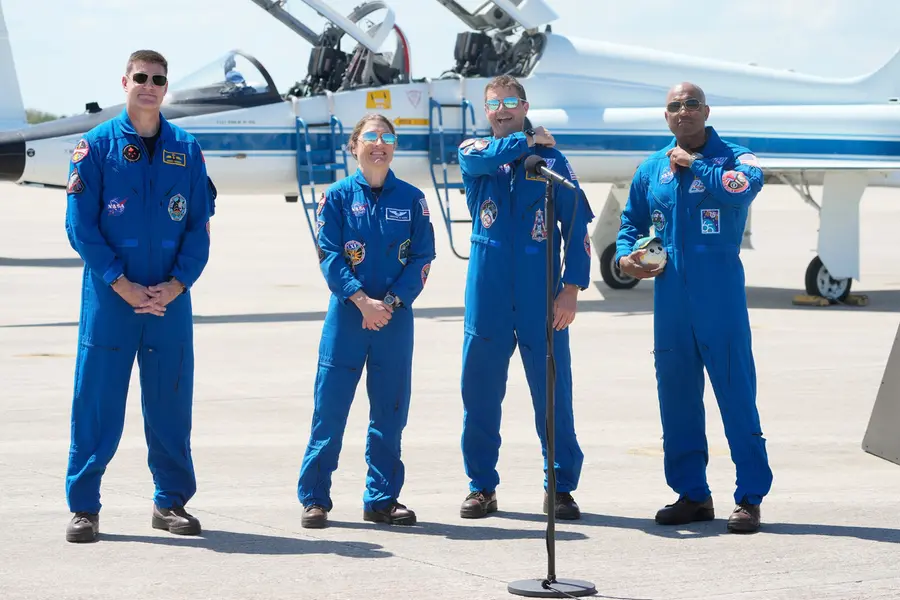
Cape Canaveral: NASA is entering the final stretch of preparations for Artemis II, the agency’s first crewed journey to the Moon in more than 50 years. The countdown is underway at the Kennedy Space Center, where the mission is scheduled to lift off on Wednesday, marking the most significant step in human deep-space exploration since the end of the Apollo programme in 1972.
Following a mission management review on Monday, NASA Associate Administrator Amit Kshatriya confirmed that the spacecraft, systems and crew are “ready for launch”. Weather remains the only potential obstacle, with forecasters estimating an 80 percent chance of acceptable conditions. Cloud cover and strong winds are the primary concerns.
The two-hour launch window opens at 6:24 pm EDT (22:24 GMT) on Wednesday. If required, backup opportunities will remain available through 6 April, with daily evening windows aligned to orbital mechanics, lunar positioning and Earth’s rotation.
Launch timing and schedule
The launch window on 1 April will begin in the early evening in Florida, with pre-launch coverage starting hours earlier. NASA will follow a set sequence of activities that include fuelling, final systems checks and crew ingress into the Orion capsule.
For viewers in India, the launch is expected at approximately 3:54 am IST on 2 April.
If technical issues or unfavourable weather arise, the mission may shift to one of the subsequent daily windows through 6 April.
How to watch the Artemis II launch
The event will be streamed live across multiple NASA platforms. Coverage begins at 12:50 pm EDT on NASA+ and NASA TV, both of which will broadcast the mission without advertisements. Livestreams will also run on the agency’s official YouTube channels, offering uninterrupted visuals from the launch pad.
NASA will provide real-time updates across its social media accounts, including close-up shots of the Orion spacecraft and the Space Launch System poised for ascent from Launch Complex 39B.
What Artemis II aims to achieve
Artemis II is the first crewed mission of NASA’s broader Artemis programme, a long-term effort to return humans to the Moon and build a sustained presence there as a precursor to eventual missions to Mars.
This flight will not land on the lunar surface. Instead, the crew will perform a close flyby of the Moon, looping around its far side before returning to Earth. The mission’s primary goal is to validate life-support, navigation, communications and deep-space operations with astronauts on board, critical systems that cannot be fully tested on the ground.
Artemis I, launched in November 2022, successfully demonstrated the spacecraft’s performance without a crew, laying the foundation for this next phase.
Meet the Artemis II crew
Four astronauts will undertake the roughly 10-day journey:
- Reid Wiseman, mission commander: A veteran astronaut and former commander of the International Space Station.
- Victor Glover, pilot: A US Navy aviator and the first Black astronaut assigned to a lunar mission.
- Christina Koch, mission specialist: Holder of the record for the longest single spaceflight by a woman and an experienced spacewalker.
- Jeremy Hansen, mission specialist: A former fighter pilot and the first Canadian astronaut to travel to the Moon.
During the flight, the team will test spacecraft systems, conduct medical and scientific assessments, perform suit-pressurisation checks and study lunar features during the flyby.
The mission’s unusual ‘fifth member’
While the official crew consists of four astronauts, a hand-sewn plush toy, ‘Rise’, designed by eight-year-old Lucas Ye, will also be on board as the mission’s zero-gravity indicator. Once the spacecraft reaches microgravity, the toy will begin to float, signalling the transition to weightless conditions.
Selected through a design competition, the toy represents young people’s creativity and interest in space exploration.
Weather considerations for launch
Weather plays a decisive role in launch readiness. NASA, working with the US Space Force's Space Launch Delta 45, continuously monitors ground winds, upper-level winds, cloud thickness, precipitation and potential electrical activity. Space weather, including solar flares and charged particles, is also evaluated due to possible effects on communications and navigation.
According to NASA’s latest forecast issued on 30 March, conditions appear mostly favourable, with an 80 percent chance of acceptable weather during the initial window.
What’s next for the Artemis programme?
The Artemis sequence spans multiple missions aimed at establishing long-term human activity on and around the Moon:
- Artemis III (2027): Now redesigned as a low Earth orbit mission to test integrated operations between Orion and commercial lunar landers from SpaceX and Blue Origin.
- Artemis IV (early 2028): Planned as the first crewed lunar landing since Apollo 17, targeting the Moon’s south pole.
- Artemis V (late 2028): Expected to deliver a second crewed landing and begin construction of a sustained lunar base.
Published: 01 Apr 2026, 09:06 pm IST
Related Topics
Disclaimer: Kindly avoid objectionable, derogatory, unlawful and lewd comments, while responding to reports. Such comments are punishable under cyber laws. Please keep away from personal attacks. The opinions expressed here are the personal opinions of readers and not that of Mathrubhumi.
