
India’s Samudrayaan project gears up for deep-sea exploration as scientists prepare to pilot the indigenously built Matsya-6000 submersible off Chennai coast, marking a major step in the Deep Ocean Mission.
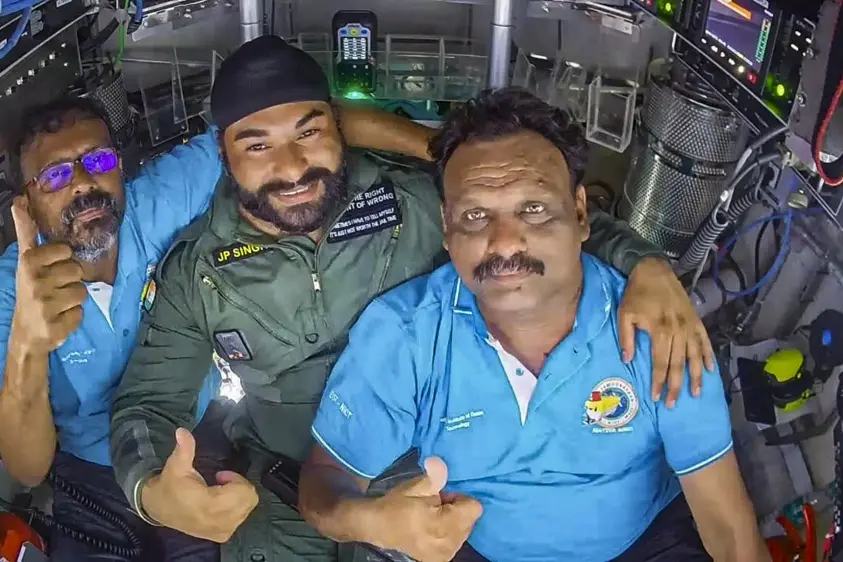
Chennai: India is set to make a splash in the realm of deep-sea exploration as two scientists from the National Institute of Ocean Technology (NIOT) prepare to pilot an indigenously built manned submersible up to 500 metres off the Chennai coast early next year. The mission, part of India’s Deep Ocean Mission, will position India among a select group of nations capable of human deep-sea exploration.
Scientists to Pilot Matsya-6000
India’s aquanauts, Ramesh Raju and Jatinder Pal Singh, will take charge of the 28-tonne Matsya-6000 submersible.
“We have explored the ocean bed at greater depths using remotely operated vehicles. This is for the first time we will be sending humans at a depth of 6,000 metres, and safety is paramount for this mission,” Balaji Ramakrishnan, Director, NIOT, told PTI.
The project, spearheaded by the Ministry of Earth Sciences, reflects India’s spirit of self-reliance. Earlier attempts to procure a manned deep-sea submersible through global tenders were blocked due to technology denials, prompting India to develop the vessel domestically.
“We took it up as a challenge. We have the expertise to dive under water, but only up to 1000 metres. Once we embarked on the project and started travelling to allied labs, we found that expertise and technologies were available within the country in laboratories of DRDO and CSIR, and institutes of ISRO,” Ramakrishnan added.
Scientists highlight the value of human presence in deep-sea exploration. “No camera can match the human eye. It has a different perception that will give a lot of insights to the deep sea floor,” Sathia Narayanan, Project Director, Samudrayaan, told PTI.
The deep ocean holds untapped minerals, fuels, and biodiversity resources. Currently, only the United States, Russia, China, Japan, and France possess the technology to carry out exploration at such depths.
Engineering the Matsya-6000
The Matsya-6000, under development at NIOT, features a 2.25-metre diameter personnel sphere made of boiler steel, high-density lithium-polymer batteries, drop weight emergency escape systems, ballast tanks, propellers, and emergency buoys as part of the drag-anchor rescue system.
The initial mission will take scientists to 500 metres, the operational depth of naval submarines. By 2027, the plan is to dive to 6,000 metres using a titanium sphere, fabricated at ISRO’s Liquid Propulsion Systems Centre in Bengaluru. “The Bengaluru lab developed the electron beam welding facility to build the titanium alloy sphere with 80 mm thick walls to withstand 600 bar pressure experienced at 6,000 metres depth,” said Sethuraman Ramesh, Group Head, Deep Sea Technology, NIOT.
Advanced safety measures
The Matsya-6000 will travel at 30 metres per minute, equipped with portholes, external lights, robotic arms for sample collection, and external cameras. All equipment will be certified by DNV, a global risk management organisation. “The DNV certification for every component will make Matsya-6000 one of the safest vessels to undertake deep ocean exploration,” Ramesh said.
In August, the two scientists gained valuable experience piloting the French submersible Nautile to a depth of 5,000 metres. The insights from that mission are aiding the development and operation of Matsya-6000.
Published: 20 Nov 2025, 02:45 pm IST
Related Topics
Disclaimer: Kindly avoid objectionable, derogatory, unlawful and lewd comments, while responding to reports. Such comments are punishable under cyber laws. Please keep away from personal attacks. The opinions expressed here are the personal opinions of readers and not that of Mathrubhumi.
