
ISRO said the Earth-orbiting DEX can provide the first-ever direct measurements of IDPs in the atmospheres of other planets, including Venus and Mars.
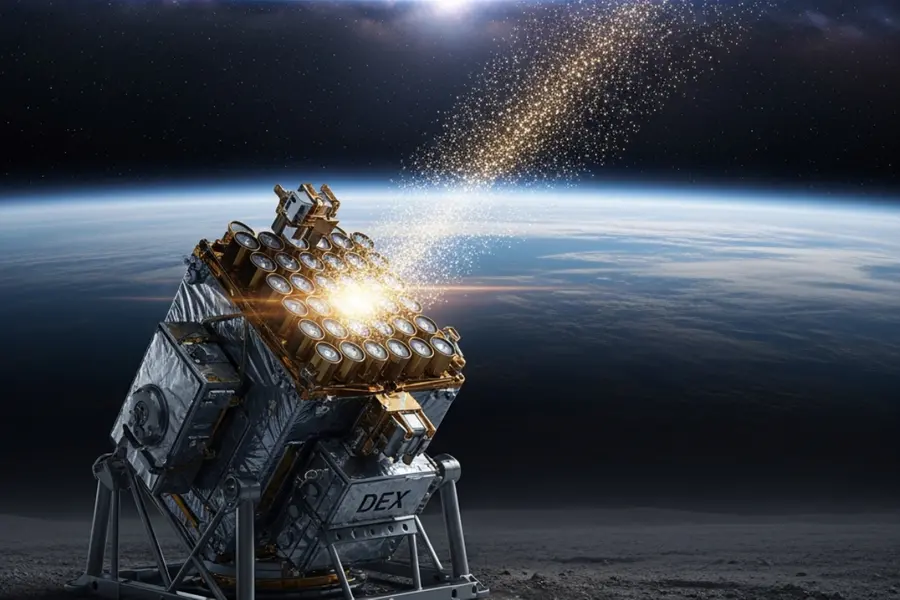
Bengaluru: India’s space agency, ISRO, said on Monday that its maiden home-made dust detector, the Dust EXperiment (DEX), has successfully detected interplanetary dust particles (IDPs) “a cosmic invader striking every thousand seconds” on Earth.
DEX, the first Indian-made instrument of its kind, was flown aboard the PSLV Orbital Experimental Module (POEM) last year. The detector was developed by ISRO’s Physical Research Laboratory (PRL), Ahmedabad, and is designed to capture high-speed space dust impacts while consuming just 4.5 Watts of power.
According to ISRO, IDPs are microscopic shrapnel from comets and asteroids that form the mysterious “meteor layer” in Earth’s atmosphere, appearing as “shooting stars” at night.
The agency said, "The 140-degree wide-view detector successfully logged signals of orbital debris' (dust) impacts during January 1, 2024, to February 9, 2024, confirming the instrument's capability to identify and measure such events. Skimming Earth's atmosphere on a 9.5 inclination, the detector registered several hits—a cosmic invader striking every thousand seconds."
DEX was flown on the POEM of the PSLV-C58 XPoSat mission on January 1, 2024, reaching an altitude of 350 km. The three-kilogram detector, based on the cutting-edge hypervelocity principle, provides vital data that can redefine our understanding of the universe and help chart safer paths for human deep-space missions.
ISRO said the Earth-orbiting DEX can provide the first-ever direct measurements of IDPs in the atmospheres of other planets, including Venus and Mars. "At present, we have no measurements of cosmic dust in the thick atmosphere of Venus or in the thin atmosphere of the red planet Mars. DEX is a blueprint of the detector which can study the cosmic dust particle at any planet having atmosphere or no atmosphere," the agency added.
Beyond scientific research, the data is mission-critical. ISRO said, “The ability to measure IDPs is essential for monitoring the space environment, precisely assessing hazards for our satellites, and ultimately, ensuring the safety and success of future manned missions to the Moon, Mars and beyond.”
Published: 05 Jan 2026, 07:47 pm IST
Disclaimer: Kindly avoid objectionable, derogatory, unlawful and lewd comments, while responding to reports. Such comments are punishable under cyber laws. Please keep away from personal attacks. The opinions expressed here are the personal opinions of readers and not that of Mathrubhumi.
