
Halzen’s IceCube observatory detected high-energy neutrinos from deep space, opening a new way to study the universe.
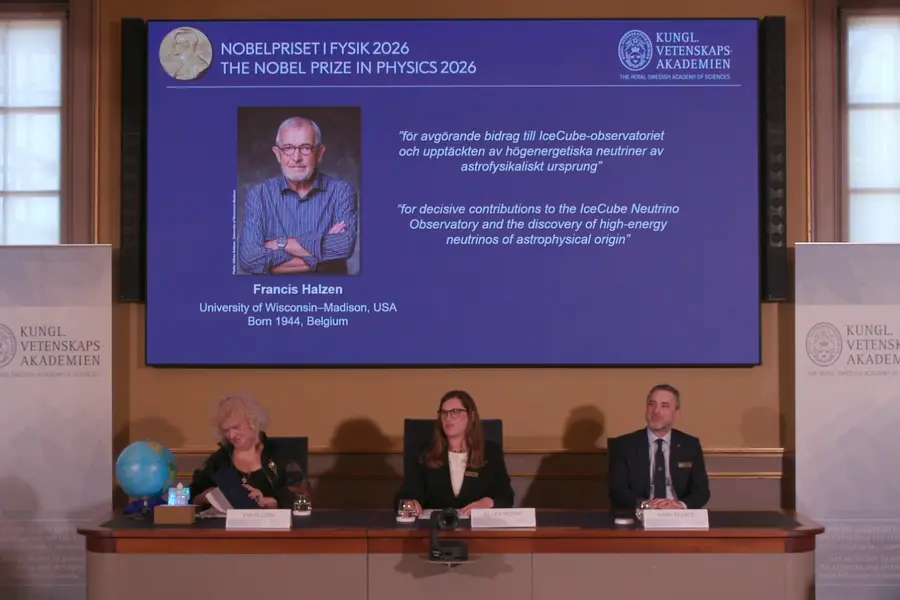
The Nobel Prize in Physics has been awarded to Belgium-born Francis Halzen "for decisive contributions to the IceCube Neutrino Observatory and the discovery of high-energy neutrinos of astrophysical origin." In plain terms: Halzen helped build a giant detector in Antarctica that, for the first time, caught extremely powerful “ghost particles” coming from deep space -- particles that travel straight from some of the most violent places in the universe and point back to where they were born.
What is a neutrino?
A neutrino is a tiny, nearly massless particle with no electric charge. It interacts so weakly with matter that it can pass through the entire Earth without hitting anything. Trillions of low-energy neutrinos from the Sun pass through your body every second, unnoticed.
“High-energy” neutrinos are millions to billions of times more energetic than the ones from the Sun or from nuclear reactors. Think of neutrinos as cosmic messengers that almost never stop or turn. Most fly straight through everything. Very rarely, one hits an atom and leaves a tiny flash of light—that’s what IceCube is built to see.
Why build a telescope in Antarctic ice?
Francis Halzen, a physicist at the University of Wisconsin–Madison, led the idea and construction of IceCube, the world’s largest neutrino detector. It sits under 1.5 to 2.5 km of ultra-clear ice near the South Pole and uses 5,160 light sensors frozen into the ice to watch for those rare flashes.
Why ice? Because when a high-energy neutrino hits an atom in the ice, it creates other particles that move faster than light does in ice (not faster than light in vacuum), producing a faint blue glow called Cherenkov light.
The sensors catch that glow and let scientists work out the neutrino’s energy and the direction it came from.
The big discovery
For decades, scientists knew about low-energy neutrinos from the Sun and from Earth’s atmosphere, but they had not clearly seen high-energy neutrinos coming from deep space.
In 2012, IceCube spotted two extremely energetic events nicknamed “Bert” and “Ernie,” hinting at something cosmic.
In 2013, the team announced 28 very high-energy neutrino events (later refined) whose energies and patterns did not match what was expected from Earth’s atmosphere.
This was the first solid evidence that high-energy neutrinos are being produced by powerful astrophysical objects outside our solar system—essentially, the birth of “neutrino astronomy.”
These neutrinos have energies up to about 1,000 times greater than those produced by the Large Hadron Collider, the most powerful particle accelerator on Earth.
Pinpointing the first source: a blazing black hole 4 billion light-years away
Detecting a diffuse glow of cosmic neutrinos was huge, but astronomers also wanted to know: where exactly are they coming from?
On September 22, 2017, IceCube’s automatic system flagged one very energetic neutrino and sent its sky position to telescopes around the world within minutes.
NASA’s Fermi satellite and other observatories quickly saw a strong gamma-ray flare from a known object: a blazar called TXS 0506+056, about 4 billion light-years away.
A blazar is a galaxy with a supermassive black hole at its centre, shooting a jet of particles and radiation almost directly toward Earth. By combining the neutrino direction with the gamma-ray data, scientists concluded that this blazar was producing both the gamma rays and the high-energy neutrino -- making it the first identified source of such neutrinos.
This was like catching a message in a bottle and, for the first time, reading the address on the label.
Why does this matter to anyone?
Neutrinos travel in straight lines and are not bent by magnetic fields, so they point directly back to their sources, unlike charged cosmic rays.
They can escape from regions that light cannot, such as the dense cores of exploding stars or the immediate surroundings of black holes.
By studying them, astronomers get a completely new way to look at the universe -- complementing light-based telescopes with a “neutrino telescope.”
In everyday terms: before IceCube, we could only “see” the universe with light and related radiation. Now we can also “listen” to it with neutrinos, learning about cosmic accelerators that would otherwise remain hidden.
The man behind it
Francis Halzen began working on neutrino detectors in Antarctica in the 1990s with a smaller project called AMANDA, then pushed for a much larger instrument.
As principal investigator of IceCube, he coordinated hundreds of scientists from many countries to build and run the detector, which has been operating since 2010.
His persistence turned a bold idea -- using a cubic kilometre of polar ice as a particle detector -- into a working observatory that has now caught dozens of cosmic neutrinos and identified their sources.
The 2026 Nobel Prize recognizes exactly that: Halzen’s key role in creating IceCube and in the discovery that high-energy neutrinos from deep space are real, detectable, and traceable to specific cosmic objects.
Published: 06 Oct 2026, 03:36 pm IST
ABOUT THE AUTHOR

Related Topics
Disclaimer: Kindly avoid objectionable, derogatory, unlawful and lewd comments, while responding to reports. Such comments are punishable under cyber laws. Please keep away from personal attacks. The opinions expressed here are the personal opinions of readers and not that of Mathrubhumi.