
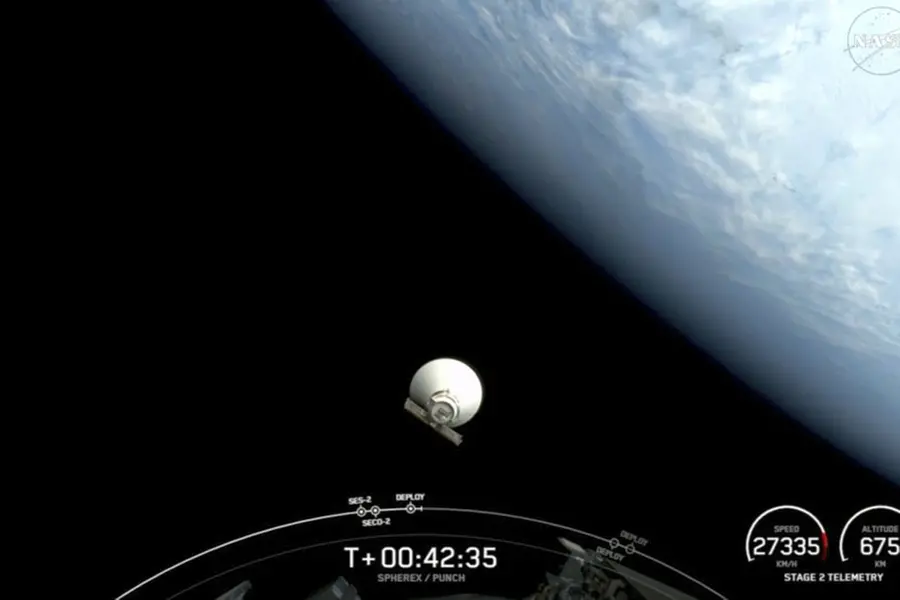
Vandenberg Space Force Base, California: American space agency NASA's latest space telescope, Spherex, soared into orbit Tuesday aboard a SpaceX Falcon 9 rocket, embarking on a groundbreaking mission to map the entire sky in unprecedented detail.
Lifting off from California’s Vandenberg Space Force Base, the Spherex observatory is set to provide a sweeping view of hundreds of millions of galaxies, capturing their cosmic glow from the earliest moments of the universe. Alongside Spherex, the rocket also carried four small satellites designed to study the sun’s outer atmosphere.
Unveiling the secrets of the universe
With a budget of $488 million, the Spherex mission is designed to unlock secrets of galaxy formation and evolution over billions of years. Scientists also hope to gain insights into the rapid expansion of the universe immediately after the Big Bang.
Closer to home, the telescope will search for water and organic molecules in the interstellar clouds of the Milky Way -- regions where new solar systems are born.
Weighing 1,110 pounds (500 kilograms), roughly the size of a grand piano, the cone-shaped Spherex will take six months to complete its first infrared survey of the entire sky. Over two years, it will conduct four full-sky surveys while orbiting Earth at an altitude of 400 miles (650 kilometers).
A different way to view the cosmos
Unlike the Hubble and Webb space telescopes, which focus on individual galaxies, Spherex will observe the collective glow of all galaxies, including some of the universe’s earliest formations.
"This cosmological glow captures all light emitted over cosmic history," said Jamie Bock, the mission’s chief scientist at the California Institute of Technology. "It is a very different way of looking at the universe."
Spherex is equipped with advanced infrared detectors capable of distinguishing 102 different colours, providing scientists with the most comprehensive cosmic map ever created. According to Beth Fabinsky, deputy project manager at NASA's Jet Propulsion Laboratory, the telescope allows researchers to see the universe "through a set of rainbow-colored glasses."
Innovative design for deep space exploration
To maintain the extreme cold temperatures necessary for infrared observations -- minus 350 degrees Fahrenheit (minus 210 degrees Celsius) -- Spherex features an innovative design with three nested aluminum-honeycomb cones. The structure acts as a thermal shield, resembling an oversized protective collar.
The launch also deployed NASA’s Punch mission, a set of four small satellites that will monitor the sun’s corona and solar wind.
The mission had been delayed for two weeks due to technical issues with the rocket, but the evening liftoff marked a successful start for both scientific endeavours.
AP
Published: 12 Mar 2025, 10:23 am IST
Related Topics
Disclaimer: Kindly avoid objectionable, derogatory, unlawful and lewd comments, while responding to reports. Such comments are punishable under cyber laws. Please keep away from personal attacks. The opinions expressed here are the personal opinions of readers and not that of Mathrubhumi.
