
Indian scientists create a scalable, efficient device for green hydrogen production using solar energy & earth-abundant materials. A breakthrough in clean energy!
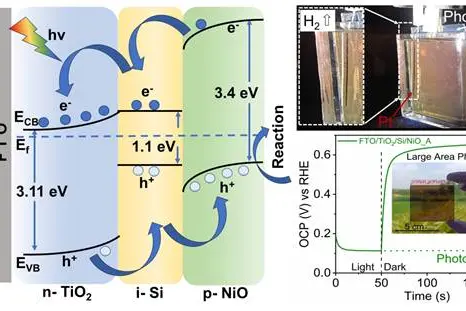
Bengaluru: A team of Indian scientists has developed a next-generation device that produces green hydrogen by splitting water molecules using only solar energy and earth-abundant materials.
What is green hydrogen?
Green hydrogen is widely regarded as one of the cleanest fuels, capable of decarbonising heavy industries, powering vehicles, and storing renewable energy. However, until now, scalable and affordable methods of production have remained elusive.
The innovation behind the breakthrough
The device was developed by a research team led by Dr. Ashutosh K. Singh at the Centre for Nano and Soft Matter Sciences (CeNS), Bengaluru, an autonomous institute under the Department of Science and Technology (DST).
“By selecting smart materials and combining them into a heterostructure, we have created a device that not only boosts performance but can also be produced on a large scale,” Dr. Singh said. “This brings us one step closer to affordable, large-scale solar-to-hydrogen energy systems.”
Published in the Journal of Materials Chemistry A, the research describes a silicon-based photoanode designed using an advanced n-i-p heterojunction architecture. This structure includes stacked layers of n-type TiO₂, intrinsic (undoped) Si, and p-type NiO semiconductors. Together, they enhance charge separation and improve transport efficiency.
How it works?
The device was made using magnetron sputtering, a scalable and industry-ready method that ensures accuracy and efficiency. This engineering approach led to faster charge transport, better light absorption, and reduced recombination loss, all of which are key ingredients for efficient solar-to-hydrogen conversion.
Notably, the device achieved an excellent surface photovoltage of 600 mV and a low onset potential of around 0.11 VRHE, making it extremely powerful at generating hydrogen using solar energy.
Moreover, it operates continuously for over 10 hours in alkaline conditions with only a 4 per cent performance drop, showcasing exceptional long-term stability. This is a rare occurrence in Si-based photoelectrochemical systems.
It demonstrated scalability as well, performing successfully at a large scale, with a 25 cm2 photoanode furnishing excellent water-splitting results.
Why it matters?
This new device is attractive for several reasons, including high efficiency, low energy input, robust durability, and cost-effective materials.
The team said that this achievement could give rise to future technologies which employ hydrogen-based energy systems from homes to factories, all powered by the sun.
Published: 21 Jun 2025, 05:59 pm IST
Related Topics
Disclaimer: Kindly avoid objectionable, derogatory, unlawful and lewd comments, while responding to reports. Such comments are punishable under cyber laws. Please keep away from personal attacks. The opinions expressed here are the personal opinions of readers and not that of Mathrubhumi.
