
NASA’s Artemis II crew captures a rare ‘Earthset’ image from the Moon’s far side, offering a breathtaking new perspective of Earth
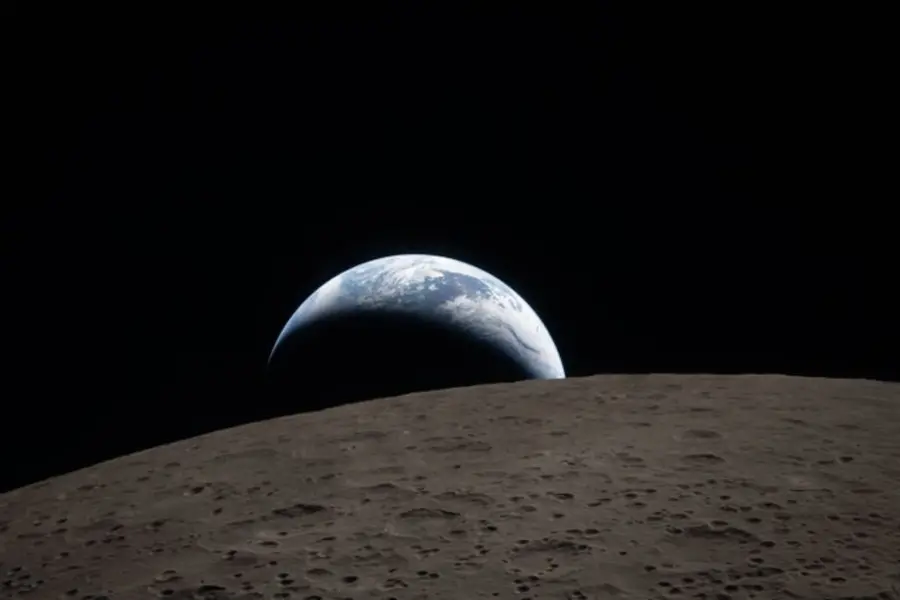
In a remarkable moment for space exploration, astronauts aboard NASA’s Artemis II mission have captured a rare and visually striking image of Earth from the far side of the Moon. The photograph, taken during a lunar flyby, offers a fresh perspective on our planet and echoes one of the most iconic images in space history.
On April 6, the Artemis II crew, travelling aboard the Orion spacecraft, recorded a stunning image showing Earth gradually dipping below the Moon’s horizon. The photograph, titled “Earthset”, presents a soft blue planet streaked with bright white clouds, partially hidden behind the Moon’s uneven and crater-filled surface.
Also Read

The image highlights a contrast between the darker portion of Earth and the brightly lit side, where cloud formations can be seen swirling above regions such as Australia and Oceania.
In the foreground of the photograph lies the Ohm crater, a prominent feature with stepped, terraced edges and a relatively flat interior. The surface is marked by central peaks rising from within the crater.
According to NASA, such peaks are formed during powerful impact events. When the Moon’s surface briefly behaves like a fluid due to the force of impact, it rebounds upwards, creating these elevated structures in complex craters.
A nod to a legendary image
NASA noted that the newly captured “Earthset” image bears a strong resemblance to the historic “Earthrise” photograph taken by astronaut Bill Anders during the Apollo 8 mission 58 years ago.
“The Artemis II crew captured this view of an Earthset on April 6, 2026, as they flew around the Moon,” NASA said while sharing the image, drawing parallels with the earlier moment that changed how humanity viewed Earth from space.
Rare eclipse seen from space
The mission also provided another extraordinary visual event. A solar eclipse was observed from space during the latter part of the spacecraft’s hours-long journey around the Moon. This occurred when the Sun briefly moved behind the Moon, creating a striking celestial alignment.
The White House shared the imagery, describing it as a perspective of “humanity from the other side”, highlighting the significance of viewing Earth from such a distant vantage point.
About the Artemis II Mission
Artemis II marks NASA’s first crewed mission to orbit the Moon in more than five decades. It serves as a key test flight within the broader Artemis programme, which aims to return humans to the lunar surface by 2028.
The mission is designed to assess the performance of the Space Launch System rocket and the Orion spacecraft, both of which are central to future plans for sustained exploration of the Moon and eventual missions to Mars.
The Artemis II mission is led by Commander Reid Wiseman. The crew also includes NASA astronauts Victor Glover and Christina Koch, along with Jeremy Hansen from the Canadian Space Agency.
During their journey, the four astronauts spent approximately seven hours documenting the Moon’s surface, capturing images and making observations of its geological features as part of this historic flyby.
With agency inputs
Published: 07 Apr 2026, 09:33 pm IST
Related Topics
Disclaimer: Kindly avoid objectionable, derogatory, unlawful and lewd comments, while responding to reports. Such comments are punishable under cyber laws. Please keep away from personal attacks. The opinions expressed here are the personal opinions of readers and not that of Mathrubhumi.