
NASA’s Artemis II astronauts have become the humans to travel furthest from Earth, breaking Apollo 13’s record during a historic lunar flyby
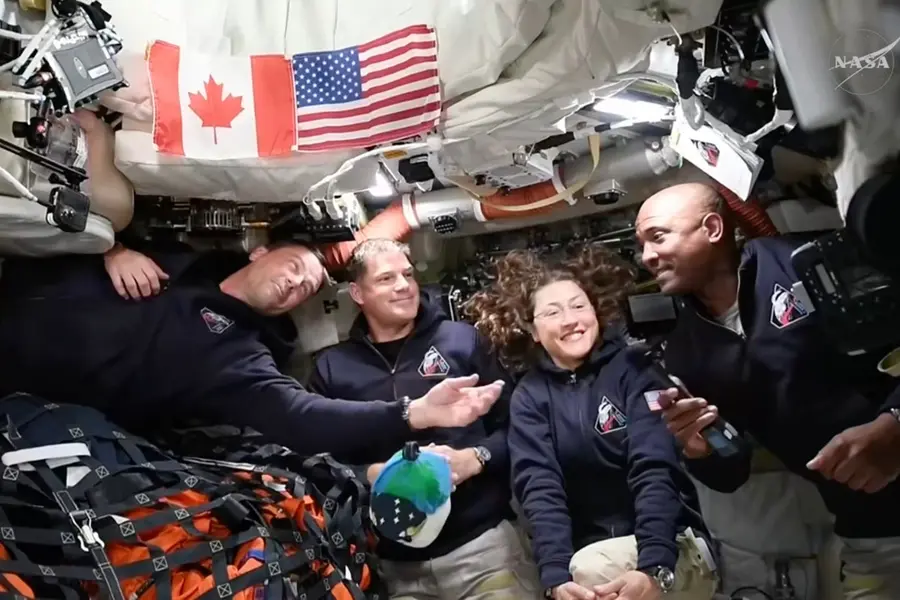
Four astronauts on NASA’s Artemis II mission became the humans to travel the furthest distance from Earth on Monday, as they prepared to witness regions of the Moon never before seen with the naked eye.
The crew is expected to surpass the distance record previously held by the 1970 Apollo 13 mission by roughly 4,105 miles (6,606 kilometres), reaching an anticipated maximum distance of 252,760 miles (406,778 kilometres) from Earth later today.
A personal message from Apollo 13 legend
The astronauts began their day by hearing a recorded message from Apollo 13 commander Jim Lovell, who passed away last August. “Welcome to my old neighbourhood,” said Lovell, who also flew on Apollo 8, humanity’s first lunar visit. “It’s a historic day and I know how busy you’ll be, but don’t forget to enjoy the view.”
Carrying with them the Apollo 8 silk patch that Lovell took to the Moon, the crew shared it as the flyby approached. “It’s just a real honour to have that on board with us,” said commander Reid Wiseman. “Let’s go have a great day.”
Artemis II is using the same free-return lunar trajectory as Apollo 13, which allows spacecraft to loop around the Moon and return to Earth without landing. This path, a figure-eight shaped route using Earth and lunar gravity, reduces fuel consumption while ensuring the astronauts’ safe return.
The crew — Wiseman, pilot Victor Glover, Christina Koch, and Canada’s Jeremy Hansen — are set to pass as close as 4,070 miles (6,550 kilometres) from the Moon. Their Orion capsule will whip past the lunar surface, perform a U-turn, and head back to Earth, with a planned splashdown in the Pacific in four days. Their estimated speed at closest approach will reach 3,139 mph (5,052 kph).
A historic mission
Artemis II is NASA’s first astronaut mission to the Moon since Apollo 17 in 1972. It lays the groundwork for Artemis III, scheduled for next year, where a crew will practice docking with lunar landers in orbit. A subsequent Moon landing near the south pole is planned for Artemis IV in 2028.
While Artemis II traces Apollo 13’s path, it also honours Apollo 8, the first humans to orbit the Moon in 1968. For the crew, flying during Holy Week held a special significance. Victor Glover remarked on the beauty of creation and the unique perspective Earth provides amid the vastness of the universe.
“This is an opportunity for us to remember where we are, who we are, and that we are the same thing and that we’ve got to get through this together,” Glover said, clasping hands with his fellow astronauts.
With agency inputs
Published: 06 Apr 2026, 11:50 pm IST
Disclaimer: Kindly avoid objectionable, derogatory, unlawful and lewd comments, while responding to reports. Such comments are punishable under cyber laws. Please keep away from personal attacks. The opinions expressed here are the personal opinions of readers and not that of Mathrubhumi.
