
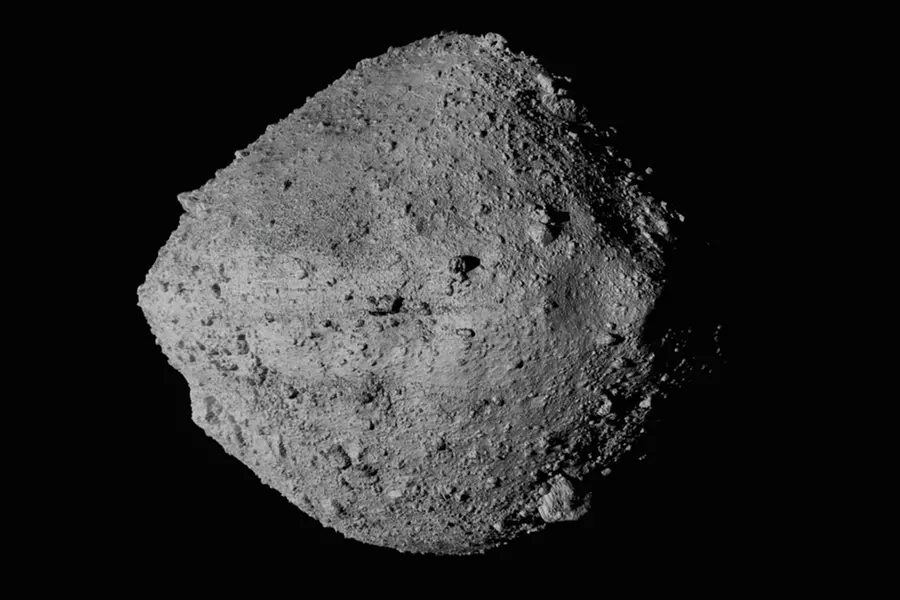
Cape Canaveral: NASA's groundbreaking asteroid sample mission has delivered some surprising revelations, hinting that the building blocks for life could have been mixed with salty water from ancient cosmic environments. Scientists reported Wednesday that the samples returned from the near-Earth asteroid Bennu reveal not only the elemental building blocks for life but also the salty remains of an ancient water world.
Bennu's role in unlocking life’s origins
"That's the kind of environment that could have been essential to the steps that lead from elements to life,” said Tim McCoy from the Smithsonian Institution, who is one of the lead authors of the study. This discovery strengthens the argument that asteroids, like Bennu, may have played a key role in seeding life on Earth, bringing with them essential ingredients that were already interacting with water billions of years ago.
NASA's Osiris-Rex spacecraft made the historic collection, bringing back 122 grams (4 ounces) of Bennu's precious dust and pebbles. This cosmic haul, delivered in 2023, remains the largest asteroid sample ever collected, dwarfing previous missions by Japan, which brought back much smaller amounts of material. The samples are filled with leftover materials from the solar system's formation 4.5 billion years ago, and now, they’re shedding light on ancient processes that could have sparked life.
Salt, amino acids, and genetic clues found in Bennu’s samples
The first of many studies have been published in 'Nature' and 'Nature Astronomy', revealing that Bennu's black grains hold more than just space dust. Sodium-rich minerals have been detected in the samples, alongside amino acids, nitrogen in the form of ammonia, and even parts of the genetic code. These findings provide strong evidence of how the ingredients for life were already mingling with water in space.
Yasuhito Sekine, from the Institute of Science in Tokyo, who wasn’t involved in the research, explained, “This discovery was only possible by analyzing samples that were collected directly from the asteroid then carefully preserved back on Earth.”
This marks an extraordinary breakthrough because, without such direct analysis, scientists might not have been able to preserve these delicate salts, which are similar to those found in the dry lakebeds of places like California’s Mojave Desert and Africa’s Sahara. Such salts would typically be stripped away if present in meteorites falling to Earth.
Sodium-rich water worlds and pathways to life
Combining the essential ingredients for life with an environment of sodium-rich saltwater or brines, as found in Bennu’s samples, is exactly the kind of pathway that could have led to the formation of life. McCoy further explained, “That’s really the pathway to life. These processes probably occurred much earlier and were much more widespread than we had thought before.”
One of the most striking findings came from the detection of relatively high amounts of nitrogen, including ammonia. While similar organic molecules have been found in meteorites before, NASA's Daniel Glavin pointed out that those found in the Bennu samples are "real extraterrestrial organic material formed in space and not a result of contamination from Earth."
Bennu’s cosmic water history
Bennu, which is a small, rubble-filled asteroid just one-third of a mile (half a kilometre) across, was once part of a much larger asteroid. It was blasted apart by other space rocks, leaving Bennu as a fragmented remnant. The new results suggest that Bennu’s parent body may have had an extensive network of underground lakes or even oceans, and the water evaporated over time, leaving behind salty clues about its watery past.
Global collaboration in Asteroid research
A global team of scientists is analysing Bennu’s samples, with 60 labs around the world involved in the research. Dante Lauretta, the mission’s chief scientist from the University of Arizona, highlighted that most of the material gathered by the $1 billion mission has been set aside for future analysis. The initial results are just the beginning of a much broader investigation into Bennu’s secrets. Scientists stress that further testing is needed to better understand the asteroid samples and what they can tell us about the early solar system and the formation of life.
Future missions to water-rich worlds
While Bennu has given us an incredible look into life’s building blocks, many researchers are already looking ahead to the next mission. China is planning to launch an asteroid sample return mission this year, and experts are advocating for missions that could collect rocks and dirt from water-rich bodies like the dwarf planet Ceres, which resides in the asteroid belt. There are also exciting prospects for exploring Jupiter's moon Europa and Saturn's moon Enceladus, both of which are believed to harbour vast oceans beneath their icy crusts.
In the meantime, NASA is preparing to send core samples from Mars back to Earth. Although delivery plans are on hold, the aim is to study these Martian samples to understand the possibility of life beyond Earth.
McCoy concluded, “Are we alone? That’s one of the questions we’re trying to answer.”
AP
Published: 29 Jan 2025, 10:28 pm IST
Related Topics
Disclaimer: Kindly avoid objectionable, derogatory, unlawful and lewd comments, while responding to reports. Such comments are punishable under cyber laws. Please keep away from personal attacks. The opinions expressed here are the personal opinions of readers and not that of Mathrubhumi.
