
It allows virtual testing of dangerous scenarios, like Martian parachute deployments or wing-icing, ensuring mission success.
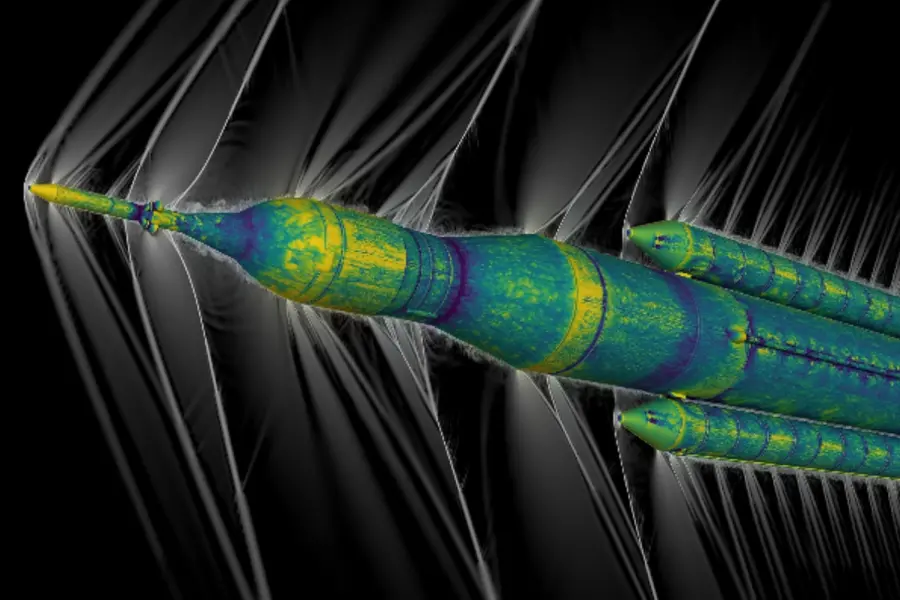
NASA is all set to put its behind-the-scenes tool in the spotlight. For years, some of NASA’s most complex missions, from launching rockets into space to landing spacecraft on Mars, have relied on a powerful but little-known software tool. Now, NASA has made that tool, called Launch Ascent and Vehicle Aerodynamics (LAVA), available to the wider aerospace community.
In simple terms, LAVA helps engineers understand how air moves around rockets, aircraft, and spacecraft. While that may sound straightforward, these airflow patterns can make the difference between a smooth flight and a mission failure.
What exactly does LAVA do?
Whenever a rocket blasts off or a spacecraft re-enters Earth’s atmosphere, it faces extreme conditions like intense heat, pressure, and powerful air currents. LAVA uses advanced computer simulations to predict how these forces will behave.
Think of it like a highly detailed weather forecast, but instead of predicting rain or wind, it predicts how air will flow around a moving object at very high speeds. This allows engineers to test designs virtually, long before anything is physically built or launched.
Big leap in speed
In the past, running such complex simulations could take days or even weeks on powerful computers. LAVA has changed that dramatically. Thanks to modern computing technology, including specialised processors known as GPUs, these simulations can now be completed in just a few hours.
As Jared Duensing, LAVA team lead at NASA’s Ames Research Centre, puts it: “This is not only about releasing software; it is about accelerating innovation.” Faster simulations mean engineers can test more ideas, fix problems quickly, and improve designs at a much faster pace.
One of LAVA’s biggest strengths is its ability to simulate situations that are difficult or nearly impossible to recreate in real life.
For example, when NASA needed to understand how parachutes would open in the thin atmosphere of Mars, it couldn’t simply test this on Earth. Instead, LAVA provided detailed insights into how the parachute would behave, helping ensure a safe landing.
Similarly, the software has been used to study how ice forming on an aircraft wing affects flight performance, something that is critical for aviation safety.
Helping rockets fly safer
LAVA has also played a key role in NASA’s Artemis missions. During the launch of the Space Launch System rocket, the software was used to simulate how powerful exhaust plumes interact with air, water, and the launchpad.
In another example, engineers used LAVA to study airflow around the rocket and identify areas where vibrations could occur. By adding small structures called “strakes” to the rocket, they were able to smooth out these vibrations, improving safety during launch.
Making complex science easier
Traditionally, such advanced simulations required massive computing power and expert-level knowledge. LAVA changes that by making high-quality simulations more accessible, even on smaller systems.
It also allows engineers to use different methods to study airflow, giving them flexibility depending on the problem they are trying to solve. In a way, it turns what used to be a single tool into a complete toolkit for aerospace design.
By releasing LAVA to researchers, companies, and universities, NASA is opening the door for wider innovation. Smaller companies can now design aircraft, drones, or even space vehicles with the same level of precision that was once limited to large organisations.
This could lead to faster development of new technologies, from supersonic passenger aircraft to air taxis and advanced space missions.
All in all, the story of LAVA is not just about software; it is about how technology is changing the way we explore the skies and beyond. By making powerful tools more accessible, NASA is helping a new generation of engineers and innovators push the boundaries of what is possible.
In the end, whether it is a rocket heading to the Moon or a new aircraft taking shape, tools like LAVA ensure that every design is tested, refined, and ready, long before it ever leaves the ground.
Published: 26 Apr 2026, 10:30 am IST
ABOUT THE AUTHOR

Related Topics
Disclaimer: Kindly avoid objectionable, derogatory, unlawful and lewd comments, while responding to reports. Such comments are punishable under cyber laws. Please keep away from personal attacks. The opinions expressed here are the personal opinions of readers and not that of Mathrubhumi.