
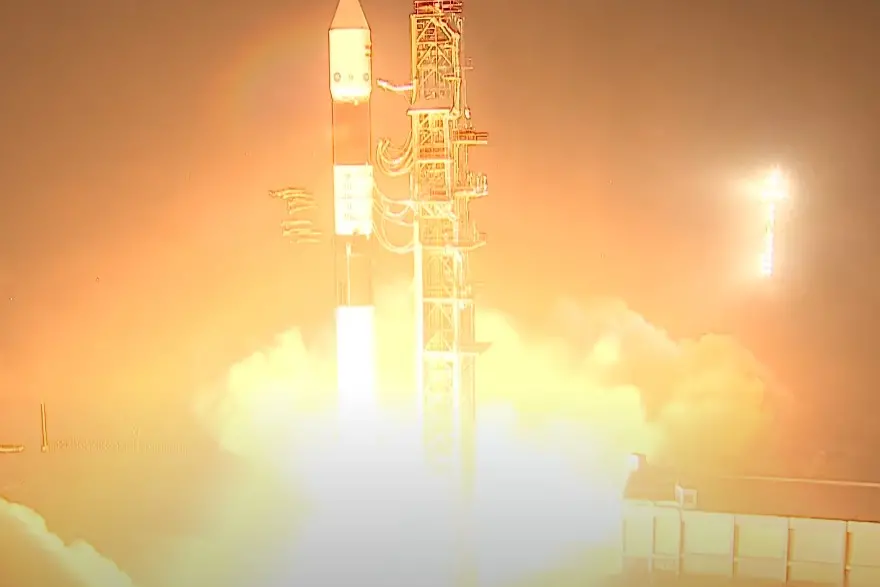
New Delhi: ISRO's PSLV-C60 rocket carrying two spacecraft that would aid in demonstration of space docking, a critical technology for future space missions, lifted off from the spaceport here late on Monday.
Billed as a prelude to ISRO's setting up its own Space Station by 2035, the 44.5 metre tall Polar Satellite Launch Vehicle (PSLV) carried Spacecraft A and B, each weighing 220kg that would help in space docking, satellite servicing and interplanetary missions.
Upon the conclusion of the 25-hour countdown, PSLV-C60 in its 62nd flight lifted-off majestically, emanating thick orange colour fumes, from the first launch pad at this spaceport.
The lift-off was originally planned at 9.58 pm on Monday but ISRO authorities later rescheduled to 10 pm. However, there was no official information behind the reason for the rescheduling.
Preparations have been made to launch the PSLV-C60 rocket. ISRO is ready with all the arrangements. For the 'Spatial' project, which will launch two small spacecraft, ISRO is making all the arrangements to launch the PSLV-C60 rocket from the Sriharikota launch pad.
The "Space Docking Experiment" (SpaDeX) mission will use the PSLV-C60 rocket.
As per the ISRO, the primary objective of the SpaDeX mission is to develop and demonstrate the technology needed for rendezvous, docking, and undocking of two small spacecraft (SDX01, which is the Chaser, and SDX02, the Target, nominally) in a low-Earth circular orbit.
"In addition, SpaDeX, because of its small size and mass, is even more challenging due to the finer precision required for the rendezvous and docking maneuvers compared to docking two large spacecraft. This mission will be a forerunner for autonomous docking needed for future lunar missions like Chandrayaan-4 without the support of GNSS from Earth," ISRO said in a statement.
Like all ISRO satellites in low-Earth orbit, both the SpaDeX spacecraft carry a differential GNSS-based Satellite Positioning System (SPS), which provides PNT (Position, Navigation, and Timing) solutions for the satellites.
"In SpaDeX, a novel RODP processor is included in the SPS receiver, which allows accurate determination of the relative position and velocity of the Chaser and the Target. By subtracting the carrier phase measurements from the same GNSS satellites in both Chaser and Target SPS receivers, highly accurate relative states of the two satellites are determined. The VHF/UHF transceivers in both satellites aid this process by transferring the GNSS satellite measurements from one satellite to the other. Hardware and software test beds, including closed-loop verifications, were carried out to characterise the RODP performance," the statement said.
The SpaDeX spacecraft were designed and realized by the UR Rao Satellite Centre (URSC) with the support of other ISRO centers (VSSC, LPSC, SAC, IISU, and LEOS). The spacecraft, in its orbital phase, will be controlled from ISTRAC using ISRO ground stations and other externally hired ground stations. (ANI)
Published: 30 Dec 2024, 10:01 pm IST
Related Topics
Disclaimer: Kindly avoid objectionable, derogatory, unlawful and lewd comments, while responding to reports. Such comments are punishable under cyber laws. Please keep away from personal attacks. The opinions expressed here are the personal opinions of readers and not that of Mathrubhumi.
