
Explore India`s ambitious Deep Ocean Mission, Samudrayaan project, & MATSYA 6000 submersible. Learn about deep-sea exploration, Blue Economy initiatives, and recent achievements.
India achieved a historic feat recently when two of the country’s aquanauts successfully completed record-breaking deep-sea dives in the Atlantic Ocean. This marked a crucial step in the nation's preparations for its ambitious Samudrayaan mission.
The aquanauts, Cdr (Retd) Jatinder Pal Singh and R Ramesh, went to depths of 5,002 meters and 4,025 meters, respectively, aboard the French submersible Nautile. Their missions on August 4 and 5 set new records for an Indian, with the previous deepest dive of 670 meters also held by Singh. An Indian flag was unfurled alongside a French one during the dives.
The deep-sea training is part of India’s push for the Samudrayaan mission, which aims to send three aquanauts to a depth of 6,000 meters by 2027 in a made-in-India titanium submersible.
Let us deep-dive into India's Deep Ocean Mission
What is the Deep Ocean Mission?
The Deep Ocean Mission is a comprehensive initiative launched by India that focuses on sustainably harnessing ocean wealth and strengthening the Blue Economy. Its primary aim is to develop technologies for exploring and sustainably utilizing the deep ocean’s living and non-living resources. It's designed as a full-throttle national project to drive India's Blue Economy.
When was the Deep Ocean Mission launched and by whom?
The mission was launched on September 7, 2021, by the Ministry of Earth Sciences (MoES).
What are the main objectives of the Deep Ocean Mission?
The mission has several key objectives:
* To sustainably harness ocean wealth and strengthen the Blue Economy.
* To develop technologies for exploring and sustainably utilizing the deep ocean’s living and non-living wealth.
* To contribute to finding oil and gas reserves under the sea as part of the 'Samudra Manthan' vision.
* To provide solutions to global challenges like climate change.
* To tap into ocean resources and boost India's maritime economy to surpass ₹100 billion.
* To unlock vast reserves of minerals, biodiversity, and energy.
* To position India among the few nations with advanced deep-sea exploration technology, fostering indigenous technology, boosting marine-based industries, and creating new opportunities.
How much investment is allocated for this mission?
The Deep Ocean Mission has an overall investment of ₹4077 crore spread across five years, and it will unfold in phases.
What are the key components or initiatives of the Deep Ocean Mission?
The mission is structured around six main components:
* Development of Technologies for Deep Sea Mining, and Manned Submersible: This includes creating a manned submersible and an Integrated Mining System to extract polymetallic nodules.
* Development of Ocean Climate Change Advisory Services: Focusing on studying and forecasting key climate variables to enhance understanding of climate trends and promote coastal tourism.
* Technological innovations for exploration and conservation of deep-sea biodiversity: This involves bio-prospecting deep-sea flora, fauna, and microbes, and researching sustainable use of these resources.
* Deep Ocean Survey and Exploration: Aimed at identifying multi-metal hydrothermal sulphide sites along mid-oceanic ridges and supporting deep-sea resource exploration.
* Energy and freshwater from the Ocean: Proposing studies and engineering design for an offshore Ocean Thermal Energy Conversion (OTEC) powered desalination plant.
* Advanced Marine Station for Ocean Biology: Focused on building talent and innovation in ocean biology and engineering, and turning research into industrial products.
What is the Samudrayaan Project?
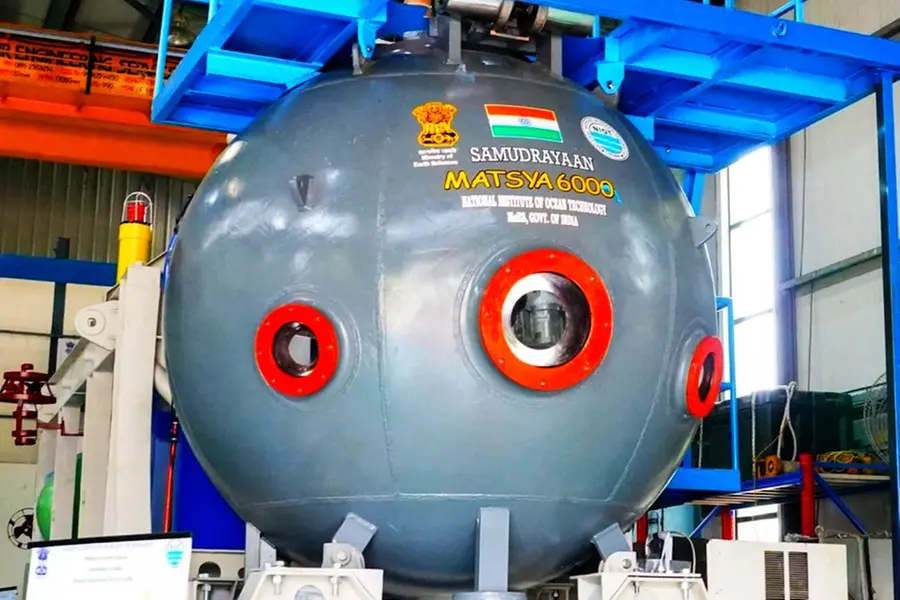
The Samudrayaan Project is a key initiative under the Deep Ocean Mission that focuses on deep-sea exploration through a manned submersible. It involves the development of 'MATSYA 6000'.
What is MATSYA 6000?
MATSYA 6000 is India's first self-propelled manned submersible vehicle. It is designed to transport three individuals to depths of up to 6,000 meters beneath the ocean surface. It is equipped with a comprehensive array of scientific instruments and exploration tools for extensive deep-sea research. The submersible is built to operate for 12 hours and can sustain up to 96 hours in emergency scenarios, featuring advanced safety systems. It is developed through a collaboration between the National Institute of Ocean Technology (NIOT), MoES, and Vikram Sarabhai Space Centre (VSSC), ISRO.
What kind of technology is used in MATSYA 6000's construction?
The vehicle's core is a spherical titanium-alloy vessel (Ti6Al4V - ELI grade), measuring 2260 mm in diameter with an 80 mm wall thickness. It's designed to withstand 600 bar pressure and temperatures as low as -3°C. The titanium vessel was constructed using a special high-penetration Electron Beam Welding (EBW) process, developed by ISRO’s Liquid Propulsion Systems Centre (LPSC) after 700 trials. Its welding quality is tested with advanced Non-Destructive Evaluation (NDE) methods.
What significant progress has India made in deep-sea exploration so far under this mission?
India has made notable strides:
* Over 100 kg of cobalt-rich polymetallic nodules were collected from 1173m depth in the Andaman Sea.
* Indian aquanauts, Cdr. Jatinder Pal Singh and Sh. Raju Ramesh, conducted India's first-ever deep-sea venture up to a depth of 5000m in August 2025. This expedition, aboard IFREMER’s submersible Nautile in the Atlantic Ocean, provided hands-on experience in deep-sea operations.
* The MATSYA 6000 submersible has undergone integrated dry and wet trials. Wet trials assessed its power, control, stability, human support, navigation, and communication systems, and its scientific payloads were tested.
* In December 2022, the Ocean Mineral Explorer (OMe 6000), an autonomous vehicle, explored mineral-rich zones at a depth of 5,271 meters in the Central Indian Ocean Basin, surveying 14 sq. km to assess polymetallic nodule distribution and deep-sea biodiversity.
* Future plans include a shallow water demonstration of MATSYA-6000 by early 2026, deep-water tests by mid-2027, and scientific explorations during 2027–28.
Why is the 'Blue Economy' a focus of the Deep Ocean Mission?
The Deep Ocean Mission directly aims to strengthen India's Blue Economy, which encompasses all marine-based industries, including fishing, shipping, biotechnology, and tourism. The government has placed the Blue Economy among the ten core growth dimensions in the Vision of New India by 2030, recognizing India's unique geographical advantage with its extensive coastline and islands. The mission seeks to boost India's maritime economy to surpass Rs 100 billion by turning deep-sea potential into sustainable prosperity.
Published: 18 Aug 2025, 12:54 pm IST
Related Topics
Disclaimer: Kindly avoid objectionable, derogatory, unlawful and lewd comments, while responding to reports. Such comments are punishable under cyber laws. Please keep away from personal attacks. The opinions expressed here are the personal opinions of readers and not that of Mathrubhumi.
