
Cape Canaveral: After years of delays, Boeing's Starliner capsule is set to ferry astronauts to the International Space Station (ISS) Monday, a milestone for the US aerospace giant and NASA.
The flight, a final test before Starliner takes up regular service for the space agency, is critical for Boeing, whose reputation has suffered of late due to safety issues with its passenger jets.
For NASA, the stakes are also high: Having a second option for human space flight in addition to SpaceX's Dragon vehicles is "really important," said Dana Weigel, manager of the agency's International Space Station program.
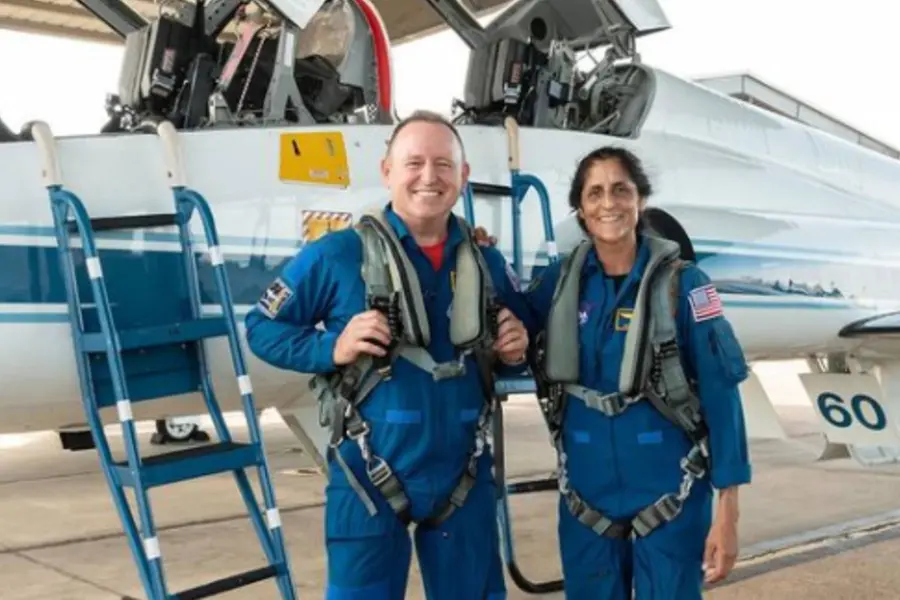
Astronauts Butch Wilmore and Sunita Williams are set to take off from Cape Canaveral at 10:34 pm Monday (0234 GMT Tuesday), if favorable weather predicted for the launch continues to hold.
Starliner will be propelled into orbit by an Atlas V rocket made by United Launch Alliance, a Boeing-Lockheed Martin joint venture.
Once in space, one of Wilmore and Williams's tasks will be to temporarily pilot the craft manually, in a test.
The astronauts, both Navy-trained space program veterans, have each been to the ISS twice, traveling once on a shuttle and then aboard a Russian Soyuz vessel.
"It's going to be like going back home," Williams said ahead of the launch.
As for the Boeing spacecraft, Wilmore said: "Everything is new."
Starliner is scheduled to arrive at the ISS at about 0500 GMT Wednesday, and remain there for a little over a week. Tests will be performed to check it is working properly, and then Williams and Wilmore will reboard the capsule to return home.
A successful mission would help dispel the bitter taste left by the numerous setbacks in the Starliner program.
In 2019, during a first uncrewed test flight, the capsule was not placed on the right trajectory and returned without reaching the ISS.
Then in 2021, with the rocket on the launchpad for a new flight, blocked valves forced another postponement.
The empty vessel finally reached the ISS in May 2022. But problems since then have delayed Monday's crewed test flight, necessary for the capsule to be certified for NASA's use on regular ISS missions.
NASA associate administrator Jim Free had predicted the mission would not be hiccup-free.
"We certainly have some unknowns in this mission, things we expect to learn, being a test mission. We may encounter things we don't expect," Free said, noting that Starliner is just the sixth US-built class of vessel for NASA astronauts.
SpaceX's Dragon capsule joined that exclusive club in 2020, following the Mercury, Gemini, Apollo and space shuttle programs.
In 2014, the agency awarded fixed-price contracts of $4.2 billion to Boeing and $2.6 billion to SpaceX to develop the capsules.
Once Starliner is fully operational, NASA hopes to alternate between SpaceX and Boeing vessels to ferry astronauts to the ISS.
Even though the ISS is due to be mothballed in 2030, both Starliner and Dragon could be used to taxi humans to future private space stations, which several companies are planning to build.
Sunita Williams to fly to space again
Indian-origin astronaut Captain Sunita Williams and her fellow veteran NASA astronaut Butch Wilmore are set to fly to the International Space Station (ISS) on a brand new spacecraft, the Boeing Starliner on Monday.
The duo will launch into space from the Cape Canaveral Space Force Station, Florida in the first crewed test flight of Starliner. The flight, if it succeeds, will become the second private firm being able to provide crew transport to and from the ISS.
The launch is scheduled to take place on 10:34 p.m. EDT Monday, May 6, ie May 7 at 8.04 am Indian Standard Time.
Boeing's competitor Elon Musk's SpaceX was able to fly its crew flight test in the year 2020. It has sent 12 crewed missions to the ISS since 2020. After a botched attempt in December 2019, Starliner made a successful second uncrewed test flight in May 2022.
Williams, 59, a retired US Navy captain and Wilmore will pilot the flight, which Boeing is calling its Crew Flight Test (CFT) and that will be docked with the ISS for about a week. The Starliner flight to the ISS is expected to last about 26 hours, and the two astronauts will live and work on the ISS for 8 days before undocking and returning to Earth on May 15.
During the test flight, the astronaut duo will take the Starliner through a series of tests before NASA certifies it to be fit to fly to space on rotational missions to the ISS under the US space agency's Commercial Crew Program.
Unlike previous US capsules that splashed down in the sea on returning to Earth, the Starliner will touch down on land at a site somewhere in the western part of the United States, NASA said.
Both the astronoauts will be launching on a United Launch Alliance's Atlas V rocket to the International Space Station.
Williams and Wilmore were both former commanders of the International Space Station.
Williams, from Needham, Massachusetts, earned a physical science degree from the US Naval Academy, and a master's in engineering management from the Florida Institute of Technology. Her first spaceflight was Expedition 14/15 (from December 2006 to June 2007) launching on space shuttle Discovery's STS-116 mission to reach the International Station, according to NASA.
While onboard, Williams established a world record for women at the time with four spacewalks. She concluded her tour of duty by returning to Earth with shuttle Atlantis' STS-117 flight to land at Edwards Air Force Base in California on June 22, 2007.Selected as an astronaut by NASA in June 1998, Williams has spent a total of 322 days in space on two missions and accumulated 50 hours and 40 minutes of cumulative EVA time on seven spacewalks.
Williams worked with Roscosmos on its contribution to the space station and with the first Expedition crew.
Meanwhile, 61-year-old, Wilmore has logged 178 days in space and has 25 hours and 36 minutes of time on four spacewalks.
Boeing has planned six manned missions for the platform over the next six years, the projected end of the ISS' operating lifespan.
NASA plans to use both SpaceX's Dragon and Boeing's Starliner to send up astronauts at least every six months from US soil. Both Boeing and SpaceX were given the responsibility in 2014 by NASA to send commercial crew missions to the ISS.
Boeing received over USD 4 billion in US federal funds to develop the Starliner, while SpaceX received about USD 2.6 billion.
Meanwhile, India has its own human spaceflight program, the Gaganyaan led by the Indian Space Research Organisation (ISRO). It envisages demonstration of human spaceflight capability by launching crew of 3 members to an orbit of 400 km for a 3 days mission and bring them back safely to earth, by landing in Indian sea waters.
Earlier in February this year, Prime Minister Narendra Modi announced the names of the four astronauts who will be part of Gaganyaan, slated to be launched in 2024-25.
The four chosen Indian Air Force pilots - Group Captain Prashanth Nair, Group Captain Ajit Krishnan, Group Captain Angad Pratap, and Wing Commander Shubhanshu Shukla- were trained at Yuri Gagarin Cosmonaut Training Center in Russia. (Agencies)
Published: 06 May 2024, 12:57 pm IST
Disclaimer: Kindly avoid objectionable, derogatory, unlawful and lewd comments, while responding to reports. Such comments are punishable under cyber laws. Please keep away from personal attacks. The opinions expressed here are the personal opinions of readers and not that of Mathrubhumi.
