
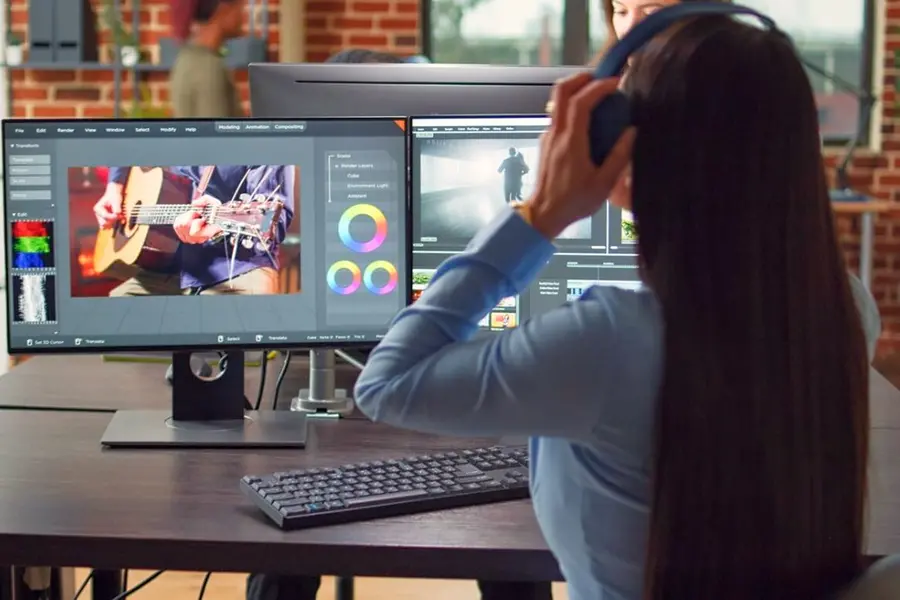
Artificial Intelligence (AI) is transforming the world of video editing in 2025 to make it faster, easier, and more accessible than ever before. This technological shift opens doors for both beginners and professionals, changing the way videos are created and edited. Joining video clips is now much more streamlined, but achieving true perfection is something that still requires human expertise, while AI delivers good results. An artistic director's view and creativity would still be essential because the final result should tell a story compellingly and visually appealing.
Modern video editing platforms, such as Adobe Premiere Pro and Final Cut Pro, have become AI-friendly just to keep their relevance in a changing world. They now boast features that take away the bother of doing things, such as extracting backgrounds and chroma keying which were previously intricate and time-consuming. These save both time and energy, as editing can then go into creative, intuitive storytelling.
Plugins have continued to evolve, even further refining and enhancing these products, and a new generation of more intuitive and user-friendly AI has emerged in recent years to offer video editing options. Canva, Kapwing, and Runway are suites designed to make editing and content creation as seamless as possible. They are perfect for users who are in a hurry for quick results without the need for extensive technical skills. Descript innovates by working on altering the video based on what the script demands. This allows video editing to be as effortless as text, bringing words and images together in a manner not previously thought of.
Wondershare Filmora is another very accessible tool using AI to facilitate the most difficult editing processes. Capsule streamlines video production workflows, ensuring teams can more easily collaborate on perfect videos. Fliki is a special tool for creators of social media that helps to produce the best content, specifically for each different platform. Peech serves the content marketing team, and through the use of such a service, they are able to produce videos which attract their audience. Synthesia uses digital avatars to produce high-quality professional videos in a matter of minutes. Therefore, AI gives new possibilities for businesses and people.
AI also changed the face of animation and visual effects production. Tools like Vyond can create animated character videos using simple text prompts, and with Visla, a script can easily be turned into a fully realised video. InVideo is an easy-to-use platform that supports AI-driven video creation in multiple formats, allowing the creator to tailor their content for different audiences and purposes. Clipchamp, the Microsoft application, is unique because it uses its AI-powered tool for text-to-speech. This feature adds a new dimension to video narration and accessibility with more than 400 voice styles available.
The advancements in AI are not only limited to editing tasks. Animation, stop motion, and visual effects have become much easier to develop, thus democratizing access to these techniques. Creators who once needed specialized skills or expensive software can now produce high-quality visuals with minimal effort. This has led to a surge in creativity and experimentation, as more people are empowered to bring their ideas to life.
Although these are significant breakthroughs, some arguments regarding creativity affected by AI have emerged. Critics argue that high reliance on automation will only lead to a decrease in originality and the input of human creativity, while reality has proven that AI is not removing creativity but transforming it. AI takes over the monotonous redundant actions that it deems time-wasting, which provides creators with ample time to spend on the artistic aspects of a project. This collaboration between human ingenuity and machine efficiency ensures that the final product is both innovative and high-quality.
For instance, a video editor working on a promotional campaign might use AI tools to quickly assemble footage, apply basic edits, and generate a draft. This frees up time to refine the visual storytelling, experiment with different styles, and ensure that the message resonates with the intended audience. The result is a more polished and impactful video, achieved in less time than traditional methods would allow.
AI has also made it easier for small businesses and independent creators to compete with larger organizations. The availability of affordable and user-friendly tools means that high-quality video content is no longer limited to those with extensive resources. This democratization of video production has levelled the playing field, enabling a wider range of voices to be heard.
Video editing with AI will surely continue to be expanded with future development. For example, future development could come in the form of even more advanced personalisation options, real-time collaboration features, and deep integration with other creative tools. The possibilities are endless, and the potential for innovation is immense.
AI in 2025 is no longer a video editing tool but a creative partner. It empowers the creator to push the boundaries of imagination, explore new ideas, and deliver content that is both visually stunning and emotionally engaging. Embracing such advancements, video editing is now entering a new era where technology and creativity come together to create something extraordinary.
The author of this feature is Dean of Mathrubhumi Media School in Kochi, Kerala
Published: 07 Jan 2025, 09:26 am IST
Related Topics
Disclaimer: Kindly avoid objectionable, derogatory, unlawful and lewd comments, while responding to reports. Such comments are punishable under cyber laws. Please keep away from personal attacks. The opinions expressed here are the personal opinions of readers and not that of Mathrubhumi.
