
While Alonso remains publicly optimistic, the team faces a massive task to recover and challenge for titles. Honda is investigating the issues, and Aston Martin plans upgrades for the Australian Grand Prix, though a full resolution is uncertain.
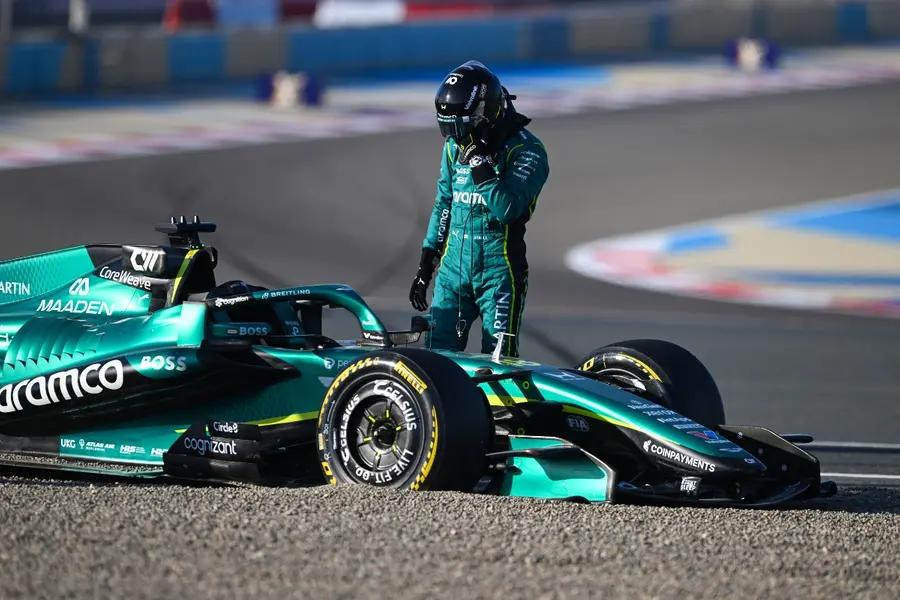
In what was billed as the dawn of a new era, Aston Martin's exclusive partnership with Honda has instead opened with a full-blown crisis, as the AMR26 endured a nightmare pre-season in Bahrain marked by the least mileage and among the slowest times of any 2026 car.
The troubles have not only exposed serious flaws in Honda’s new power unit but also cast doubt on whether Fernando Alonso can realistically mount a title challenge in what may be the final stretch of his storied Formula 1 career.
Honda Power Unit Meltdown
Across three days of official testing at Sakhir, Aston Martin's running was repeatedly curtailed by Honda power unit issues, headlined by a major battery-related failure that halted Alonso's race simulation on the second day. Day one saw the Spaniard limited to around 28 laps by a power unit-related stoppage during gearbox work, while teammate Lance Stroll completed only a modest number of laps as the team focused on simply understanding the new package.
Honda later confirmed that safety systems had triggered a shutdown after detecting abnormal parameters in the energy store, and with spare batteries in short supply, Aston Martin’s programme was effectively crippled. The situation deteriorated to the point where, by the final test day, Stroll was able to complete only six laps before the team ended running early, citing a lack of critical components and the need to protect what remained of the power unit pool.
ALSO READ: Why 2026 power unit reset has the paddock in meltdown
Underpowered And Off the Pace
The crisis has not been confined to reliability. Honda executives are understood to be “not happy” with their own performance, as the new unit has been significantly down on power and energy recovery compared with rival manufacturers.
Reports from within the paddock suggest the Honda hybrid system has struggled to recover energy even at the lower regulatory benchmark of 250kW, let alone approach the 350kW deployment levels teams target for peak performance.
This shortfall has translated into eye-catching deficits on the straights, with Aston Martin believed to be over 30km/h slower than front-running cars at the Bahrain test speed traps, leaving Alonso and Stroll vulnerable and masking the true potential of Adrian Newey's first Aston Martin chassis.
Combined with frequent de-rating -- where the car loses electrical boost well before the end of the straights -- engineers have struggled to draw meaningful conclusions about the AMR26’s aerodynamics or race pace.
ALSO READ: Looking back at the F1 team that punched above its weight
Newey's Stark Assessment
Behind closed doors, Aston Martin's chief technical officer is reported to have laid bare the scale of the problem during a recent F1 Commission meeting. According to those briefed on the discussions, Newey described Honda's power unit situation as "shockingly poor", highlighting both inadequate energy recovery and a chronic lack of usable power that fundamentally compromises the car's competitiveness.
He is also understood to have raised concerns about integration issues between Aston Martin’s in-house gearbox and the Honda unit, which contributed to erratic behaviour on track and further undermined driver confidence.
With only one fully functional battery reportedly available by the final day of testing, Newey's technical assessment underscored that this is not a marginal deficit but a structural crisis that will require urgent and substantial remediation.
Alonso: Frustrated But Publicly Optimistic
Fernando Alonso, who joined Aston Martin in pursuit of a final shot at a world championship, has tried to maintain a front of measured optimism in public despite the grim testing picture.
The two-time champion acknowledged that "many things" need to be fixed after his running was repeatedly interrupted by Honda-related stoppages, but insisted that "everything can be fixed" in the short to medium term.
Alonso has framed the team's approach as one of "walking before we run", warning that Aston Martin is "not where we want to be" while still expressing faith in the combined efforts of the Silverstone factory and Honda's Sakura operation to turn the situation around before the season-opening Australian Grand Prix.
However, parallel reports now suggest he is "very likely" to consider retirement at the end of 2026 if the project fails to progress, adding a personal edge to the urgency of the recovery.
ALSO READ: Red Bull’s secret weapon? How Verstappen’s 1st-gear trick is winning 2026 engine war
Aston Martin And Honda's Planned Response
In response to the Bahrain debacle, Honda has launched an intensive investigation at its HRC Sakura facility, running the specification power unit on dynos in an effort to reproduce and resolve the battery and energy recovery failures seen on track.
Engineers are working to refine control software, recalibrate safety thresholds, and address hardware weaknesses that triggered automatic shutdowns during Alonso's race run.
Aston Martin, meanwhile, has shifted to a conservative test philosophy, using short stints separated by long data-analysis windows to limit mileage while parts remain scarce.
An upgrade package is planned for the Australian Grand Prix, including new components and an aero evolution of the AMR26, though sources caution this is not expected to fully resolve the fundamental power unit issues witnessed in Bahrain.
With no major additional track testing available, much of the early-season rescue effort will rely on simulation and correlation work between Honda and Aston Martin's technical groups.
Title Ambitions Under Threat
For a project that was marketed as a fully integrated works partnership designed to propel Aston Martin into championship contention under the 2026 regulations, the opening act has been bruising. Instead of talking about victories and titles, the team's short-term objectives have been reduced to simply achieving reliable race distances and clawing back a severe straight-line speed deficit.
Alonso's faith, Newey's reputation, and Aston Martin's ambitious long-term plan now hinge on how quickly Honda can transform a troubled power unit into a competitive one. Until that happens, the AMR26 remains less a title challenger and more a high-profile case study in how fragile modern F1 projects can be when the engine and hybrid package miss the mark.
Published: 24 Feb 2026, 03:03 pm IST
Related Topics
Disclaimer: Kindly avoid objectionable, derogatory, unlawful and lewd comments, while responding to reports. Such comments are punishable under cyber laws. Please keep away from personal attacks. The opinions expressed here are the personal opinions of readers and not that of Mathrubhumi.
