

The tournament had its first from French man Lucien Laurent scoring the first ever goal in the tournament, incidentally against Mexico.
Football’s spectacular FIFA World Cup journey began in 1930 dotted with outstanding performances from players in each era and the journey continues. Back in 1930 when Uruguay got the honour of hosting the inaugural edition, the sport was already on an exciting note in Latin America. As it happened, Uruguay, which had become the Olympic champion, went on to capture the Jules Rimet trophy and expectedly the Estadio Parque Central stadium in Montevideo erupted providing a kind of scene which was to get repeated in different ways at each World cup finale since. The tournament had its first from French man Lucien Laurent scoring the first ever goal in the tournament, incidentally against Mexico. The American Bert Paternaude had the distinction of striking the first hat trick, against Paraguay, though the feat was not acknowledged then but decades later, years after his death in 1974! Much evidence was needed to prove that he indeed had scored all the three goals in the match! Those were the days.
Talk of the inaugural world cup and the first name that always come to mind to football followers was the Uruguayan captain Jose Nasazzi, who anchored his team’s defence and eventually was recognised as the tournament’s stand out player. He became the first captain in the World Cup to lead his team to title-win. Argentina’s Guillermo Stabile came into focus for his scoring ability as the matches began. With eight goals in four matches, he had won the Golden Boot award. Called the ‘infiltrator’ for his scoring skills, Stabile did not take long to win the fans’ appreciation back home but still it took time for him to get into the national team. Such was Argentina’s football strength then. And when he made it to the national team for the World Cup, he was not even sure of a place in the starting eleven in an era when substitutions did not exist. His success in Uruguay was remarkable and marked the beginning of a great career with Argentina.
Four years later in Italy, the elegant attacker Giuseppe Meazza provided the home team with its first cup with his goals. He was widely considered one of the greatest players of his era and had helped his country to the Cup win in 1938 too. In 1934 he won the Golden Boot award as the best player. In the next edition held in France, Meazza was again in the centre of action as the captain now. He helped his team past Brazil in the semi-final and then in the final against Hungary, even though he did not score, he was there to provide three assists that helped Italy win again, back to back World cup triumph. Silvio Piola and Giovanni Ferari were two others, both Italians, who had shot to fame. Piola was a perfect finisher and had scored two in the final against Hungary in 1938 while Ferrari earned a reputation for being a creative midfielder and playmaker. Ferrari is among the few players in history to have featured in two consecutive World cup triumphs.
Another popular name of that era was Leonidas da Silva, called the Brazilian ‘black diamond’. His best had come in the 1938 edition when he was the top scorer. The diamond had been found and the world of football had to wait for some years for another classic player to set the football field on fire by his radiance and brilliance. Yes, none other than Pele, the nickname for Edson Arantes do Nascimento! The intervening World War put a stop to football until the next edition came on stage 12 years later in 1950. The world had to wait for another eight years for a phenomenon to take the stage and mesmerize football lovers and opponents on the field.
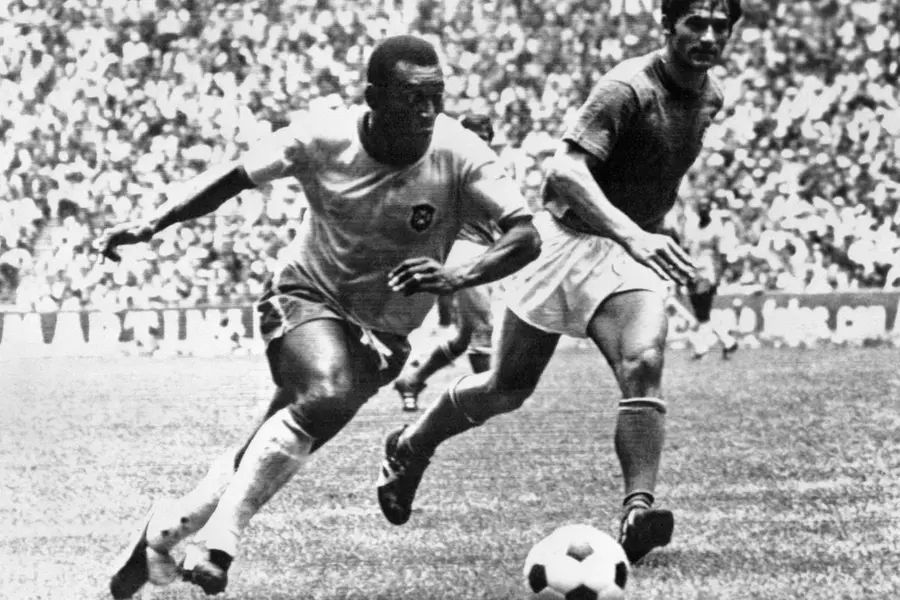
The 1958 edition was in Sweden. Seventeen-year-old Pele was the talk of the town and the to-be Brazilian-great ensured that his skills did not go waste as he helped his country to its first triumph. His deft scoring ability came into full view. A hat trick in the semi-final against France and two more in the final against host Sweden not only boosted his image but put Brazilian football skills onto a special plane. One of his goals in the final, a volley over a defender after chesting the ball, is considered one of the greatest goals in world cup history. Brazil and football excellence became synonymous. In fact following his grand debut, the Brazilian government did not lose time in declaring Pele as a ‘national treasure’. Featuring in three World Cup wins for Brazil in 1958, 62 and 70, Pele became a global face of the sport.
While Pele was the focus for some time in international football, the sport continued to bring forth maestros in each era like Franz Beckenbauer, the West German, who led his country to title-win in 1974. Der Kaiser as he was called was credited with the introduction of the sweeper role in modern day football. Post his playing days, Beckenbauer took up coaching the German team and what is more, guided the side to a Cup win in 1990 to earn the distinction of winning the Cup both as a player and a coach. The Dutch player Johan Cruyff was another to catch the eye in the seventies. The brain behind the ‘total football’ concept, he had helped his country finish runner up in 1974 while also winning the Golden Boot award for being the best player.
The world had to wait until the eighties, in 1986 to see another legend rise in the sport by name Diego Maradona. The Argentine led his country to World Cup triumph but it was the two goals against England in the quarterfinal that immortalised him. One is now famously called the ‘Hand of God’ goal, a touch controversial but his second was considered the goal of the century. Indeed the 1986 edition signalled the pinnacle of Maradona’s career but what made him a global icon was his genius, his ball control and passing. Yet for all this his association with drugs led to his face-losing downfalls. In the 1994 edition, he was trooped out from the competition after testing positive. But football lovers the world over will forgive him for that because he had given the sport the kind of spectacle that was simply outstanding.
On to the current times and the titans among the very many outstanding players include the Brazilian Ronaldo, considered a striker non pareil at one time. Scoring 15 world cup goals and having featured in the 2002 Brazilian success, the country’s last win till date, Ronaldo had a special place in football history. On to Lionel Messi and Cristiano Ronaldo, the modern day heroes. Both are set for a record sixth World Cup appearance. Indeed the 2026 edition should leave a lasting show for these Argentine and Portuguese greats, even as we look ahead for fresh masters to take the stage and rock, so to say.
Published: 09 Jun 2026, 10:34 am IST
ABOUT THE AUTHOR
Related Topics
Disclaimer: Kindly avoid objectionable, derogatory, unlawful and lewd comments, while responding to reports. Such comments are punishable under cyber laws. Please keep away from personal attacks. The opinions expressed here are the personal opinions of readers and not that of Mathrubhumi.