
The two-time T20 world champions in blue were listless in all facets of the format throughout the bilateral series.
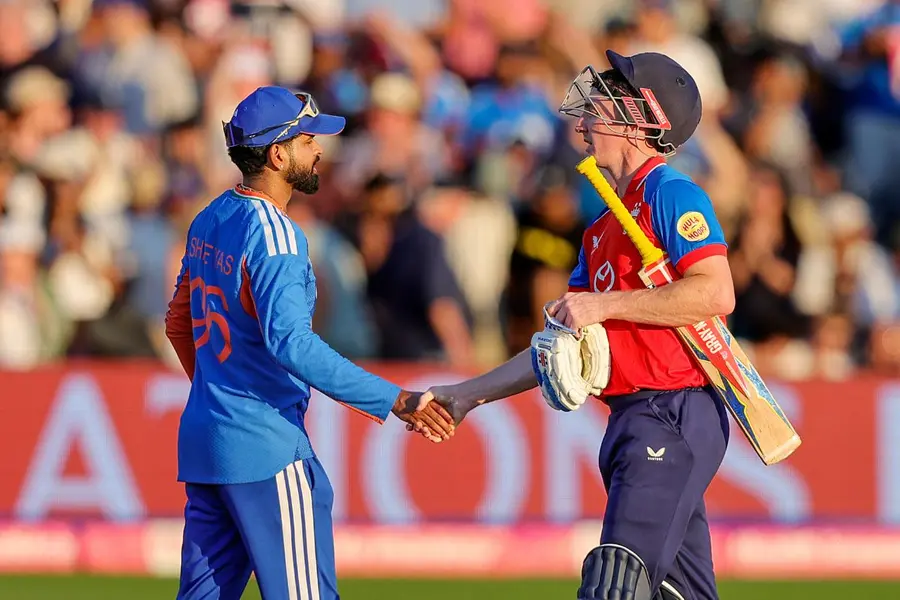
England has emphatically dismantled Twenty20 cricket's traditional powerhouse, delivering India a sobering reality check as it begins the two-year task of building a team capable of reclaiming the T20 World Cup.
The two-time T20 world champions in blue were listless in all facets of the format throughout the bilateral series. The misery culminated on Saturday in Southampton during the final game, where England sealed a dominant 4-0 series victory after India conceded over 250 runs for the first time in T20 history.
Key takeaways from the series
-
Total Domination: Harry Brook’s England side completely neutralized India's proven Indian Premier League (IPL) big hitters, including Abhishek Sharma, Ishan Kishan, and newly crowned captain Shreyas Iyer.
-
Prodigy Grounded: The selectors’ ambitious road map to hand 15-year-old prodigy Vaibhav Sooryavanshi his international debut after a bumper IPL season backfired big time. The young left-hander was bounced out twice by his Rajasthan Royals teammate Jofra Archer, managing a combined total of just 42 runs across three appearances.
-
Unwanted History: The aftermath of the series whitewash leaves India with several brutal new records:
-
They had never previously lost six consecutive T20 international games.
-
A historic 16-series unbeaten streak was decisively snapped.
-
It marks the first time India has ever been blanked by England in a bilateral series featuring more than two matches.
-
Also read: Jos Buttler's 131 seals England's dominant 4-0 T20I whitewash of India
Structural vulnerabilities & missing stars
The glaring shortcomings of this experimental Indian squad were exposed well before landing in England. Stripped of veteran stars like Jasprit Bumrah, Hardik Pandya, and axed World Cup-winning captain Suryakumar Yadav, India suffered a shocking 2-0 series defeat away against Ireland.
The selectors also chose to leave out Gujarat Titans skipper Shubman Gill, though his absence means he could now heavily come into the reckoning as India shifts its focus toward the next T20 World Cup in Australia and New Zealand.
Throughout the four games against England, India's top three openers struggled to find any rhythm, while a chaotic middle-order suffered from a total lack of clarity due to constant shuffling between positions five through eight. Prolific Asian-conditions performer Tilak Varma was a lone bright spot of sorts, scraping together 104 runs across the series, which included a fighting half-century in the final match.
The coaching staff's verdict
Following the fourth game at Bristol, India assistant coach Ryan ten Doeschate offered a candid assessment of the squad's inability to adjust to challenging English conditions:
“I guess we have spoken so much about adaptability, but I think it’s got to the point now where you actually have to unpack that suitcase,” India assistant coach Ryan ten Doeschate had said after India lost the fourth game at Bristol.
“It’s easy to say we need to adapt. We need to assess and adapt. Every coach from under-nine cricket says that about every department of the game. It’s got to a point now where we actually have to really unpack what that means and understand the process that’s needed to be able to make those adaptations, so to speak.”
The batting coach echoed these concerns, emphasizing that India must accept it is drastically underachieving outside of home comforts and desperately needs a mental shift to survive on the global stage:
“Do we want to be a team that smashes 250 in India and looks great when you hit 80-meter sixes at Eden Gardens? Or do we want to come to places like this and places like Manchester and places like Southampton where things are slightly different?
“And again, thinking further down the line, the MCG and those sort of places, do we want to be the team that actually excels in different conditions and do we have the mentality to make those adjustments? And that’s the mental challenge and that’s (what) we need the players to be able to take on.” (PTI)
Published: 12 Jul 2026, 08:04 am IST
Disclaimer: Kindly avoid objectionable, derogatory, unlawful and lewd comments, while responding to reports. Such comments are punishable under cyber laws. Please keep away from personal attacks. The opinions expressed here are the personal opinions of readers and not that of Mathrubhumi.
