
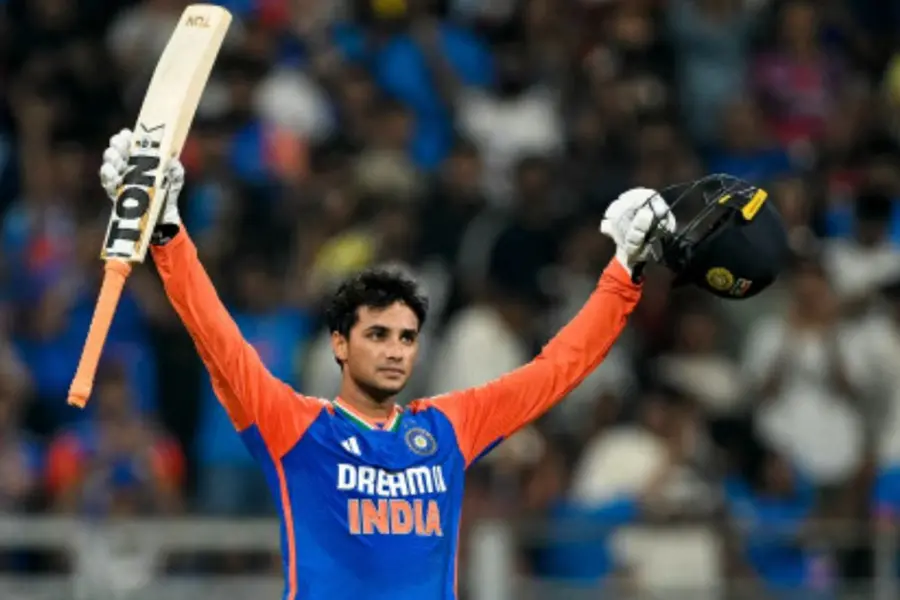
Abhishek Sharma produced one of the most scintillating T20I performances in recent memory, unleashing a display of sheer power hitting that left the England bowlers powerless in the fifth and final T20I at Wankhede Stadium in Mumbai. The left-handed batter delivered a fiery knock that not only propelled India to a dominant total but also etched his name in the record books with a century off just 37 balls, sending a clear message of his burgeoning talent and fearless approach to the game.
Sharma's audacious assault on the English attack began right from the word go, with the 22-year-old taking full advantage of the powerplay overs. Asked to bat by England captain Jos Buttler after winning the toss, India was off to a blistering start, thanks in large part to Sharma's boundary-hitting spree. As the ball flew off his bat with unrelenting force, it quickly became evident that this was going to be a memorable evening for the young opener.

A Century in Just 37 Balls: Breaking Records
With an innings full of elegant yet destructive strokes, Sharma reached his century in just 37 balls, becoming the second-fastest Indian to achieve the feat in T20 internationals. His rapid hundred surpassed the previous record set by Sanju Samson, who had scored 100 off 40 balls against Bangladesh. The record for the fastest century in T20Is for India still belongs to Rohit Sharma, who made a century off 35 balls against Sri Lanka in 2017.
Sharma’s explosive knock was a testament to his aggressive approach, using the powerplay overs to full advantage. With each boundary, he seemingly gained confidence, timing the ball perfectly and dealing with both pace and spin with equal finesse. The England bowlers, led by Jofra Archer, were left reeling as Sharma dictated the terms of the game. His innings included a series of boundaries and maximums, with Archer in particular bearing the brunt of his attack.
In addition to his blistering century, Sharma also recorded the second-fastest fifty for an Indian player in T20 internationals. His 50 came off just 18 balls, surpassing KL Rahul, who had previously held the record with a 50 from 18 balls against Scotland in Dubai. Sharma’s blistering start and ability to find the boundary consistently were critical to India’s soaring run rate.
The Record Books: Sharma’s Impressive T20I Milestones
In a remarkable series of feats, Sharma’s innings not only placed him in the record books for his century but also marked a string of rapid milestones. He became the fastest Indian to score a fifty in T20Is, surpassing the mark previously set by KL Rahul. This now leaves Yuvraj Singh’s iconic 12-ball half-century from the inaugural T20 World Cup as the fastest ever for an Indian, though Sharma’s 18-ball fifty firmly positions him in the league of modern-day power hitters.
Sharma’s extraordinary performance at Wankhede was also a reminder of the importance of the middle-order batsman who can take control and provide momentum, especially in T20 cricket. His ability to shift gears so effortlessly, from initially finding his rhythm to blasting England’s bowlers into all corners of the ground, was a key highlight of the evening.
Sanju Samson’s Early Departure and Sharma’s Resilience
Despite Sharma’s heroics, the evening wasn’t without its setbacks. Sanju Samson, who had been looking to make a statement after a series of disappointing dismissals in the previous matches, fell early for 16. His innings began with a six off the very first ball, pulling a short delivery from Jofra Archer into the stands. However, his brief cameo ended when he was caught in the deep off the bowling of Mark Wood. This pattern of early dismissals has been a recurring theme for Samson throughout the series, with all five of his dismissals coming in a similar fashion.
Samson’s early exit might have rattled India momentarily, but Sharma’s brilliance ensured there was no further momentum lost. He took charge of the game, leaving England’s bowlers scrambling for answers as the runs flowed freely from his bat.
England's Bowling Struggles and the Impact of Archer and Wood
England, who had already lost the series, were hoping to end the tour on a high, but Abhishek Sharma had other plans. The pace attack, led by Jofra Archer and Mark Wood, who had been brought in as part of a tactical change to replace Saqib Mahood, was unable to contain the onslaught. Archer, known for his pace and bounce, was often dispatched to the boundary by Sharma, while Wood’s pace was also negated by the Indian batter’s precision and power.
Throughout the series, Sharma had faced a total of 32 balls from Jofra Archer, amassing a staggering 60 runs at an impressive strike rate of 187.4. His fearless approach, particularly against the extreme pace of Archer and Wood, was a hallmark of his innings. Sharma’s willingness to charge down the track and meet the pace head-on left the English bowlers scratching their heads, unable to stop the onslaught.
Strategic Changes and Team Adjustments
England made one change to their lineup for the final match, with Mark Wood coming in for Saqib Mahood. India also made a tactical change, replacing Arshdeep Singh with Mohammed Shami in their bowling attack. Despite the fresh personnel, neither team could influence the outcome of the match, with India already having clinched the series with an unassailable lead. The fifth T20I, in essence, was a dead rubber, but it proved to be a thrilling spectacle for the crowd, thanks to Sharma’s breathtaking performance.
The Bigger Picture: India’s Dominance and Sharma’s Promise
While India had already sealed the series before the final match, Sharma’s performance on the day underlined India’s dominance in the T20 format. With a mix of experienced players and exciting young talent, the Indian team’s depth is becoming increasingly evident, and players like Sharma are poised to play key roles in the future.
Abhishek Sharma, who has been a revelation in this series, continues to show immense promise as a power-hitting middle-order batter. His aggressive intent and ability to take on the best of bowlers make him a valuable asset for India, particularly in the T20 format. As his career progresses, it’s clear that Sharma’s raw power and technical prowess will make him one of the most exciting players to watch in international cricket.
Looking Ahead: Sharma’s Role in Future Tournaments
With this explosive knock in Mumbai, Abhishek Sharma has staked his claim as one of the rising stars in Indian cricket. His ability to dominate the bowlers in the powerplay, along with his consistent striking ability, will surely make him a key figure in India’s T20 lineup moving forward. As India gears up for more international tournaments and series, Sharma’s explosive performances will only add to his growing reputation.
The Mumbai T20I will go down as a memorable match in Sharma’s young career, but it also serves as a reminder of the exciting future Indian cricket fans can expect with this talented player in their ranks. With the Indian team looking ahead to new challenges, Sharma’s fearless approach will no doubt be an asset for years to come.
Published: 02 Feb 2025, 08:18 pm IST
Disclaimer: Kindly avoid objectionable, derogatory, unlawful and lewd comments, while responding to reports. Such comments are punishable under cyber laws. Please keep away from personal attacks. The opinions expressed here are the personal opinions of readers and not that of Mathrubhumi.