
Despite replays suggesting the ball touched the grass while Holder braced himself, the third umpire upheld the dismissal, citing sufficient control.
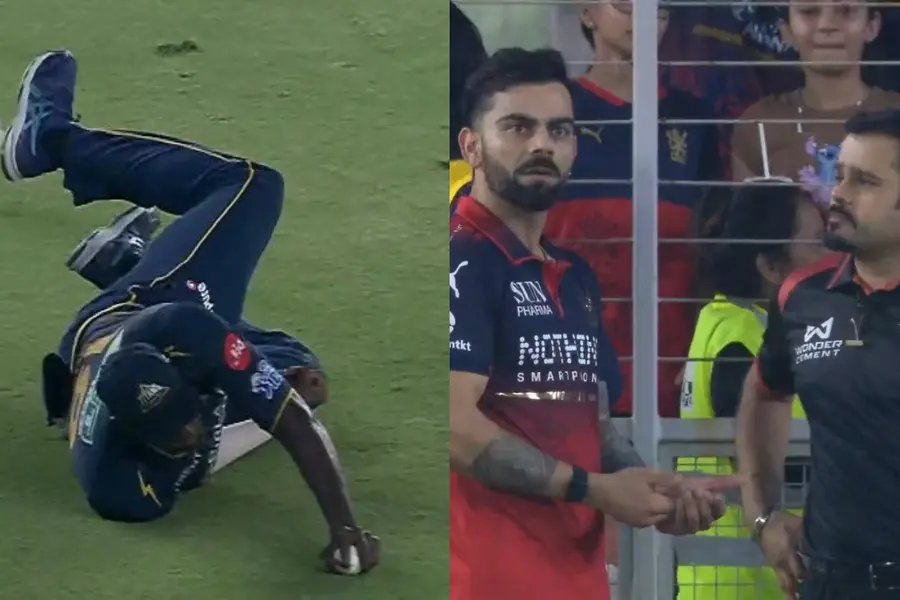
Ahmedabad: A contentious catch by Gujarat Titans fielder Jason Holder during Thursday’s fixture against Royal Challengers Bengaluru has reignited the debate surrounding the "clean catch" law, as the RCB camp and several critics questioned the validity of Rajat Patidar’s dismissal.
The incident occurred in the eighth over when Holder sprinted across the turf to intercept a strike from Patidar. While the initial catch appeared secure, video replays indicated that the ball may have made contact with the grass as Holder used his hand to brace himself while rising from a slide. Despite animated protests from Virat Kohli and the Bengaluru dugout, television umpire Abhijit Bhattacharya ruled that Holder had maintained possession long enough to satisfy the requirements for a completed catch.
"We saw that the ball touched the ground, but I don't know what the umpire told [the players], so it's something within the law or whatever," RCB seamer Bhuvneshwar Kumar remarked during the post-match press conference. "I have no idea about that, but yeah, we wanted to have the umpire to have a closer look at that."
Ambiguity in the Laws
The dismissal left RCB at 79 for 3, an early blow that contributed to their eventual total of 155—a score the Titans surpassed with 25 deliveries remaining.
The Marylebone Cricket Club (MCC) Laws of Cricket stipulate that a catch is only deemed legal if the fielder establishes "complete control over the ball and their own movement before it [the ball] touches the ground." The interpretation of "complete control" remains the central point of friction between the officiating crew and the critics.
Expert Analysis
Former West Indies fast bowler Ian Bishop and former Indian opener Abhinav Mukund, both while speaking for ESPNcricinfo, argued that the evidence favoured the batsman. Bishop highlighted the lack of bodily control during the sliding motion as a primary concern.
"And then you talk about control of the ball, but also control of the body. So when you're looking to get yourself up having slid along the ground, are they determining that his fingers was under the ball?" Bishop asked. "Because the back of the hand was to the sky, which means the ball was facing the grass. And so there was to me doubt there about ball and ground, because you're not in control of your body until you stop sliding and you stand up if you're going to do that."
Bishop concluded that, in his estimation, there was "sufficient evidence" to overturn the on-field decision.
Mukund was more definitive, asserting that any contact between the ball and the turf should result in a "not out" verdict.
"To me, that's not out because the ball should not touch the ground," Mukund said. "If the ball touches the ground, then it clearly is not out. And there are multiple ways to get up. You're an extremely fit international athlete. You don't need your hands or a ball to get up."
Mukund added that while he recognises the "ambiguity in the law itself," the visual evidence provided to the viewers and the third umpire clearly showed the ball touching the grass. The decision stands as one of the most polarising officiating moments of the 2026 season thus far.
With inputs from ESPNcricinfo
Published: 01 May 2026, 10:54 am IST
Disclaimer: Kindly avoid objectionable, derogatory, unlawful and lewd comments, while responding to reports. Such comments are punishable under cyber laws. Please keep away from personal attacks. The opinions expressed here are the personal opinions of readers and not that of Mathrubhumi.
