

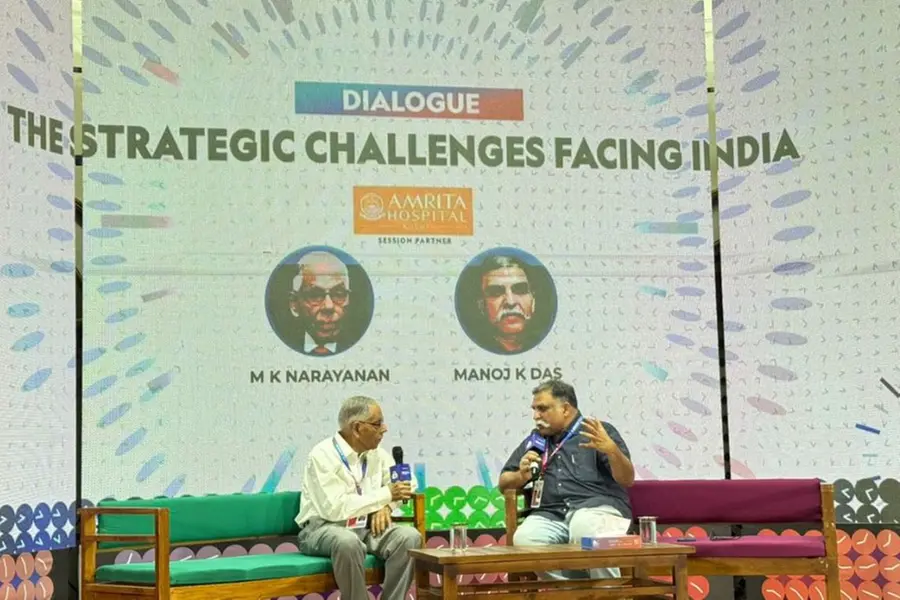
MK Narayanan, former National Security Advisor and former Governor of West Bengal, delivered a session on 'The Strategic Challenges Facing India' at the Mathrubhumi International Festival of Letters (MBIFL) in Thiruvananthapuram where he provided a deeper understanding of India’s evolving geopolitical landscape, with particular attention to the country’s relationship with the United States and China.
Narayanan addressed the challenges posed by neighbouring countries, the shifting global power dynamics, and the need for India to focus on strengthening its internal capabilities while managing its foreign relations with key global players.
Drawing on his extensive expertise in intelligence and security policy, Narayanan discussed India’s defence preparedness and the complexities of navigating global geopolitics.
A key theme of his address was the growing influence of China in the region. Narayanan made a notable distinction regarding India’s relationship with China, stating: “India and China are not enemies. They are two rival civilisations. The Chinese are as afraid of India as we are of them. I know that Chinese are even petrified of India’s faith, Indian music… It’s unlikely India and China will have an open war.”
This view contrasts with the perspectives expressed by Congress Member of Parliament Shashi Tharoor in another session at MBIFL 2025, where Tharoor debated Chandran Nair on China’s intentions toward India.
Tharoor outlined five criteria and stated that if three of them were met, he would reconsider his stance on China's goodwill.
While acknowledging the historical tensions between the two nations, Narayanan emphasised that both India and China share a deep mutual respect and apprehension towards each other’s cultural and strategic influence.
He cautioned against provoking China, arguing that India’s defence capabilities are strong, but an open conflict would be neither prudent nor necessary. Instead, he urged India to focus on bolstering its internal strengths and prioritise its own development over external threats.
In his remarks on India’s relationship with the United States, Narayanan expressed concern about an overreliance on US support, particularly in light of India’s critical role in the global supply of manpower and resources.
He pointed out that without India’s contributions, the US would struggle to maintain its global influence. Narayanan cautioned that India should not allow the US to overshadow its own strategic priorities, particularly in terms of sustaining global peace and balance. "Yes it is true that we are in a much difficult position today with the US, even worse than a year ago, when Biden was the president," he said.
He, however, urged India to adopt a more balanced approach towards both powers. This balance, he argued, is vital for ensuring long-term stability in the region.
Narayanan’s session also addressed the ongoing global threat of extremism, particularly the persistent threat posed by groups such as ISIS. While he noted that the threat of terrorism has weakened in certain regions, the danger from organisations like ISI remains. Narayanan also downplayed the significance of the Naxal movement, suggesting that while there are pockets of insurgency, it is not a major security concern for India at large.
On the topic of Kashmir, Narayanan questioned the strategic importance of Pakistan-occupied Kashmir (PoK), suggesting that the issue is more of political interest to a few rather than an existential concern for India. "Who needs PoK other than a few politicians," he asked.
Published: 11 Feb 2025, 09:48 am IST
ABOUT THE AUTHOR
Related Topics
Disclaimer: Kindly avoid objectionable, derogatory, unlawful and lewd comments, while responding to reports. Such comments are punishable under cyber laws. Please keep away from personal attacks. The opinions expressed here are the personal opinions of readers and not that of Mathrubhumi.