
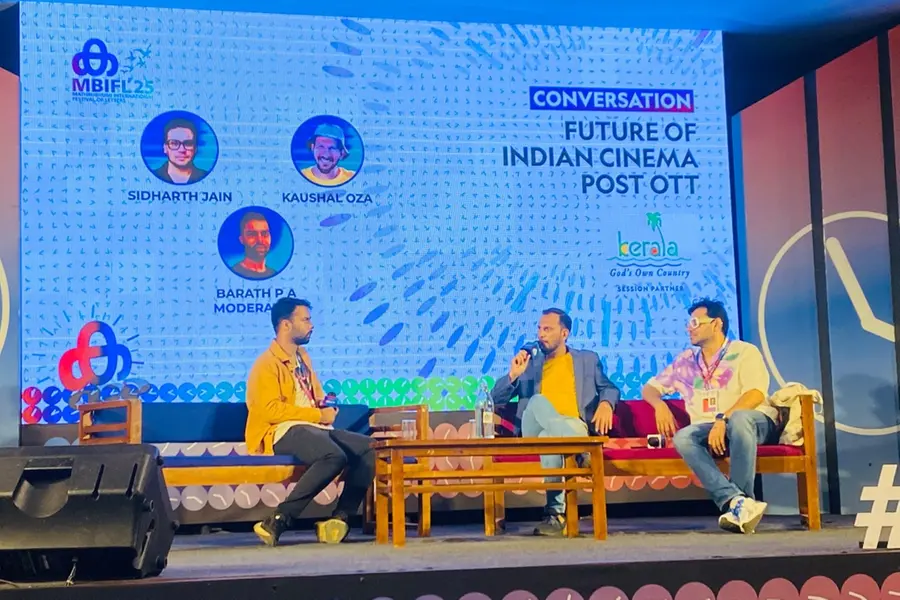
At the Mathrubhumi International Festival of Letters (MBIFL), filmmaker Kaushal Oza sat down with producer and story consultant Sidharth Jain for a session on the 'Future of Indian Cinema: Post OTT.' Moderated by data analyst Barath P A, the session explored the evolving landscape of indie cinema, the impact of OTT platforms, and the future of storytelling.
What makes an ideal indie film?
“Filmmaking is about finding the right people for the right story and then convincing the financiers,” Sidharth remarked. He emphasised that an indie film thrives when the creative team shares a unified vision to strike the right balance of art and commercial value.
Kaushal, on the other hand, mentioned that he doesn't identify with the terms indie and commercial film. For him, the only thing that makes a film independent is the fact that it is produced outside the studio system. He, however, admitted that it allows the filmmaker to focus on the story rather than fitting into a formula dictated by a corporate structure.
How has the indie film industry evolved in the last 10-15 years?
Both speakers agreed that the past decade has been metamorphic for the film industry, particularly because of the COVID-19 pandemic and resulting lockdowns.
“We have lived a hundred years of change in just the last two years," Kaushal said, referring to the unpredictable shifts in audience preferences.
"It’s a flood now—everyone likes different things, and we haven’t yet figured out what truly works."
Sidharth linked this change to technological advancements.
"During COVID, people started consuming content they never considered before. With fast internet made available at a reasonable price, subtitles for global films, and devices being cheaper, audiences are now watching films from across the world. This has broadened perspectives but also made storytelling more competitive. Now, everyone wants 'something else.'."
Does short-form content perform better than traditional films?
With people preferring to spend their days on short-form content, Barath asked the question if short-form storytelling is taking over or will soon take over traditional cinema.
"It depends on the audience’s expectation," Sidharth explained, adding, "If I am waiting for an Uber, I want a short video. If I am settling in for the evening, I will watch a long film. It’s like a buffet—different options for different moods."
Kaushal agreed but noted a concern, "The attention span is changing. In the future, storytelling will have to evolve to match what audiences are willing to engage with."
Sidharth countered that strong storytelling still holds power.
"Pushpa 2 and Animal are long films, yet they work. Netflix thrives on binge-watching. To combat the issue of attention span, it is important to focus on how we tell the story," he said.
Has OTT streaming changed the filmmaking process?
Kaushal insisted that, for him, the rise of OTT has not altered his creative approach. "I work on one film at a time. As a writer, I don’t think about the external world. I focus on whether the story in front of me moves me."
Sidharth, however, called OTT a game-changer.
"It has made storytelling limitless. Earlier, we had to tell a plot-driven story in two hours. Now, because of the favorability of series, we can tell character-driven stories over several episodes. But with so much content available, keeping an audience engaged is harder than ever."
On the influence of AI, Kaushal was sceptical.
"If AI makes life easier in some ways, we’ll just find new ways to make things difficult for ourselves," he joked.
He laid out the example of digital filmmaking, which was expected to save time but instead led to excessive footage, increasing editing work. He said that we're still far from the idea of AI doing everything with the click of a button.
Is filmmaking more financially viable today?
On whether the industry is in a better financial position post-COVID, Kaushal noted, "Change happens every year. No two years are the same. The industry has cycles of ups and downs."
Sidharth saw long-term growth. "After COVID, the entertainment industry has expanded. Digital revenue has surged, and we now have more opportunities. Anyone who has lasted over ten years in this industry has had to sacrifice financial security at some point. Filmmaking is not for the faint-hearted.”
The role of YouTube in filmmaking
Both speakers praised YouTube as a platform for independent creators.
“YouTube is one of the best platforms for young filmmakers,” Sidharth said.
“It’s a democratic space—just do your thing and show it to the world.”
Kaushal agreed. “When I did a short film, we had the option to release it on OTT or YouTube, and we chose YouTube because we wanted people to watch it. Exposure matters more than money sometimes.”
Censorship and political storytelling
An audience member asked about censorship in streaming.
"Self-censorship is now a bigger issue than official censorship,” Kaushal responded. “It’s coming not just from the industry but from societal pressures. But filmmakers have always found intelligent ways to tell their stories, and we will continue to do so.”
Sidharth remarked, “Everything is offensive to someone now. That’s a bigger problem than censorship itself.”
Published: 09 Feb 2025, 07:50 pm IST
Related Topics
Disclaimer: Kindly avoid objectionable, derogatory, unlawful and lewd comments, while responding to reports. Such comments are punishable under cyber laws. Please keep away from personal attacks. The opinions expressed here are the personal opinions of readers and not that of Mathrubhumi.
