
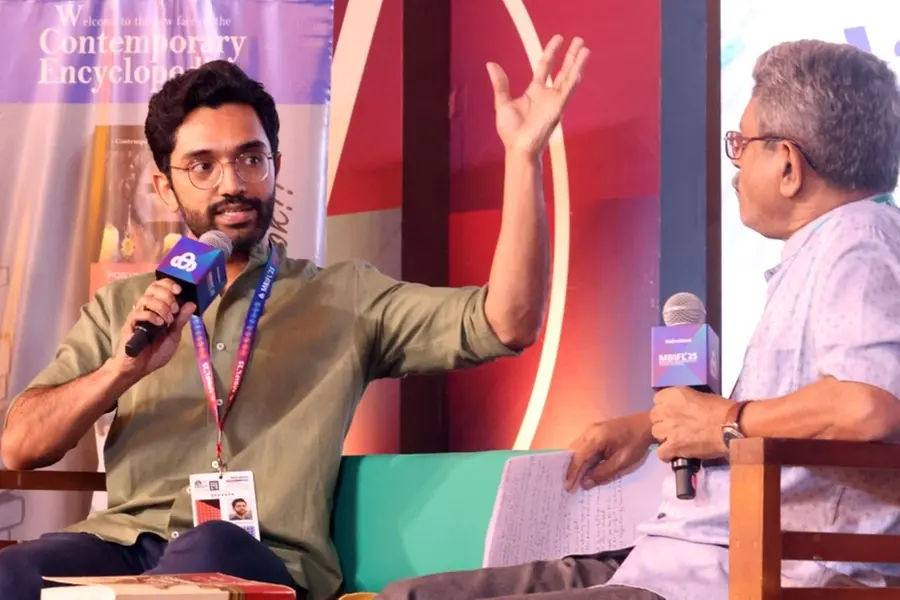
Historian, writer, and award-winning author Manu S Pillai has penned acclaimed works such as The Ivory Throne, Rebel Sultans, The Courtesan, the Mahatma & the Italian Brahmin, and False Allies, all of which delve into India’s rich and complex past. His latest book – Gods, Guns and Missionaries: The Making Of the Modern Hindu Identity – traces the transformation of Hinduism from a fragmented set of traditions into a powerful collective identity. Set against the backdrop of the Mughal decline, missionary influence, and colonial rule, the book examines how these forces shaped the rise of Hindutva and Hindu nationalism in India.
Speaking at the Mathrubhumi International Festival of Letters on February 6, Manu shared that he wrote the first part of the book in 2021, just two years after the Jamia Millia Islamia attack in New Delhi, which had been triggered by student protests against the Citizenship Amendment Act (CAA).
Prof P Vijaya Kumar, channelling the discourse, posed a question: "Did it ever strike you at this point that the nationalism – the growth of which you’re describing – was then expressing itself on the streets of Delhi?"
To this, Manu replied: "It did. One of the reasons I wrote this book is because, when I was a teen, Vajpayee’s government was in power, and these conversations were already bubbling up. In the year 2000, when I was still in school, books about India as the next big power were being published – Sunil Khilnani, Shashi Tharoor, and others were writing about the twenty-first century being India’s age. But as I moved into my teenage years, I started reading other kinds of literature, including the work of Meera Nanda, which made me realise that this romantic image had its flaws. The narrative was not as pretty as it seemed. This led to a self-doubt that led me, even as a master’s student, to investigate the origins of Hindutva and this form of cultural and religious nationalism."
He went on to explain: "The initial plan was to extend the epilogue to the present. [details omitted] I had a paranoia that if I brought the book into the present, then all the discussions would be about the present. The book would be hijacked by the ending of it rather than the subject it dealt with."
When asked why Pune and Maharashtra featured more prominently than Mavelikkara in his book, and why its spirit was more aligned with that of Bal Gangadhar Tilak and Veer Savarkar, Manu responded: "That’s because we are tracing the rise of Hindutva. Whether you personally subscribe to it or not, you have to truly understand what these figures did. I had to step into another man’s mind to understand what drove him to define Hindutva."
He further elaborated: "Tilak attempted to define Hindutva, but his version didn’t endure. It was his protégé, Savarkar, who formulated the definition that has lasted for a century. And as for Maharashtra – its significance remains undeniable. Even today, the RSS headquarters is in Maharashtra, its leadership is largely Maharashtrian Brahmins. The book highlights how the history of Maharashtrian Brahmins, tracing back to the Peshwa era, plays a crucial role in understanding the rise of Hindutva and Hindu nationalism. Historically, the Maharashtrian Brahmins were characterised by masculinity, militancy, and elite status, which helped shape Hindutva’s ideological foundation."
When an audience member asked about the increasing involvement of the Travancore Royalty in Hindutva politics, Manu pointed out that, while he had not observed any such active association, historically, royalty from other regions – such as Gwalior – were among the biggest contributors to the Bharatiya Jan Sangh.
Through research-backed historical facts and confident storytelling, Manu captivated his audience, offering them a compelling exploration of The Making Of the Modern Hindu Identity.
Published: 07 Feb 2025, 12:29 pm IST
Related Topics
Disclaimer: Kindly avoid objectionable, derogatory, unlawful and lewd comments, while responding to reports. Such comments are punishable under cyber laws. Please keep away from personal attacks. The opinions expressed here are the personal opinions of readers and not that of Mathrubhumi.
