
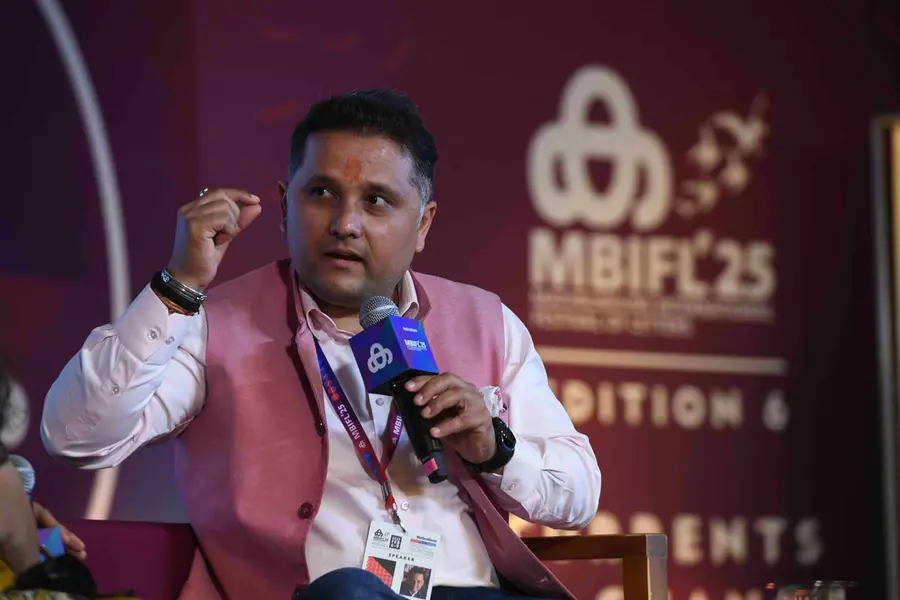
The sixth edition of the Mathrubhumi International Festival of Letters (MBIFL) 2025 hosted a mesmerizing session on 'The Creative Retelling of Epics', featuring two literary luminaries: Amish Tripathi, celebrated author of the Shiva Trilogy, and Saraswathy Nagarajan, an esteemed journalist and writer. The session was nothing short of spellbinding. A large and eager crowd gathered to immerse themselves in the timeless magic of ancient narratives, reimagined for the modern reader.
Amish Tripathi opened the discussion by emphasising the timeless relevance of epics.
"These stories," he asserted, "contain universal truths that resonate across generations. They connect us to our roots and offer invaluable life lessons."
He illustrated this point with a lighthearted "pop quiz", comparing the enduring popularity of the 'Ramayana' television series in India to the global phenomenon of 'Game of Thrones', highlighting the deep connection Indians have with their traditional narratives.
"We never tire of hearing our stories," Tripathi explained, "because they are connected to us."
Tripathi addressed the question of why he chose epics as his source of inspiration. He spoke of India's unique position as the only surviving pre-Bronze Age civilisation, attributing this longevity partly to the continuous retelling and reinterpretation of its ancient stories. He emphasised the importance of these narratives as carriers of Indian culture, arguing that for an Indian writer to ignore them would be a "stupid" decision.
The conversation touched upon the numerous interpretations of epics throughout history, from Kalidasa's Kumarasambhava to Bhasa's epic plays demonstrating the rich tradition of reimagining these tales. Tripathi stated that, "Traditions is not about the glorification of ashes, it's a preservation of fire".

Tripathi shared his perspective on the creative process, describing it as either the "easiest or most difficult job". He explained that it becomes easy when the writer acts as a "channel" for the story, acknowledging the influence of divine inspiration, which he personally attributes to Lord Shiva. He recounted anecdotes from his own experience, including a humorous interaction with his school friends who questioned his authorship due to his lack of prior creative writing, further reinforcing his belief in divine inspiration.
The discussion then turned to the challenges of humanising divine characters. Tripathi acknowledged the sensitivity surrounding reinterpretations of figures like Ram and Sita, but emphasised the importance of respect in such endeavors. He shared his view that Indians are generally receptive to different interpretations as long as they are presented with reverence. He cited the example of SS Rajamouli’s films, where even potentially-controversial scenes are embraced when executed with genuine devotion.
Addressing the question of creative freedom, Tripathi acknowledged the right of writers to express themselves freely, even if their interpretations are controversial. However, he also pointed out that such choices often lead to public debate and potential legal challenges. He emphasised that in India, these controversies rarely escalate to violence.
The conversation explored the pan-Indian nature of epics, with Tripathi highlighting the geographical reach of the 'Ramayana' and 'Mahabharata'. He spoke of the unifying power of these stories and their ability to bring people together. He also shared a personal anecdote about a Christian driver in Kerala who displayed both a cross and a picture of Adi Guru Shiva in his car, illustrating the spirit of mutual respect that he believes is essential to Indian culture.
Tripathi also addressed the issue of societal division and polarization, acknowledging the rapid changes happening in India. He traced India’s economic journey over the past two millennia, highlighting the country’s recent resurgence and expressing optimism for the future. He stressed the importance of mutual respect in a diverse society and cautioned against the dangers of extremism.
The dialogue concluded with a reflection on the role of stories in shaping society. Tripathi reiterated his belief in the power of storytelling to connect people, promote understanding, and preserve cultural heritage. The session provided a platform for a vibrant exchange of ideas, leaving the audience with a renewed appreciation for the enduring power of epics and their continued relevance in the 21st century.
Published: 07 Feb 2025, 06:49 pm IST
Related Topics
Disclaimer: Kindly avoid objectionable, derogatory, unlawful and lewd comments, while responding to reports. Such comments are punishable under cyber laws. Please keep away from personal attacks. The opinions expressed here are the personal opinions of readers and not that of Mathrubhumi.