

When Dr Manmohan Singh failed to show up to take charge as Finance Minister, Prime Minister Narasimha Rao called to ask, “Didn’t PC Alexander tell you that I have asked you to be the Finance Minister?”
“Yes, sir, he did. But I did not think he was serious,” Dr Singh replied calmly.
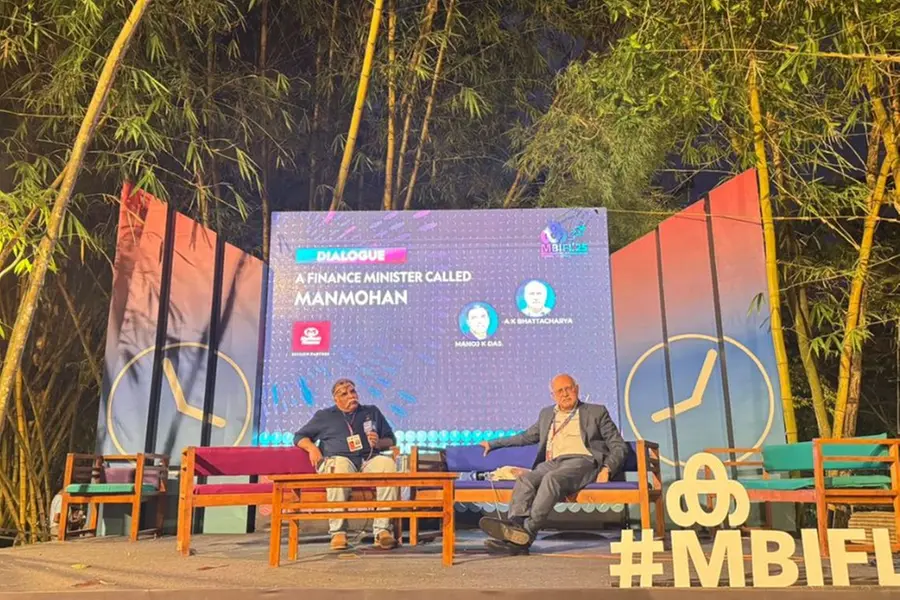
This anecdote, shared during the Mathrubhumi International Festival of Letters 2025 (MBIFL) session titled ‘A Finance Minister called Manmohan,’ encapsulates the understated essence of a man who would become one of India’s most transformative figures.
AK Bhattacharya, the respected journalist who has followed Dr Singh’s career closely, fondly recalled how the latter’s quiet strength and focus shaped the country’s economic trajectory.
In 1991, when India was on the brink of economic collapse, Dr Singh became the first economist to serve as Finance Minister. The first choice for the role was IG Patel, but he refused and recommended Dr Singh.
Singh’s reforms -- liberalising the economy and opening India to global trade -- changed the nation’s future.
Bhattacharya shared a story from Dr Singh’s early days as Finance Minister, where he had a meeting with the senior bureaucrats. With characteristic confidence, Singh made it clear that radical economic changes were necessary, even if it meant alienating some in the bureaucracy. But he also signalled his awareness of the political realities, acknowledging the need to balance the aspirations of the people with the practicalities of governance.
It wasn’t all smooth sailing, of course.
Dr Singh’s tenure as Prime Minister in the years that followed was marked by contradictions. As a leader, he had to make compromises that sometimes hurt his public image.
Bhattacharya shared a poignant moment when Dr Singh as Prime Minister was humiliated by Rahul Gandhi when he threw away the bill that Dr Singh had passed. It was, as Bhattacharya put it, the beginning of the end for the Congress-led UPA government.
Dr Singh’s true legacy lies in the understated power of his decisions. From the economic stimulus packages after the North Atlantic financial crisis to his handling of the Satyam scam, Dr Singh’s role was central.
In retrospect, Bhattacharya felt that Dr Singh’s tenure as Prime Minister wasn’t as effective as his time as Finance Minister.
“The big difference between Manmohan Singh as Finance Minister and PM was -- he had the freedom and the ability to build a team around him when he was FM with people like Ashok Desai and Ahluwalia. That he could not do when he was the Prime Minister.”
The decision-making was tied more closely to the political machinery of the Congress party, and Dr Singh often had to walk a fine line between economic reforms and political imperatives.
Dr Singh understood the power of compromise. “He knew that sometimes taking two steps backward and moving one step forward was still one step forward," said Bhattacharya.
“He was the best Finance Minister our country has ever had. Yes he played the second fiddle to the government when he became the Prime Minister. But, I think he was happy playing second fiddle.”
The session ended with Bhattacharya offering his thoughts on the current Finance Minister, Nirmala Sitharaman. “When it comes to fiscal transparency, fiscal consolidation, fiscal prudence and accounting, she is one of the better Finance Ministers. But she is also a FM who looks after the political imperatives.”
He futher added, “Lot of people believe that had she done things differently, Delhi wouldn’t have been BJP’s today.”
Published: 09 Feb 2025, 12:46 pm IST
ABOUT THE AUTHOR
Related Topics
Disclaimer: Kindly avoid objectionable, derogatory, unlawful and lewd comments, while responding to reports. Such comments are punishable under cyber laws. Please keep away from personal attacks. The opinions expressed here are the personal opinions of readers and not that of Mathrubhumi.