
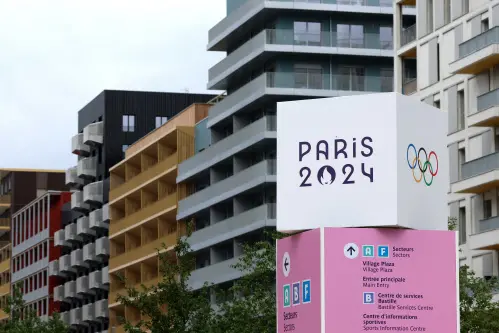
Paris: The Paris Olympic village, originally designed to minimise carbon emissions by forgoing air conditioning, will now install 2,500 temporary cooling units ahead of the athletes' arrival later this month, organisers announced on Tuesday.
Situated in a northern suburb of Paris, the complex was intended as a model of environmental sustainability, featuring a geothermal cooling system that utilises chilled water extracted from deep underground. However, concerns from national Olympic teams, exacerbated by Paris's recent bouts of summer heat waves, prompted organisers to find a compromise.
In response, teams were offered the option to procure portable air-conditioning units at their own expense for the duration of the July 26 to August 11 Olympics. This decision aimed to address athletes' concerns about sleep quality and overall comfort during the crucial competition period.
Augustin Tran Van Chau, the deputy director of the Olympic village, emphasised the tailored approach taken to accommodate athletes' needs. "The aim was to provide a very specific solution for athletes who are facing the match or competition of their lives... and who might have requirements for their comfort and recovery which are higher than in a normal summer," he explained during a media visit to the village.
Mathrubhumi English is now on WhatsApp; Join the channel
The installation of approximately 2,500 air-conditioning units reflects the scale of the accommodation complex, which comprises 7,000 rooms across roughly 40 low-rise towers. These facilities will host around 10,000 Olympians initially, followed by 5,000 Paralympians during the subsequent Paralympic Games from August 28 to September 8.
The decision to install air-conditioning units marks a departure from earlier plans outlined by Anne Hidalgo, Mayor of Paris and head of the Olympics infrastructure group Solideo. Previously, Hidalgo had prioritised environmental sustainability, resisting the use of portable air-conditioners to align with broader goals of reducing carbon emissions.
The shift in approach also underscores efforts by organisers to balance athlete comfort with environmental responsibility. The influential US Olympic team notably advocated for improved conditions, including access to air conditioning, citing the critical impact on athletes' sleep, health, and overall well-being.

Beyond cooling solutions, the Paris Games is committed to cutting its total carbon emissions by half compared to previous editions in London (2012) and Rio de Janeiro (2016). Initiatives include the use of eco-friendly building materials in the village construction and a strategy focused on temporary or renovated venues rather than new construction.
Moreover, dietary choices have been adjusted, with reduced meat consumption at the village and sports venues, and a planned 100% vegetarian menu at the temporary stadium hosting skateboarding and BMX events at Place de la Concorde.
Overall, while prioritising environmental sustainability remains paramount, the adaptation to install air-conditioning reflects a pragmatic approach to ensuring optimal conditions for athletes participating in the prestigious global event hosted by Paris. AFP
Published: 02 Jul 2024, 08:55 pm IST
Disclaimer: Kindly avoid objectionable, derogatory, unlawful and lewd comments, while responding to reports. Such comments are punishable under cyber laws. Please keep away from personal attacks. The opinions expressed here are the personal opinions of readers and not that of Mathrubhumi.