
The announcement marks a crucial moment for the Tibetan community, particularly those worried about a leadership vacuum, and for international supporters who see the Dalai Lama as a beacon of peace, compassion and cultural resilience under Chinese rule.
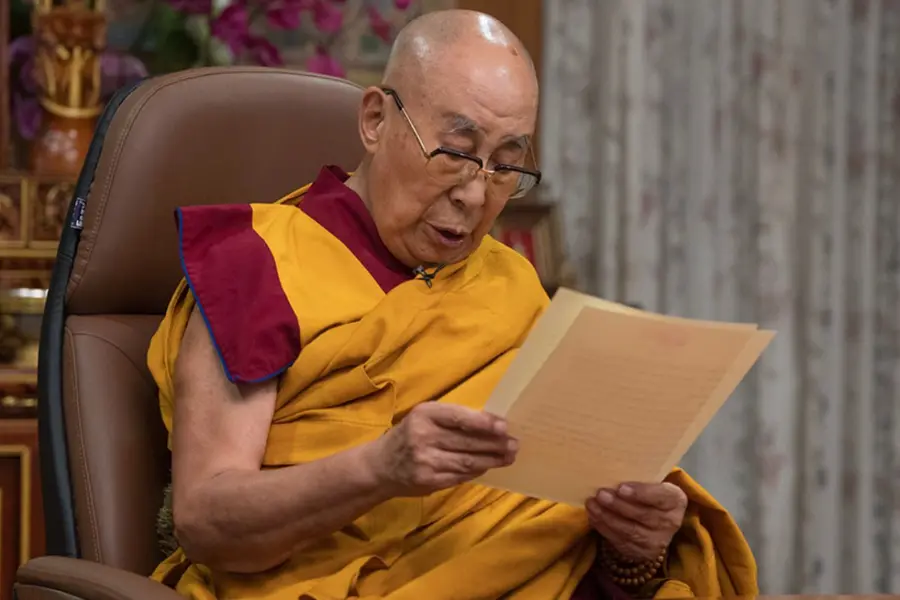
McLeod Ganj: The Tibetan spiritual leader in exile has officially confirmed that there will be a 15th Dalai Lama after his death, bringing relief to millions of Buddhist followers concerned about the future of the six-century-old tradition.
The announcement marks a crucial moment for the Tibetan community, particularly those worried about a leadership vacuum, and for international supporters who see the Dalai Lama as a beacon of peace, compassion and cultural resilience under Chinese rule.
Tenzin Gyatso, believed by Tibetans to be the 14th reincarnation of the Dalai Lama, has lived in exile in India since fleeing his homeland following the 1959 uprising in Lhasa, when Chinese forces crushed Tibetan resistance. Tibet, a vast plateau region about the size of South Africa, remains under Chinese administration.
Though he had previously said the continuation of the Dalai Lama lineage would depend on public demand, the 89-year-old Nobel Peace laureate said he had received repeated requests from Tibetans across the diaspora and within Tibet, as well as from Buddhists in the Himalayan region, Mongolia, Russia and parts of China.
"In particular, I have received messages through various channels from Tibetans in Tibet making the same appeal," he said during a video message at a gathering of religious leaders in McLeod Ganj, the Himalayan town where he has resided for decades.
"In accordance with all these requests, I am affirming that the institution of the Dalai Lama will continue," he declared, according to an official translation.
The statement comes just days before his 90th birthday on July 6 and addresses longstanding concerns about succession and the potential politicisation of the process.
Beijing has long considered the Dalai Lama a separatist and has insisted on a role in appointing his successor. However, the Dalai Lama was unequivocal in his stance.
"I hereby reiterate that the Gaden Phodrang Trust has sole authority to recognise the future reincarnation; no one else has any such authority to interfere in this matter," he said. He emphasised that the responsibility for identifying his successor would lie solely with the India-based Gaden Phodrang Trust, which serves as his official institution.
The decision is also being seen as a pre-emptive measure against any attempt by China to appoint a rival successor in an effort to reinforce its control over Tibet, which it formally annexed in 1950.
In 2011, the Dalai Lama relinquished his political responsibilities to a democratically elected Tibetan government-in-exile, currently representing around 1,30,000 Tibetans worldwide. However, concerns about the continuity of his spiritual leadership have persisted.
He has previously warned of "obvious risk of vested political interests misusing the reincarnation system" — a concern echoed by Tibetan communities wary of Chinese involvement in spiritual affairs.
Published: 02 Jul 2025, 11:54 am IST
Related Topics
Disclaimer: Kindly avoid objectionable, derogatory, unlawful and lewd comments, while responding to reports. Such comments are punishable under cyber laws. Please keep away from personal attacks. The opinions expressed here are the personal opinions of readers and not that of Mathrubhumi.
