
With the election approaching, the French government finds itself trapped between maintaining public order and managing widespread social anger.
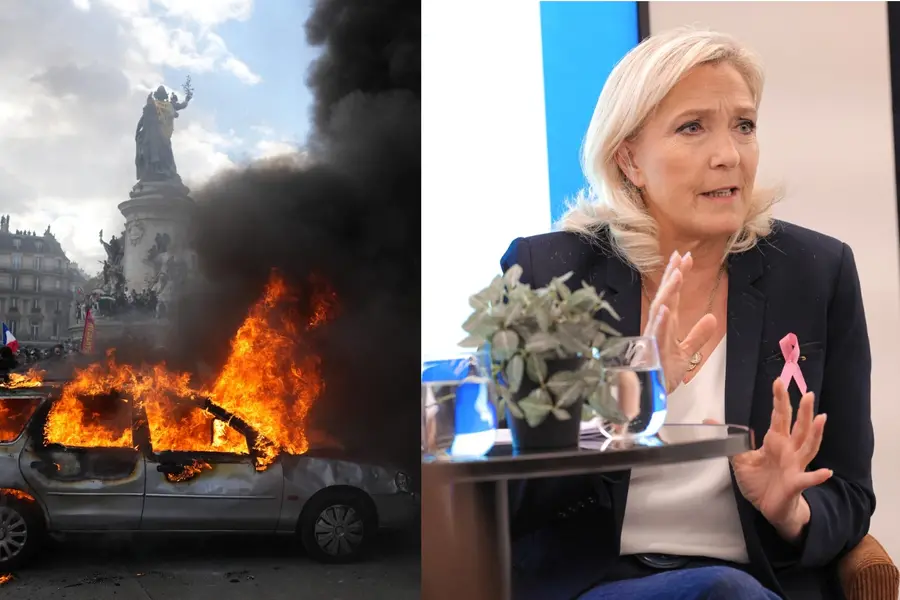
More than 400,000 people took to the streets across France on Saturday to voice their frustration over the rising cost of living. What began as broad public demonstrations quickly turned chaotic when splinter groups of masked demonstrators broke away from the main crowds. Fires were lit, shops were vandalised, and riot police moved in with force. By Sunday, the French Interior Ministry confirmed that police had arrested 1,314 people nationwide and responded to 75 separate blazes. Across various cities, 24 shops were looted, while 53 police personnel sustained injuries during the clashes.
The violence also left demonstrators with severe wounds. Interior Minister Laurent Nunez acknowledged two serious casualties among the public, located in Toulouse and Clermont-Ferrand. In Toulouse, local authorities reported that a 20-year-old man suffered grave hand trauma. A volunteer street medic treating the crowds noted that the young man had "several fingers" blown off his right hand. Another man in Clermont-Ferrand hurt his hand, though officials clarified he did not lose any fingers. In Poitiers, a 19-year-old was injured in his left eye when riot police charged the crowd while deploying tear gas and stun grenades. The government noted that the rest of Saturday night had turned "calm" and stated that "several investigations have been opened", whilst Minister Nunez attributed much of the street violence to "ultra-left" extremists.
Why household budgets are driving citizens to the streets
Saturday’s unrest marked the second straight weekend of national demonstrations, building on a month of student strikes protesting against the poor condition of French schools. Ordinary families are feeling the squeeze of high daily expenses, yet the state has very little room to provide financial relief. France’s national debt and budget deficit currently exceed European Union limits. Consequently, President Emmanuel Macron’s administration is struggling to push through a budget aimed at cutting public spending rather than increasing it.
Public anger has deepened over what many citizens view as Macron’s aloofness throughout his two terms in office. Recent official orders restricting street rallies have further inflamed tensions, drawing sharp criticism from civil rights groups and trade unions who accuse authorities of stifling the democratic right to protest. Recent weeks have also seen multiple instances of demonstrators being maimed by police-issue stun grenades and tear gas canisters during student rallies. Although official inquiries are underway, the heavy-handed response has left a large section of the public convinced that the government itself is responsible for the crisis.
Marine Le Pen surges as Macron nears the exit
This widespread discontent is reshaping the country’s political landscape just six months ahead of the two-round presidential elections scheduled for April and May. Macron cannot contest again, as he has reached his two-term limit. Capitalising on the public fatigue is Marine Le Pen, the far-right leader of the National Rally (RN) party, who currently leads the race in opinion polls. An Ipsos poll published on Saturday indicated she would secure 32 to 34 per cent of the votes in the first round.
Le Pen has actively supported the police during the unrest, criticising Macron’s centrist administration for being weak on rioters and lacking firm authority. In her campaign platform, she pledges to tackle living costs by placing caps on household energy bills, reducing taxes, and cutting France’s financial contributions to the European Union. She has also openly criticised NATO and opposed French assistance to Ukraine in its conflict with Russia.
On Sunday, Le Pen travelled to the central city of Orléans to deliver her first major campaign speech before 10,000 party supporters. However, her arrival highlighted deep political divisions. Between 13,000 and 26,000 anti-fascist demonstrators rallied in Orléans on Saturday to oppose her anti-immigration, nationalist agenda, prompting police to set up vehicle checkpoints on incoming roads ahead of a second counter-protest on Sunday. Expressing concern over a potential far-right presidency, 35-year-old yoga teacher Antonine Rochet remarked: "One of the risks of the National Rally coming to power, beyond the implementation of its policies, is the atmosphere it could create".
Mounting unrest and the threat of winter strikes
With the election approaching, the French government finds itself trapped between maintaining public order and managing widespread social anger. The political and economic pressures will not disappear quickly, especially since whoever succeeds Macron will inherit severe European Union deficit restrictions and tight state finances.
Street action shows no signs of slowing down. The Yellow Vest movement—which staged disruptive highway blockades and protests against Macron eight years ago—has called for fresh nationwide demonstrations next Saturday. In addition, the powerful CGT trade union has announced plans for rolling strike action starting from 5 November. As winter draws near, the combination of high living costs, public fury, and election campaigning suggests France is heading into an increasingly volatile period.
Published: 25 Oct 2026, 05:30 pm IST
Related Topics
Disclaimer: Kindly avoid objectionable, derogatory, unlawful and lewd comments, while responding to reports. Such comments are punishable under cyber laws. Please keep away from personal attacks. The opinions expressed here are the personal opinions of readers and not that of Mathrubhumi.
