
Around 100 campaign members have demanded the withdrawal of Bengaluru’s 2021 protest restrictions, threatening mass civil disobedience on November 28 if the government fails to act.
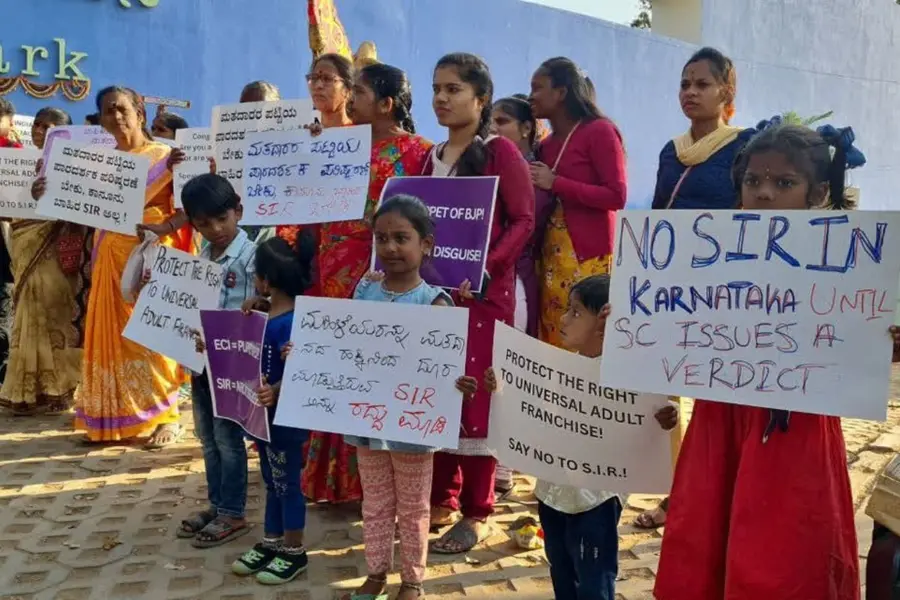
A city’s right to dissent cannot be confined to a single designated park, civil society representatives argued on Monday as around 100 members of the Campaign for the Right to Protest demanded the withdrawal of Bengaluru’s five-year-old restrictions on public demonstrations, warning of a city-wide mass civil disobedience movement on November 28 if the government fails to act by Constitution Day on November 26.
The campaign called for the immediate revocation of the 2021 police order limiting protests in Bengaluru to Freedom Park.
Participants at a round-table meeting resolved to submit memorandums to Home Minister Priyank Kharge and Bengaluru Police Commissioner Seemanth Kumar Singh, while also demanding that all FIRs registered against people for protesting outside Freedom Park be quashed.
At the heart of the dispute is the legal basis for the restrictions. The campaign rejected police claims that the curbs complied with a Karnataka High Court order, arguing that the court directed authorities to implement the existing order rather than mandate the restrictions.
Advocate Maitreyi Krishnan, president of the All India Lawyers’ Association for Justice, said the restrictions originated in the Licensing and Regulation of Protests, Demonstrations and Protest Marches (Bengaluru City) Order, 2021. She maintained that the police commissioner had the authority to modify or rescind the order and that the state government had a constitutional obligation to withdraw it.
Historian and writer Ramachandra Guha also criticised the restrictions, arguing that demonstrations in a democratic city must take place in spaces where the public can see and engage with them.
He called for protesters to be allowed to assemble at prominent locations such as Maurya Circle, Town Hall and Mysore Bank Circle, as well as outside the offices of the authorities they intend to address.
The campaign contended that confining demonstrations to Freedom Park disproportionately affects workers and marginalised communities, for whom public protest can be a crucial means of asserting their rights.
Trade union convenor KV Bhat highlighted the difficulties faced by organisers seeking permission for May Day rallies.
Representatives of sex workers and street vendors, meanwhile, underlined the importance of public demonstrations in drawing attention to alleged police harassment and the denial of basic rights.
The campaign said it would continue to press for the withdrawal of the restrictions and convene another meeting to constitute a central committee.
With the November 26 deadline approaching, the government faces a demand that goes beyond the location of demonstrations: whether citizens should be allowed to take their grievances to visible public spaces or remain confined to a designated protest zone.
Published: 27 Oct 2026, 08:24 am IST
ABOUT THE AUTHOR

Related Topics
Disclaimer: Kindly avoid objectionable, derogatory, unlawful and lewd comments, while responding to reports. Such comments are punishable under cyber laws. Please keep away from personal attacks. The opinions expressed here are the personal opinions of readers and not that of Mathrubhumi.