
The Iranian force initially identified the intercepted platform as a Remus 600, an autonomous underwater vehicle that it alleged was conducting espionage missions inside the strait.
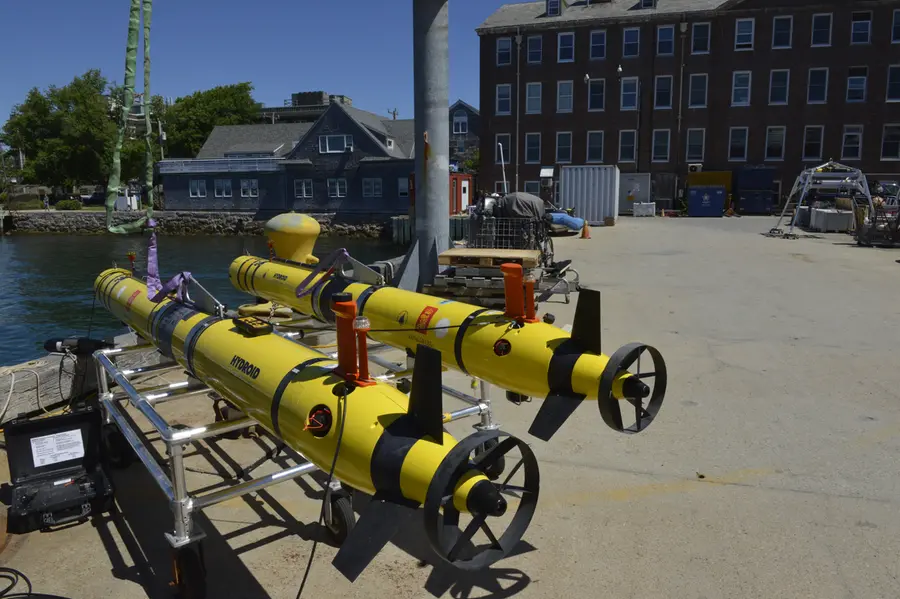
Washington: The United States military has denied Iran's claim that its forces seized an American unmanned underwater surveillance vehicle in the Strait of Hormuz, insisting that all its operational drones in the region remain accounted for.
The denial came after Iran's Islamic Revolutionary Guard Corps (IRGC) Navy claimed to have captured an advanced underwater drone, initially identified as a Remus 600, during an operation in the strategic waterway.
Speaking to Al Jazeera on Sunday, US Central Command (CENTCOM) spokesman Captain Tim Hawkins dismissed the Iranian claim, saying the United States maintains "positive control of all of our operational drone assets".
Hawkins described the assertion as "clearly desperate", Al Jazeera reported.
The IRGC Navy had earlier announced that it had intercepted an unmanned autonomous underwater vehicle (AUV), which was later identified as a "Mk 18 Mod 2 Kingfish" belonging to the US military in the Strait of Hormuz.
What is the REMUS 600 underwater drone?
The REMUS 600 is an autonomous underwater vehicle (AUV) designed for underwater surveillance, reconnaissance and data collection. It can operate without a human onboard and is used for missions such as seabed mapping, underwater inspections and mine detection.
It was originally developed at the Woods Hole Oceanographic Institution and is manufactured by HII (Huntington Ingalls Industries). Designed for both deep-water and coastal operations, the autonomous underwater vehicle can dive to depths of up to 600 metres.
What is the Mk 18 Mod 2 Kingfish?
The Mk 18 Mod 2 Kingfish is a US Navy unmanned underwater vehicle used for underwater reconnaissance and mine countermeasure operations.
The system is designed to collect information about underwater environments and help identify potential threats, including mines. It can operate autonomously and is part of the US military's unmanned underwater systems. It can be launched quickly from small boats, such as 11-meter rigid-hull inflatable boats (RHIBs). According to reports, it features Iridium satellite connectivity for tracking and data relay.
According to a statement carried by Iranian state broadcaster IRIB on Sunday, the operation targeted what Iranian military authorities called the "second subsurface [submarine] of the American terrorist army" operating in the strategic waterway.
The IRGC claimed that the capture was carried out through a "coordinated and complex operation" involving military intelligence and electronic warfare capabilities.
"With the help of God Almighty, the IRGC Navy soldiers, through a coordinated and complex operation with intelligence and electronic warfare, were able to trap an advanced UAV of the American terrorist army that was operating in the Strait of Hormuz for the purpose of espionage," the statement read.
The Iranian force initially identified the intercepted platform as a Remus 600, an autonomous underwater vehicle that it alleged was conducting espionage missions inside the strait.
"This submersible is a type of intelligent and advanced submersible called the Remus 600, which was captured by the IRGC Navy and is now in the hands of the force's specialists to retrieve its information," the statement added.
IRIB reported that the captured vehicle had been handed over to specialist military technicians for analysis and data recovery.
The IRGC Navy also reiterated its position on maritime traffic through the Strait of Hormuz, declaring the waterway closed and warning against unauthorised movements.
"The IRGC Navy firmly declares that the Strait of Hormuz is closed and we are taking strong and relentless action against dangerous movements and unauthorised traffic through the Strait of Hormuz," the statement added.
Published: 28 Sept 2026, 10:05 am IST
ABOUT THE AUTHOR

Related Topics
Disclaimer: Kindly avoid objectionable, derogatory, unlawful and lewd comments, while responding to reports. Such comments are punishable under cyber laws. Please keep away from personal attacks. The opinions expressed here are the personal opinions of readers and not that of Mathrubhumi.