
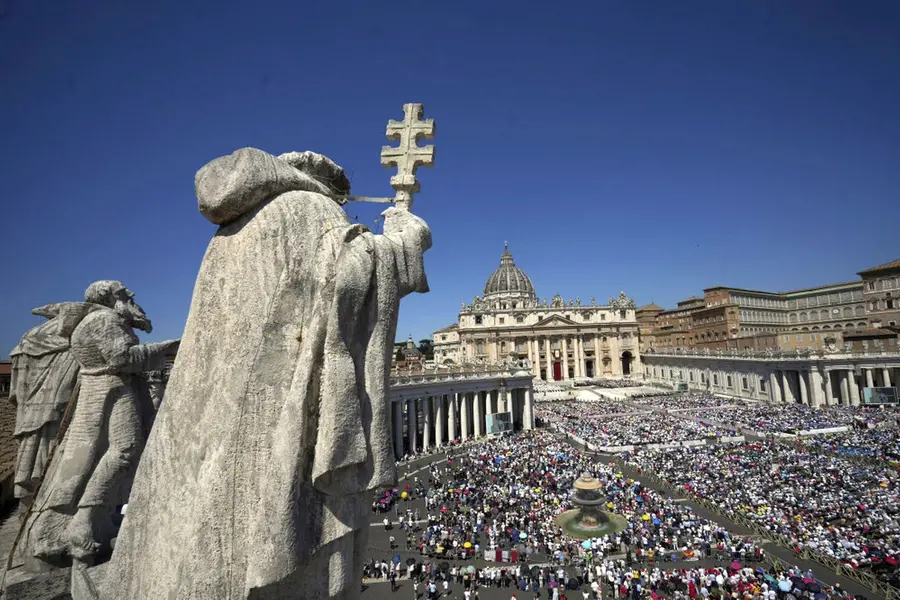
The world's smallest sovereign state, Vatican City, is facing a substantial budget crisis, with its central government, the Holy See, struggling to cover operational costs due to declining donations and underperforming financial assets. Pope Leo XIV is now tasked with finding solutions to pull the city-state out of the red.
Unlike traditional nations, the Vatican does not tax its residents or issue bonds. Its primary sources of revenue include global donations, ticket sales from the Vatican Museums, and income from investments and a vast, yet often underperforming, real estate portfolio.
The last consolidated budget published in 2022 projected expenditures of 770 million euros ($878 million), with major outlays directed towards its worldwide embassies and Vatican media operations. However, in recent years, these revenues have consistently fallen short of expenses.
Donations to the Vatican primarily stem from two sources. Canon law mandates an annual fee from bishops worldwide, with amounts varying based on diocesan resources. From 2021 to 2023, US bishops contributed over one-third of the $22 million (19.3 million euros) collected annually under this provision.
The second, more widely known source is Peter's Pence, a special collection typically held on the last Sunday of June. While individual Catholics in the US generously contributed an average of $27 million (23.7 million euros) to Peter's Pence from 2021-2023, accounting for more than half of the global total, overall contributions have sharply declined.
After peaking at $101 million (88.6 million euros) in 2006, donations dropped to $47 million (41.2 million euros) in the first year of the COVID-19 pandemic and remained low. This decline was exacerbated by revelations surrounding the Vatican's problematic investment in a London property, which confirmed that the majority of Peter's Pence funds had been used to cover the Holy See's budgetary shortfalls rather than papal charity initiatives as widely believed.
Despite this, Peter's Pence donations saw a slight increase in 2023, with officials anticipating further growth, partly attributed to the traditional bump following papal elections.
Further compounding the financial challenges, annual contributions from the Vatican Bank and the city-state's governorate, which oversees the museums, have also dwindled. A decade ago, the bank contributed approximately 55 million euros ($62.7 million) annually to the pope's budget.
However, in 2023, despite registering a net profit of 30 million euros ($34.2 million), the bank provided no specific contribution to the pope's budget, with similar declines observed in the governorate's giving. This has led some Vatican officials to question the credibility of asking for increased donor generosity when internal institutions are holding back.
Attracting donations from outside the US presents another hurdle, given the different cultural approaches to philanthropy, notes Rev. Robert Gahl, director of the Church Management Program at Catholic University of America's business school. He highlighted that in Europe, individual philanthropy is less common, with corporations and government entities typically shouldering most donations or allocating designated tax dollars.
Gahl also emphasized the need for a shift from a "mendicant mentality" of fundraising to encouraging Catholics to view their contributions as investments in the broader mission of the church.
The Vatican also possesses an extensive global real estate portfolio, comprising 4,249 properties in Italy and an additional 1,200 in cities like London, Paris, Geneva, and Lausanne.
According to the APSA patrimony office, which manages these assets, only about one-fifth are rented at fair market value. Approximately 70 percent generate no income as they house Vatican or other church offices, while the remaining 10 percent are rented at reduced rates to Vatican employees.
In 2023, these properties generated only 35 million euros ($39.9 million) in profit. Financial analysts have long identified this undervalued real estate as a significant source of potential revenue.
Ward Fitzgerald, president of the US-based Papal Foundation, which finances papal charities, suggests the Vatican should be willing to sell properties, particularly those that are expensive to maintain. This echoes challenges faced by bishops in parts of the US and Europe where declining church attendance has left many churches empty.
While the Vatican recently sold its embassy property in Tokyo's high-end Sanbancho neighbourhood to a developer, there remains an institutional reluctance to part with even money-losing properties, as evidenced by the 2021 decision to not sell the struggling Fatebenefratelli Catholic hospital in Rome, opting instead to create a fundraising foundation to support it.
"They have to come to grips with the fact that they own so much real estate that is not serving the mission of the church," stated Fitzgerald, who has a background in real estate private equity.
Published: 07 Jun 2025, 12:06 pm IST
Related Topics
Disclaimer: Kindly avoid objectionable, derogatory, unlawful and lewd comments, while responding to reports. Such comments are punishable under cyber laws. Please keep away from personal attacks. The opinions expressed here are the personal opinions of readers and not that of Mathrubhumi.
