
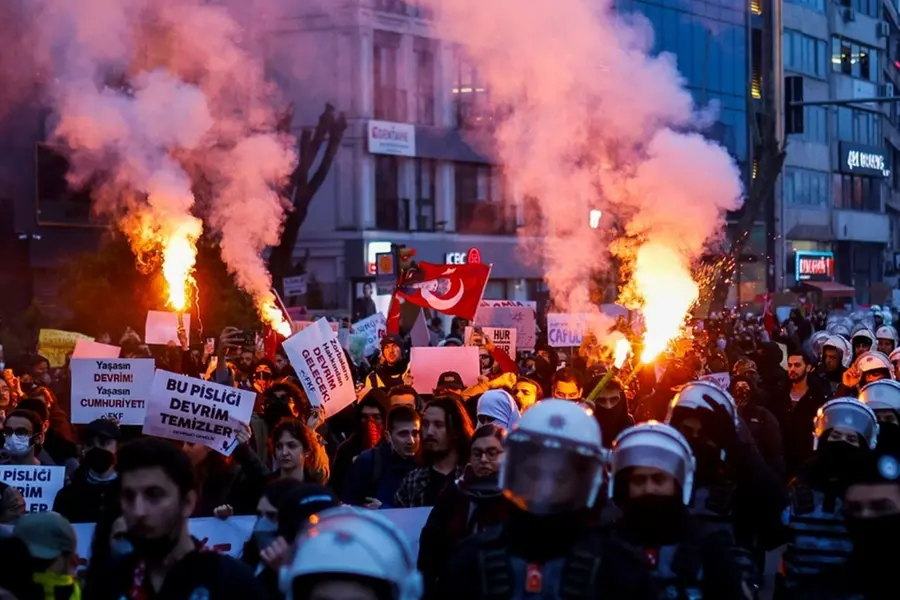
Istanbul: Turkey is facing its largest wave of protests in over a decade after the arrest of Istanbul Mayor Ekrem Imamoglu on corruption charges, a move widely seen as politically motivated. Tens of thousands have taken to the streets daily since March 19, defying government bans and calling for justice, free elections, and an end to what they describe as President Recep Tayyip Erdogan’s increasingly authoritarian rule.
Widespread crackdown on protesters and journalists
The Turkish government has responded with a forceful crackdown, arresting at least 1,418 people, including opposition activists, students, and journalists covering the demonstrations. Interior Minister Ali Yerlikaya has vowed “no concessions” for those who “terrorise the streets,” echoing Erdogan’s rhetoric dismissing the protests as “street terror.”
Among those detained is AFP photographer Yasin Akgul, one of seven journalists taken into custody and later remanded by an Istanbul court on charges of "taking part in illegal rallies and marches." Media watchdogs, including Reporters Without Borders (RSF), have condemned the arrests, calling them a direct assault on press freedom. The Council of Europe has criticised the Turkish government's response as a "disproportionate" use of force, while Human Rights Watch has described the situation as a "dark time for democracy" in Turkey.
The political context: Imamoglu's arrest and opposition backlash
Imamoglu, a key rival of Erdogan, has been a significant political figure since he won the Istanbul mayoral election in 2019, dealing a major blow to Erdogan’s ruling Justice and Development Party (AKP). His arrest has been met with widespread scepticism, with opposition supporters viewing the corruption charges as a strategy to eliminate political opponents ahead of the next general elections.
The Republican People’s Party (CHP), Turkey’s main opposition, has thrown its full support behind Imamoglu. CHP leader Ozgur Ozel has called for a massive rally in Istanbul on Saturday, describing it as the "largest open-air referendum in history" and a direct challenge to Erdogan’s rule. "We do not decrease in numbers with arrests—there will be even more of us," Ozel told crowds in Sarachane, where thousands have gathered outside Istanbul City Hall every night since the protests began.
Growing unrest across the country
Despite the government's crackdown, the protests continue to intensify. Students in Istanbul’s Sisli district marched in defiance of riot police, chanting "government, resign" while residents in apartment buildings above banged pots in solidarity. Demonstrations have spread beyond Istanbul to Ankara, Izmir, and other major cities, with reports of violent clashes between protesters and security forces.
Police have deployed water cannons, pepper spray, and rubber bullets against crowds, with eyewitness accounts describing aggressive tactics to disperse demonstrators. Many protesters have covered their faces with scarves or masks to avoid being identified by authorities. "We can't express ourselves freely," said Nisa, a student who joined the protests. "But we have no choice—we must defend democracy."
International pressure and Erdogan’s defiant response
The international community has expressed growing alarm over the situation. The United Nations has condemned Turkey's mass detentions and "unlawful blanket ban on protests," urging an investigation into potential police abuses. US Secretary of State Marco Rubio raised concerns in a meeting with Turkish Foreign Minister Hakan Fidan, while France and Germany have also called for the immediate release of detained journalists.
Erdogan, however, remains defiant. He has dismissed the protests as an organised attempt to destabilise Turkey and has vowed to take strong measures against what he calls “lawless elements.” "Those who spread terror in the streets and want to set fire to this country have nowhere to go," he declared in a televised address.
With protests showing no signs of slowing down, Turkey is bracing for what could be a prolonged period of civil unrest. The CHP’s planned mass rally on Saturday is expected to be a major test of public sentiment, with opposition leaders hoping to turn the protests into a larger movement for political change.
As Erdogan doubles down on his hardline approach, critics warn that the government's crackdown on dissent and press freedom could further erode Turkey’s democracy, deepening tensions ahead of the next elections. Whether the opposition can sustain its momentum in the face of government repression remains to be seen, but the events of the past week have already marked a significant moment in Turkey’s political landscape.
Published: 26 Mar 2025, 07:31 am IST
Related Topics
Disclaimer: Kindly avoid objectionable, derogatory, unlawful and lewd comments, while responding to reports. Such comments are punishable under cyber laws. Please keep away from personal attacks. The opinions expressed here are the personal opinions of readers and not that of Mathrubhumi.
