
Venezuela faces turmoil as US captures Maduro, Trump backs Delcy Rodríguez, sparking political and constitutional chaos.
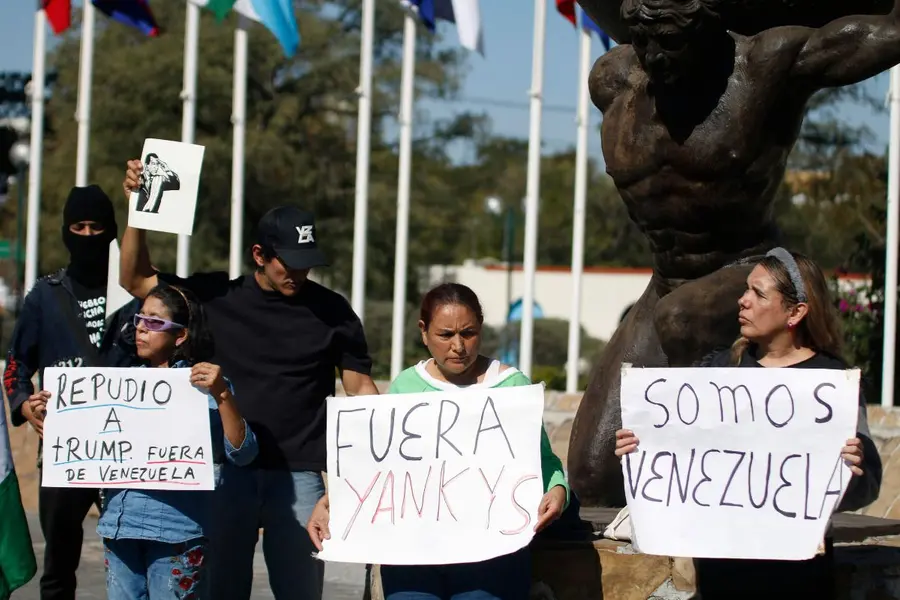
Venezuela was plunged into deep uncertainty on Saturday after a U.S. military operation captured President Nicolás Maduro, leaving citizens and political leaders scrambling to understand who now holds power in the crisis-hit South American nation.
“What will happen tomorrow? What will happen in the next hour? Nobody knows,” Caracas resident Juan Pablo Petrone said.
Trump signals U.S. role, points to Delcy Rodríguez
US President Donald Trump fuelled confusion by suggesting that the United States could take control of Venezuela, possibly in coordination with one of Maduro’s closest allies.
Trump indicated that Delcy Rodríguez, Maduro’s vice president since 2018, was his preferred interlocutor. Rodríguez has overseen much of Venezuela’s oil-dependent economy and its powerful intelligence apparatus, and was sanctioned by the US during Trump’s first term for undermining Venezuelan democracy.
“She’s essentially willing to do what we think is necessary to make Venezuela great again,” Trump told reporters.
Trump also claimed Rodríguez held a lengthy conversation with US Secretary of State Marco Rubio, saying she told him, “‘We’ll do whatever you need.’”
“I think she was quite gracious,” Trump added. “We can’t take a chance that somebody else takes over Venezuela that doesn’t have the good of the Venezuelan people in mind.”
Public anxiety, empty streets and small protests
Across Caracas, long queues formed outside supermarkets and petrol stations as residents stocked up, bracing for fresh turmoil. Small pro-government rallies broke out in parts of the capital, with demonstrators burning an American flag, though most streets in the country of 29 million people remained deserted.
Residents living near military installations reported damage from explosions. Yanire Lucas, whose home is next to a military base, said shattered glass littered her house after a blast.
“What is happening is unprecedented,” she said. “We’re still on edge, and now we’re uncertain about what to do."
Rodríguez rejects U.S. action, demands Maduro’s release
Rodríguez sought to project unity within the ruling camp, rejecting any suggestion of cooperation with Washington. In a televised address, she demanded the immediate release of Maduro and his wife, Cilia Flores, and condemned the US operation as a violation of international law.
“There is only one president in this country, and his name is Nicolás Maduro," Rodríguez said, flanked by senior civilian officials and military commanders.
She did not declare herself acting president or refer to any political transition. A ticker on state television continued to identify her as vice president.
“What is being done to Venezuela is an atrocity that violates international law,” she said. “History and justice will make the extremists who promoted this armed aggression pay.”
Confusion over power transfer and constitutional process
Trump claimed that Rodríguez had already been sworn in as president under constitutional provisions governing a transfer of power. However, Venezuelan state television did not broadcast any swearing-in ceremony, and there was no official confirmation of a change in leadership.
The Venezuelan constitution mandates a new election within a month if the president is absent. Analysts are divided over whether those provisions apply, given the disputed legitimacy of the government and the extraordinary nature of the US military intervention.
Military leaders strike defiant tone
Senior military and security figures moved quickly to project resistance. Defence Minister Gen. Vladimir Padrino López, wearing fatigues in a video message, said: “They have attacked us but will not break us.”
Interior Minister Diosdado Cabello appeared on state television in a helmet and flak jacket, urging citizens to defend national sovereignty.
“These rats attacked and they will regret what they did,” Cabello said of the US.
Rodríguez’s background and political balancing act
A lawyer educated in Britain and France, Rodríguez has long represented the Bolivarian revolution founded by the late Hugo Chávez on the international stage. She and her brother, Jorge Rodríguez, who heads the Maduro-controlled National Assembly, come from a prominent leftist family. Their father, a socialist leader, died in police custody in the 1970s, a case that deeply influenced many activists, including Maduro.
Unlike several figures in Maduro’s inner circle, the Rodríguez siblings have not been criminally indicted in the US. Delcy Rodríguez has cultivated links with Republican figures in the oil sector and on Wall Street, who have opposed direct US-led regime change.
Her past contacts include Blackwater founder Erik Prince and, more recently, Trump envoy Richard Grenell, who sought a deal with Maduro to expand US influence in Venezuela.
Fluent in English, Rodríguez is often portrayed as a relatively moderate figure compared with hardline military leaders who rose alongside Chávez in the 1990s. Many of those figures, including Cabello, are wanted in the US on drug trafficking charges and accused of serious human rights violations, yet they retain significant influence over the armed forces.
Experts warn of fragile power equation
That dynamic could complicate any attempt by Rodríguez to consolidate authority. However, analysts note that Venezuela’s elite has historically closed ranks during moments of crisis.
“These leaders have all seen the value of staying united. Cabello has always taken a second seat or third seat, knowing that his fate is tied up with Maduro’s, and now he very well might do that again,” said David Smilde, a sociology professor at Tulane University.
“A lot depends on what happened last night, which officials were taken out, what the state of the military looks like now," he added. "If it doesn’t have much firepower anymore, they’re more vulnerable and diminished and it will be easier for her to gain control.”
Opposition challenges Trump’s stance
Shortly before Trump’s press conference, opposition leader Maria Corina Machado urged her ally Edmundo González, widely seen as the winner of Venezuela’s disputed 2024 presidential election, to assert his authority.
She called on González to “immediately assume his constitutional mandate and be recognized as commander-in-chief."
In a confident statement, Machado said her movement would “restore order, free political prisoners, build an exceptional country and bring our children back home.”
“Today we are prepared to assert our mandate and take power," she added.
Trump dismissed her prospects bluntly. “I think it would be very tough for (Machado) to be the leader," he said. “She doesn’t have the support or respect within the country.”
The remarks stunned many Venezuelans, prompting speculation online that Trump had confused Machado with Rodríguez. Machado has not publicly responded.
Published: 04 Jan 2026, 06:19 am IST
Related Topics
Disclaimer: Kindly avoid objectionable, derogatory, unlawful and lewd comments, while responding to reports. Such comments are punishable under cyber laws. Please keep away from personal attacks. The opinions expressed here are the personal opinions of readers and not that of Mathrubhumi.
